
Your needs, this model
Does it fit your priorities?
Can the gray or yellow 8366 use an AC outlet as well as a car 12V socket?
Yes, AstroAI lists two power routes: a 12V vehicle accessory socket and household AC. They are separate corded arrangements, not battery power. The exact product page title says 110V AC while its description says 120V; the available ATJ-8366 family manual permits AC 110–240V, so verify the exact unit label and manual. For DC, the manual calls for a 12V 15A socket, a running engine, and no 24V source.
Explore this need in the finder →Will the 8366 stop at a set car-tire pressure?
The ATJ-8366 family manual describes plus/minus pressure setting and automatic shutoff at the selected target. It does not state the selectable target interval, gauge tolerance or a tire-size fill test. Use the vehicle placard, not the 150 PSI maximum, and confirm the manual supplied with the exact GY or LY suffix.
Explore this need in the finder →Does the 8366 package support a Presta-valve bicycle tire?
Both exact 8366 item pages list a Presta-to-Schrader adapter, and their titles name bicycle tires. The ATJ-8366 family manual describes a Schrader-compatible press-on quick connector that locks with a lever. Confirm the adapter is present in the exact offered box; no bicycle low-pressure accuracy or tire-size result is published.
Explore this need in the finder →Document-based assessment · no hands-on testing or ownership claimed
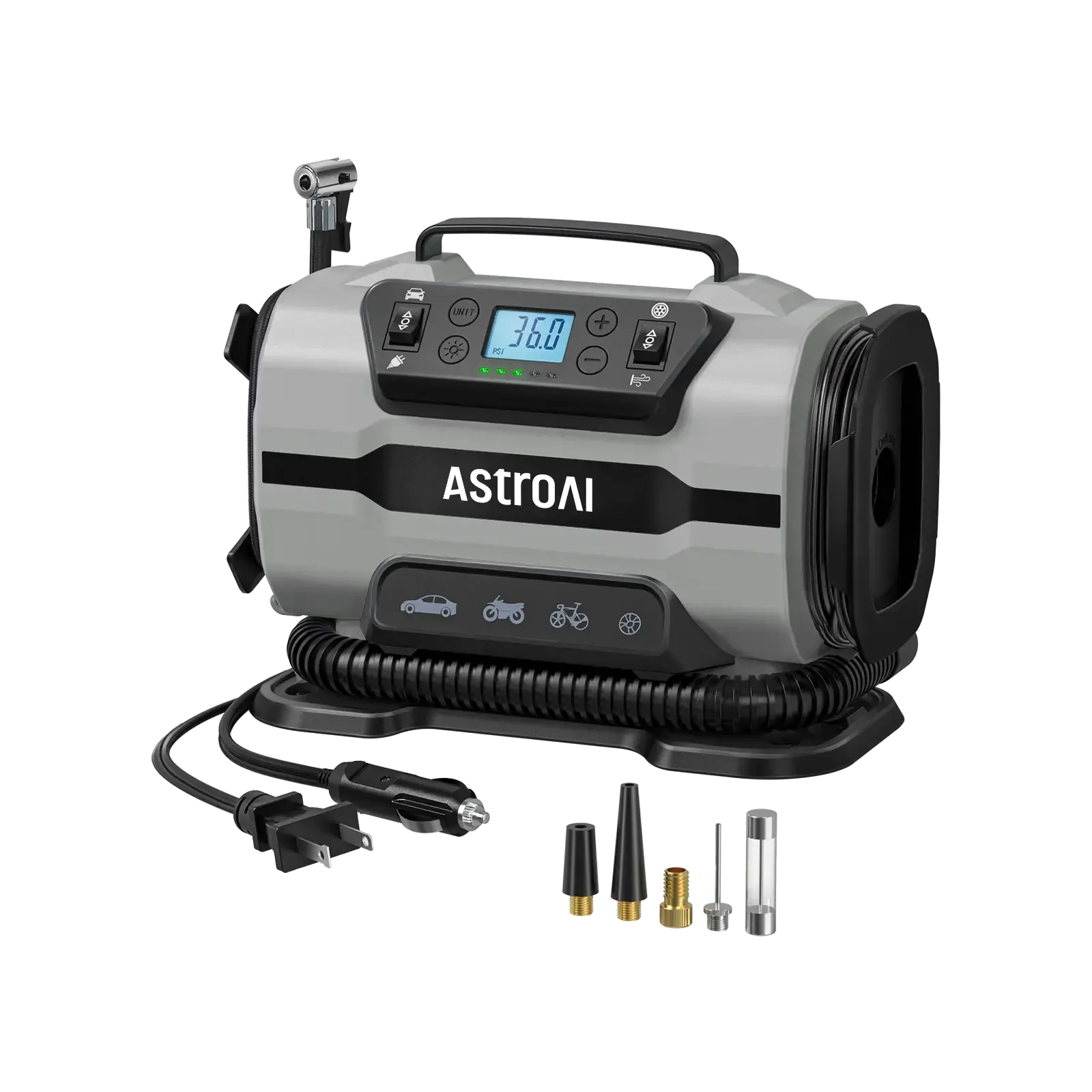
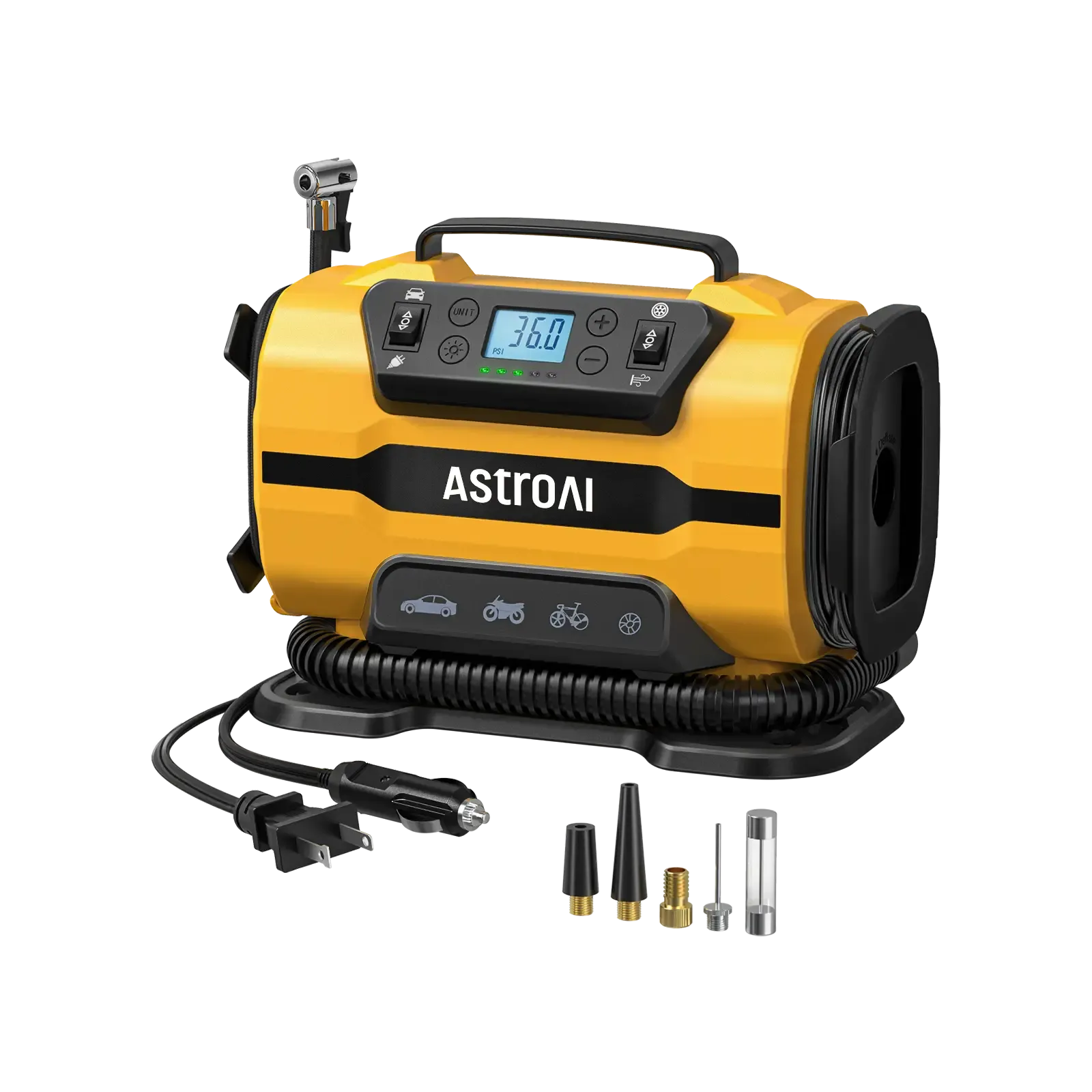
AstroAI's U.S. storefront has two visually and functionally aligned listings in its 8366 family: gray SKU ACAC8366GY-US and yellow SKU ACAC8366LY-US. Both are titled as dual-metal-motor, 150 PSI, two-mode inflators with 12V DC and household AC power, and both item pages list the same accessories. I group the two color finishes in one assessment because the displayed task, power arrangement and package list match; this is not a claim that every seller's box contains every pictured piece.
Two power routes, not a cordless pump
The product pages describe two separate inputs: a 12V vehicle accessory socket and an AC household outlet. This can suit someone who wants one plug-in unit for a garage and a roadside top-up, but neither input makes the inflator self-powered. The pages' titles say 110V AC while their descriptions say 120V; AstroAI's available family manual (file labeled ACAC8366YE-EN-v2, model ATJ-8366) specifies AC 110–240V at 50/60Hz. Treat the model label on the exact item and its supplied manual as the final check rather than assuming every similarly named AstroAI listing shares the same electrical details.
For the 12V arrangement, the ATJ-8366 manual says to use a 12V, 15A cigarette-lighter socket, not a 24V source, and to have the vehicle engine running. Its maximum-current specification is 15A; that is a manufacturer rating, not a measurement of a particular vehicle outlet. The manual lists a 9.84-foot DC lead and a 9.18-foot AC lead, but neither length establishes where the pump will sit relative to a wheel once the air hose is added. The corded setup is a poor fit if you specifically need an internal battery or direct battery clamps.
Pressure stop is useful; 150 PSI is not a tire target
The ATJ-8366 manual describes setting a target with plus/minus controls and says the compressor shuts off when the preset pressure is reached. That is a documented control feature, not proof of gauge accuracy. The same manual lists 150 PSI as maximum working pressure; it does not publish a usable preset interval, adjustment increment, gauge tolerance, or a tire-size-specific performance result. Use the vehicle placard or equipment maker's pressure recommendation. A maximum pressure rating is not an instruction to inflate a tire to that value.
The family manual reports 22 L/min without a stated pressure point or test method. The current exact-SKU AstroAI pages use “fast inflation” wording but do not provide a matched tire-size/time test. I therefore do not turn the published figure into a predicted refill time or compare it with another pump's results.
Keep tire mode separate from large-volume mode
This is a two-mode machine. Its high-pressure tire mode is the relevant route for car tires and the bicycle-tire use named in the exact product-page titles. A separate large-volume hose attaches to another port for low-pressure, high-volume objects such as an air mattress; the manual also depicts a deflation port. Those functions should not be blended into the tire setup or treated as a performance claim for a car tire. The visible manual supports a quick connector that presses onto the valve and locks with a small lever, and says the nozzle fits Schrader valves. The package list also names a Presta-to-Schrader adapter, a needle-valve adapter, air nozzles and a replacement fuse. AstroAI's exact gray and yellow item pages list these parts, though the pages do not give a count for the air nozzles. Confirm the contents of the particular box, especially if a required fitting is essential.
Plan for pauses and verify the manual bridge
The ATJ-8366 manual calls for at least ten minutes of cooling after fifteen minutes of continuous operation. That is a meaningful limit for repeated top-ups; the sources do not establish how many tires fit within a session or how quickly a larger tire will fill. The manual also warns that the body can become hot and says not to use the compressor in rain or near liquids. No tire-size ceiling, pressure accuracy, or independent performance measurement is published here.
One documentation caveat deserves attention: AstroAI's gray and yellow store records identify the suffixes GY and LY, while the available manufacturer manual file is named for a YE SKU and identifies the shared ATJ-8366 model. The 8366 base code, matching two-mode layout and package descriptions make it a useful family-level operating source, but AstroAI does not explicitly state a one-to-one crosswalk from either exact suffix to that manual. Check that the offered unit and the instructions supplied with it say ATJ-8366 before relying on the model-family run limit, chuck directions or electrical specifications. This assessment does not silently merge these units with the separate AstroAI ASIA220B-US 100 PSI 12V inflator or the ACAC3666YE-US AC/DC Mini.
Who should shortlist this configuration?
Consider the 8366 family if you value both a 12V vehicle-socket route and a household AC route, want a preset-stop feature, and can work within the corded layout and rest periods. Its exact pages name car and bicycle tires; the manual's broader wording is treated as family context rather than a guarantee for every vehicle or tire. If you need battery operation, a direct clamp lead, verified high-volume tire performance, an exact pressure tolerance, or a documented heavy-truck tire rating, this evidence does not establish that fit. Compare the exact SKU, supplied manual and package rather than shopping from the shared 150 PSI headline alone.
Key specifications
Key details at a glance
| Product-page maximum-pressure claim | 150 PSI |
|---|---|
| Automatic stop at target | Yes |
| Documented accessories | Air nozzle(s); exact gray/yellow item pages do not specify the count / Large-volume hose / Needle valve adapter / Presta-to-Schrader adapter / Replacement fuse / User manual |
| Operating power arrangement | Dual vehicle 12v and household 120v ac |
| Maximum working pressure | 150 PSI |
| Maximum current draw | 15 A |
| Tire-chuck connection style | Press-on tire chuck |
| Published duty-cycle condition | Available ATJ-8366 family manual calls for at least ten minutes of cooling after fifteen minutes continuous use. The exact GY/LY to YE suffix crosswalk is not explicit; this is not an independent endurance result. |
| Air hose length | 2.29 ft |
Use the exact model’s instructions for operating limits, supplied equipment and version differences.
Sources for this review
Sources for this assessment
- AstroAI official Air Compressors collection snapshot (partial, 25-card observation)
- AstroAI exact gray ACAC8366GY-US product record
- AstroAI exact yellow ACAC8366LY-US product record
- AstroAI ATJ-8366 dual-power multifunctional air-compressor manual (official PDF; family-level crosswalk)
- Image linked from AstroAI exact gray ACAC8366GY-US page
- Image linked from AstroAI exact yellow ACAC8366LY-US page
Match the inflator to your power and tire
Use the finder to check whether a reviewed model's documented power source, mode and accessories fit your requirements. It cannot prove an unlisted fit or predict actual fill time.