
Your needs, this model
Does it fit your priorities?
I need a small pump for topping up passenger-car tires from a 12V outlet, with a preset stop. Does this exact SKU fit that plan?
The official 100 PSI AIRUN H manual describes a 12V accessory-socket route and automatic shutoff at the preset. It says to use the vehicle while running, set pressure from the driver's-door guide, and keep the task within the 100 PSI maximum and 15-minute continuous-use limit. The current app-store title for ASIA220B-US is misleading; verify that the offer is the 100 PSI 12V unit, not a separate 150 PSI model.
Explore this need in the finder →Can I power this from a household AC wall outlet or a 24V vehicle system?
Not directly. The exact 100 PSI manual calls for 12V DC and says not to use 24V power; AC would need a separate AC-to-DC converter, which is not in the itemized package. Confirm the 10A/15A discrepancy in the exact manual and vehicle circuit before relying on a socket or converter.
Explore this need in the finder →Is it a fit for large tires, continuous workshop work or a sports ball just because the listing says 150 PSI and the kit includes a needle adapter?
No such conclusion is supported. The official manual caps working pressure at 100 PSI, permits at most 15 minutes continuous operation and calls for at least 10 minutes cooling after extended use. It lists cars, small trucks, SUVs, motorcycles and bicycles, excludes high-pressure or large-volume applications, and does not name sports balls; the needle adapter is an included accessory, not proof of a use or tire-size rating.
Explore this need in the finder →The AstroAI record carrying US store SKU ASIA220B-US is best assessed as an AIRUN H-style 100 PSI, 12V inflator—not as the 150 PSI, dual-motor AC/DC machine suggested by one conflicting catalogue heading. The manufacturer’s current item details, AIRUN H page and 100 PSI manual support a useful small-tire top-up role, but not the broader capability the category headline implies.
Start with the SKU and the manual, not the headline
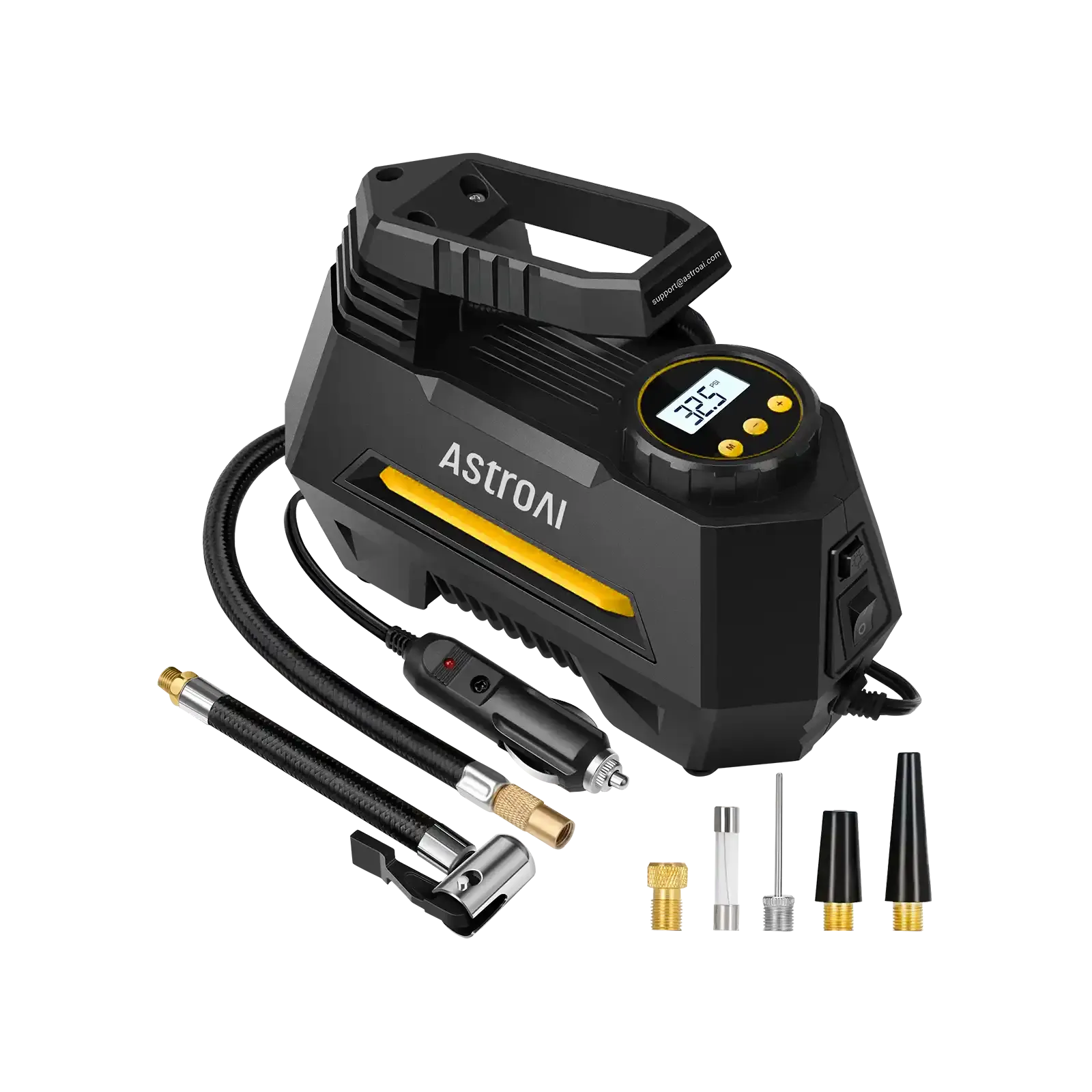
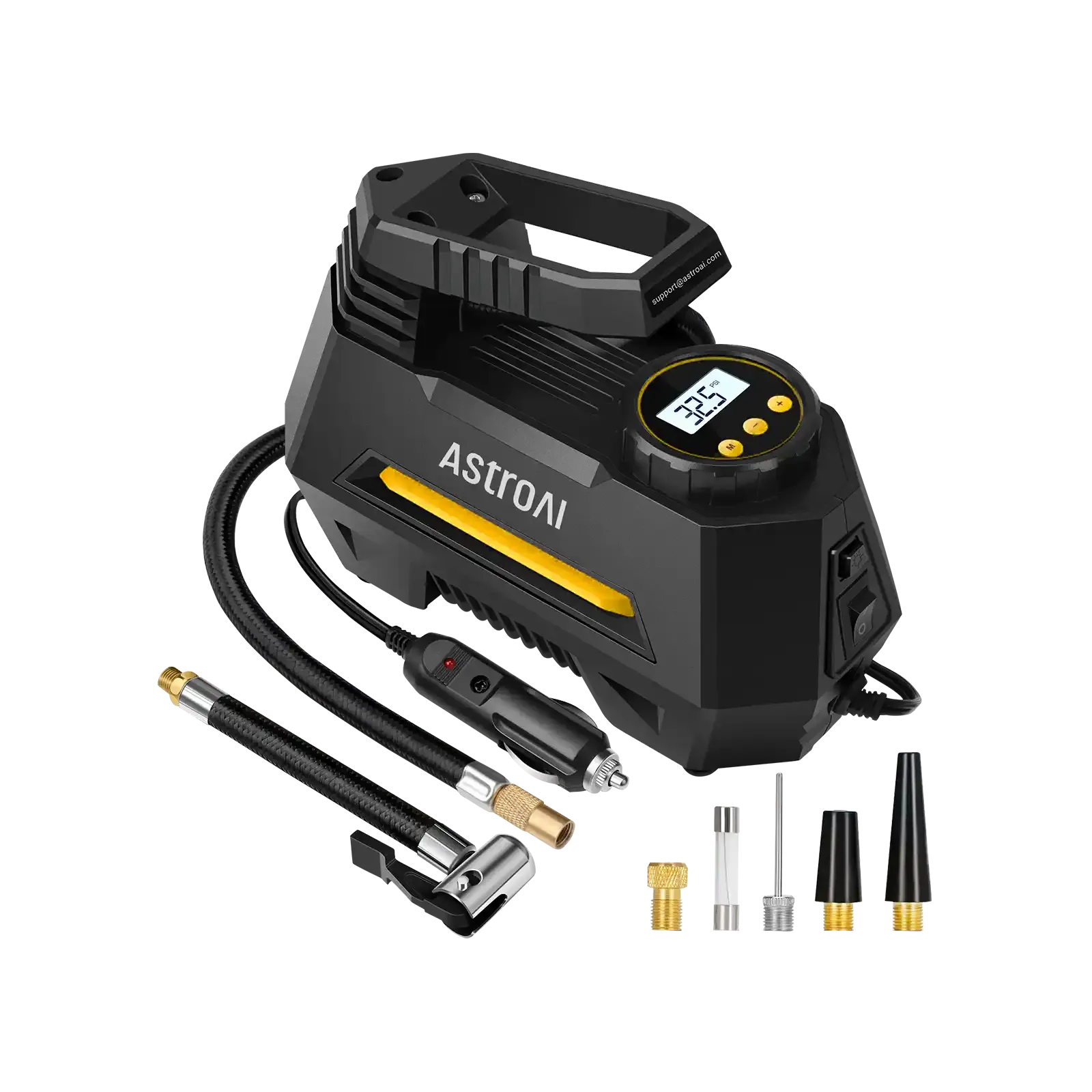
This entry needs an identity warning before any feature comparison. AstroAI’s US app-store product record assigns the exact item SKU ASIA220B-US, but its title calls it a 150 PSI dual-motor 12V/110V AC compressor. The same record’s description instead names an “AIRUN H” 12V tire inflator, and the itemized box list is a single 12V pump with nozzle cones, a needle adapter, a Presta-to-Schrader adapter, extension coupling, replacement fuse and manual. AstroAI’s AIRUN H page presents the H style as 100 PSI and 12V DC. Its official 100 PSI manual gives a compatible package and operating arrangement; the manual cover names CZK-3631, while the store uses ASIA220B-US. AstroAI does not spell out that model-code crosswalk, so this assessment keeps both identifiers visible rather than silently normalizing them.
The practical consequence is important: do not buy this item expecting 150 PSI, a built-in AC input, dual motors or a large-volume inflation mode on the strength of that erroneous heading. The official manual rates its maximum working pressure at 100 PSI and specifies 12V DC. A separate AC-to-DC converter would be needed for wall power, and AstroAI does not list one in this product’s package. The linked manufacturer material also gives inconsistent amperage information; verify the exact manual, vehicle outlet and fuse for the unit actually offered.
A narrow, practical 12V tire-top-up role
For routine pressure corrections on a car or other tire type explicitly named in the manual, the controls are straightforward on paper: choose PSI, kPa, bar or kg/cm², set the target with the plus/minus controls, attach the valve connection, and start inflation. AstroAI says the pump automatically stops when the preset pressure is reached. Use the vehicle’s door-jamb pressure label as the target reference, not the inflator’s 100 PSI ceiling; maximum capability is not a recommended tire pressure. The manual also instructs users to run the vehicle while the inflator is operating.
The manual specifically identifies cars, small trucks, SUVs, motorcycles and bicycles, and says its air nozzle is compatible with Schrader valves. It includes a Presta-to-Schrader adapter and a needle valve adapter. Those attachments make the kit more flexible than a bare vehicle-valve hose, but the manual does not name sports balls as a supported use and warns against high-pressure or large-volume applications. An included needle attachment should therefore not be treated as proof that every ball or other inflatable is suitable.
The direct valve connection is described as a threaded connection: place the nozzle squarely on the valve and thread it to seal. That twist-on arrangement can take more handling than a lever-style press-on chuck, and an angled connection may leak or produce an inaccurate reading. Refit the valve cap after disconnecting the pump.
Run time and power are real limits
The manual caps continuous operation at 15 minutes and calls for at least 10 minutes of cooling after extended use. AstroAI also says the pump heats during use. Treat those instructions as a limit, not a performance claim: the source does not publish a tire-size rating, pressure-specific duty chart, or a tested fill-time scenario for this exact configuration. The manual’s 1.23 CFM / 35 L/min figure has no stated pressure point or test method, so it cannot predict how quickly a particular tire will inflate.
Power needs the same scrutiny. The documented direct route is a 12V vehicle accessory socket; 24V power is expressly excluded. The V2 manual says a 15A socket/current is required, while AstroAI’s AIRUN H FAQ says about 10A and the older manual says 10A. Those values do not reconcile in the available material, so check the manual supplied with the exact unit and the vehicle circuit rather than guessing. The manufacturer’s FAQ says a compatible external AC-to-DC converter can run the 12V-only pump, but that is an added component—not an included AC mode.
Who should shortlist it—and who should not
This is a plausible shortlist candidate for a driver who wants a compact 12V top-up pump, wants an automatic preset stop, and can live with a 100 PSI maximum, a threaded Schrader connection, and pauses after longer use. The 9.84-foot power cable gives the documented reach; the manual lists dimensions of 8.4 × 6.8 × 3.9 inches. Neither spec proves that the lead will reach every wheel in every vehicle, so consider socket location and the actual hose routing.
Skip this configuration if a direct household-AC input, 24V vehicle operation, high-pressure or high-volume work, a large-tire capacity guarantee, or an independently verified fill-time figure is essential. Also pause if the retailer’s listing only repeats the incorrect 150 PSI/AC/DC headline: compare the SKU, included package and manual before purchasing. AstroAI provides useful feature documentation, but the identity and current draw inconsistencies make exact-model verification unusually important.
Source basis: AstroAI’s US storefront record for SKU ASIA220B-US, the official 100 PSI V2.2 manual, and the AIRUN H product page were checked on October 31, 2026. This is documentation-based analysis, not hands-on testing.
Key specifications
Key details at a glance
| Automatic stop at target | Yes |
|---|---|
| Documented accessories | AstroAI 12V tire inflator / two air-nozzle cones / needle valve adapter / Presta-to-Schrader adapter / extension hose coupling / replacement fuse / user manual |
| Operating power arrangement | 12V vehicle accessory port |
| Maximum working pressure | 100 PSI |
| Tire-chuck connection style | Twist-on tire chuck |
| Published duty-cycle condition | Manual allows no more than 15 minutes continuous operation and requires at least 10 minutes cooling after extended use; no pressure-specific duty schedule is provided. |
| Power cord length | 9.84 ft |
Use the exact model’s instructions for operating limits, supplied equipment and version differences.
Sources for this review
Sources for this assessment
Match the inflator to your power and tire
Use the finder to check whether a reviewed model's documented power source, mode and accessories fit your requirements. It cannot prove an unlisted fit or predict actual fill time.