
Your needs, this model
Does it fit your priorities?
Can I use the yellow C1 from both its battery and my car's 12V socket?
The exact yellow product page and its linked C1 manual document a 20V rechargeable battery plan and a separate 12V DC vehicle-accessory-cord plan. The manual warns against 24V input. It does not document direct battery clamps or household AC; the USB charging cord is not a compressor power lead.
Explore this need in the finder →What limits apply if I use the C1 for motorcycle or car tires?
The manual names car and motorcycle use, but gives no tire-size envelope or pressure-specific refill time. It lists a 150 PSI maximum working pressure and requires cooling after 15 minutes of continuous use for at least 10 minutes. Use the vehicle or tire maker's target instead of the compressor's maximum.
Explore this need in the finder →Does the yellow C1 include useful bike and ball fittings?
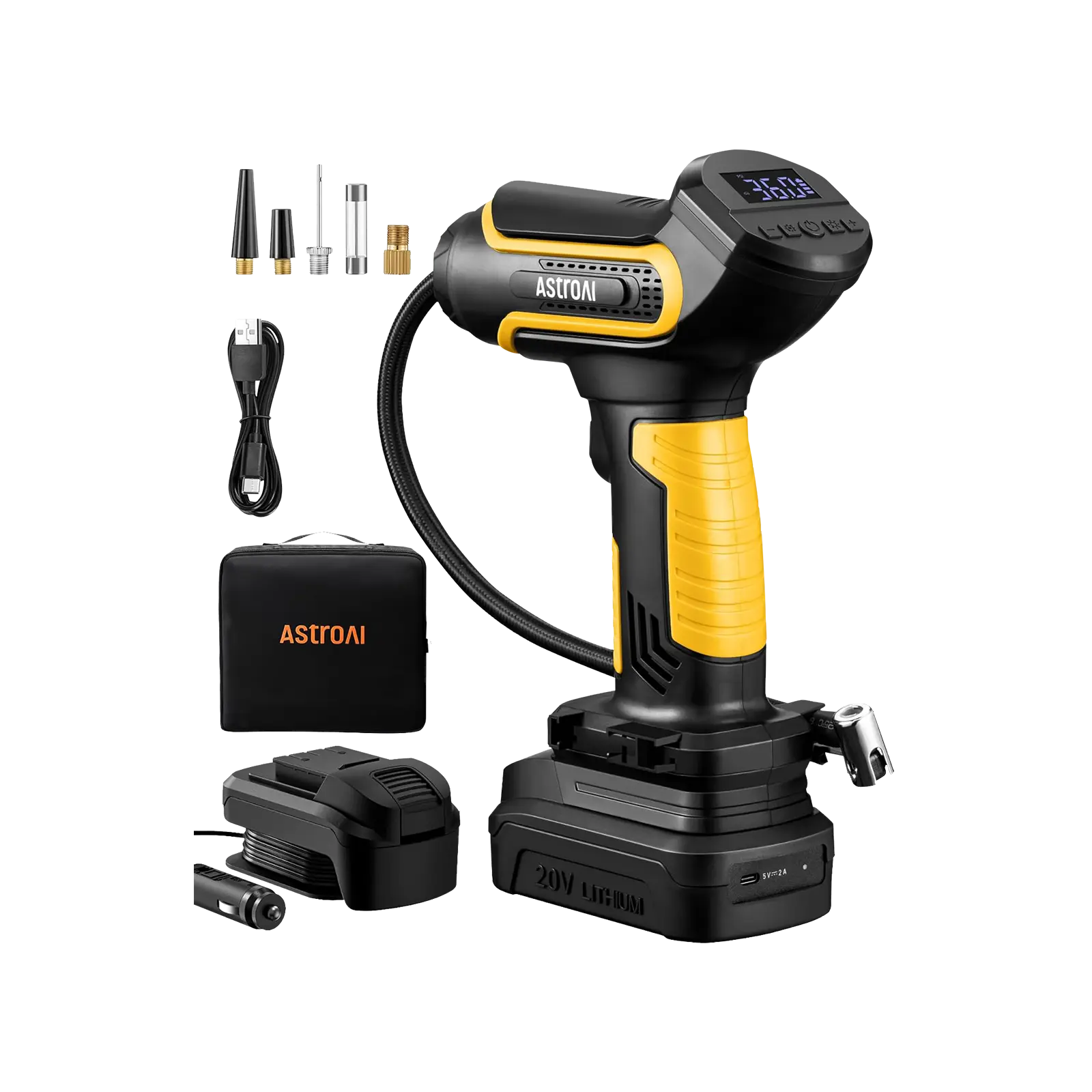
Its exact linked manual's package list includes a Presta-to-Schrader adapter and needle-valve adapter and names bicycle and basketball-/yoga-ball-sized inflatable use. The manual does not establish a default Schrader chuck subtype, gauge tolerance or suitability for every sports ball.
Explore this need in the finder →This is a document-based assessment of the yellow AstroAI C1 handheld inflator, not a hands-on test. AstroAI's U.S.-facing item record identifies SKU ACAC791YE-US-2 and the C1 150 PSI style. The product page links an English C1 manual whose cover says model LS40791 and whose help-file code is ACAC791YE. The model and matching base code support using that manual for this yellow edition; the manual itself does not print the retail suffix.
Two documented power arrangements
The manual describes a 2.0 Ah rechargeable 20V battery pack and a separate 12V DC vehicle-accessory cord. These are distinct ways to power the pump, not a battery plus a direct vehicle-battery clamp. AstroAI prohibits 24V vehicle power. The instructions also identify household-ball examples, but no household AC pump-power plan is documented for this model. Check that the exact offer includes both the battery and the DC lead if you expect to use both arrangements; do not assume the charging USB cable can run the compressor.
For a roadside kit, the split arrangement can be useful in principle: the battery avoids relying on a working accessory outlet, while the vehicle cord offers another source when the battery needs charging. That is a documented configuration choice, not a claim about how many tires either arrangement can fill. The published maximum of 150 PSI is a compressor ceiling, not an instruction for any vehicle, motorcycle, bicycle or ball. Use the pressure specified by the tire or equipment maker.
Preset stopping and the real heat boundary
AstroAI's manual says the C1 stops when the preset pressure is reached. That is a convenience for unattended pressure control only in the limited sense of the pump stopping; it is not evidence that the chosen target is correct or that the display has a particular accuracy. The manual does not establish a preset range or gauge tolerance in the sources reviewed here. Stay nearby, check the tire maker's cold-pressure recommendation, and recheck with a suitable gauge when safety matters.
The manual gives an important numerical operating limit: no more than 15 minutes of continuous use, followed by at least 10 minutes of cooling. Treat this as a boundary for the compressor, not as a promise that it can service a fixed number of tires in each interval. The manufacturer also lists a 25 L/min flow figure and 150 W in the manual; its product-page technical panel shows 100 W. That wattage conflict and the absence of a stated flow-test pressure make either number a poor basis for a fill-time comparison. No tire-size envelope or from-flat test result is supplied.
Modes and the listed fittings
The English manual names car, motorcycle, bicycle and midsize-SUV tire use, plus basketball- and yoga-ball-sized inflatables. Its package list includes two air nozzles, a Presta-to-Schrader adapter, a needle-valve adapter, replacement fuse, storage bag, battery pack and USB charging cable; the manual also describes the 12V DC power cord. The Presta adapter and needle are useful fitment items, but they do not establish low-pressure accuracy or suitability for every ball. The manual does not classify the tire-end fitting as press-on or twist-on, so this review does not assign either chuck type. Confirm that the items you need are present in the exact selected box rather than relying on the product photograph.
The listed air hose is 35 cm (about 1.14 ft), and the vehicle cord is 3 m (about 9.84 ft). AstroAI gives dimensions of 8.26 by 3.3 by 10.23 inches and a 4.27-pound product-page weight. Those published measurements help assess storage, but they are not independently checked here. A short hose means planning where the device can sit while attached; do not stretch or suspend it from a valve stem.
Which C1 record is this?
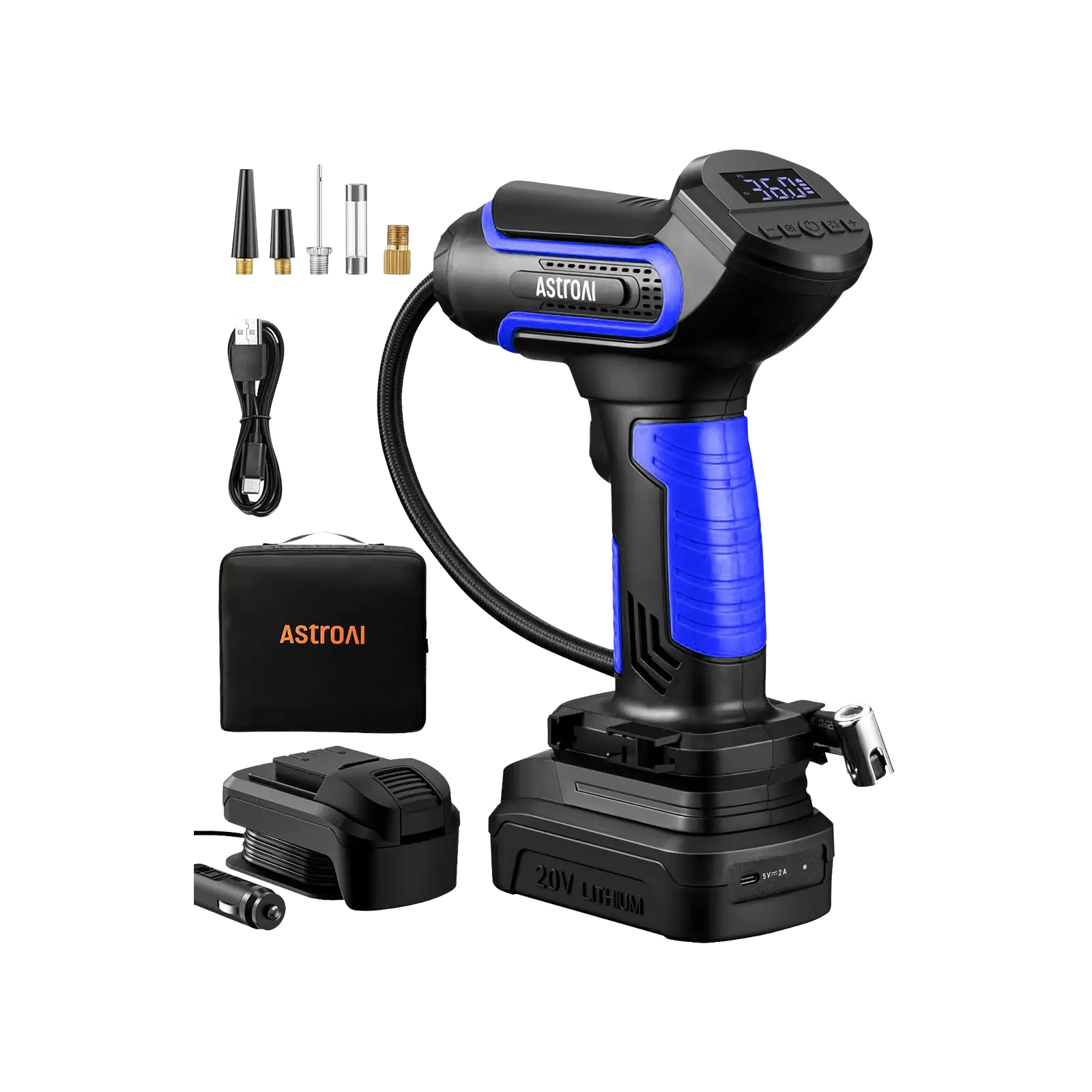
This yellow version is not interchangeable with every C1 page merely because the family name is shared. AstroAI also exposes a light-yellow C1 listing and a blue C1 listing. The light-yellow item page says 20V battery and 12V car adapter in its title but gives a shorter contents summary that names a battery and USB cable; its exact package is therefore called out separately in that assessment. The blue item is SKU ACAC791BU-US-3 and uses the C1 150 PSI style, but the yellow manual is not presented as the blue package manual. The color-selector pages show finish options, yet the exact SKU and included leads still deserve a box-content check.
Compared with AstroAI's larger clamp-powered T3, this handheld C1 has a documented rechargeable-battery plan and a 12V accessory-cord plan rather than the T3's direct battery clamps. The T3 manual sets its own 25-minute run and 30-minute cooling interval and a 120 PSI maximum; those limits do not transfer to the C1. Choose according to the exact power arrangement, supported use, fittings and operating instructions you require—not an unconditioned PSI or airflow headline.
Checks before choosing this yellow package
- Match the item to yellow SKU ACAC791YE-US-2 and confirm the 20V battery and 12V DC cord are in the offered package.
- Check that the vehicle's accessory outlet is 12V and follow its fuse and vehicle instructions; AstroAI says not to use 24V.
- Use the supplied adapter only for a compatible valve and set the tire maker's target; the 150 PSI maximum is not a recommended tire pressure.
- Keep continuous operation within 15 minutes and allow at least 10 minutes to cool; stop sooner if the manual or conditions require it.
- Do not infer fill time, accuracy, all-tire capacity or press-on/twist-on chuck style from the product listing or photograph.
The strongest documented fit is a portable C1 buyer who values two named power plans, preset stopping and a written list of vehicle/ball uses, while accepting the 15/10-minute work-rest boundary and checking the exact kit. If you need a verified chuck subtype, precise gauge tolerance, a specific tire-size capacity or a measured pressure-specific fill time, the available sources do not answer that question.
Key specifications
Key details at a glance
| Product-page maximum-pressure claim | 150 PSI |
|---|---|
| Automatic stop at target | Yes |
| Documented accessories | 12V DC vehicle power cord / two air nozzles / Presta-to-Schrader adapter / replacement fuse / needle-valve adapter / 2.0Ah rechargeable battery pack / USB charging cable / storage bag |
| Operating power arrangement | Dual internal rechargeable battery and vehicle 12v auxiliary |
| Maximum working pressure | 150 PSI |
| Published duty-cycle condition | The exact yellow C1 manual says no more than 15 minutes of continuous use and at least 10 minutes cooling; this is a manufacturer operating instruction, not an independent test result. |
| Air hose length | 1.14 ft |
Use the exact model’s instructions for operating limits, supplied equipment and version differences.
Sources for this review
Sources for this assessment

Match the inflator to your power and tire
Use the finder to check whether a reviewed model's documented power source, mode and accessories fit your requirements. It cannot prove an unlisted fit or predict actual fill time.