
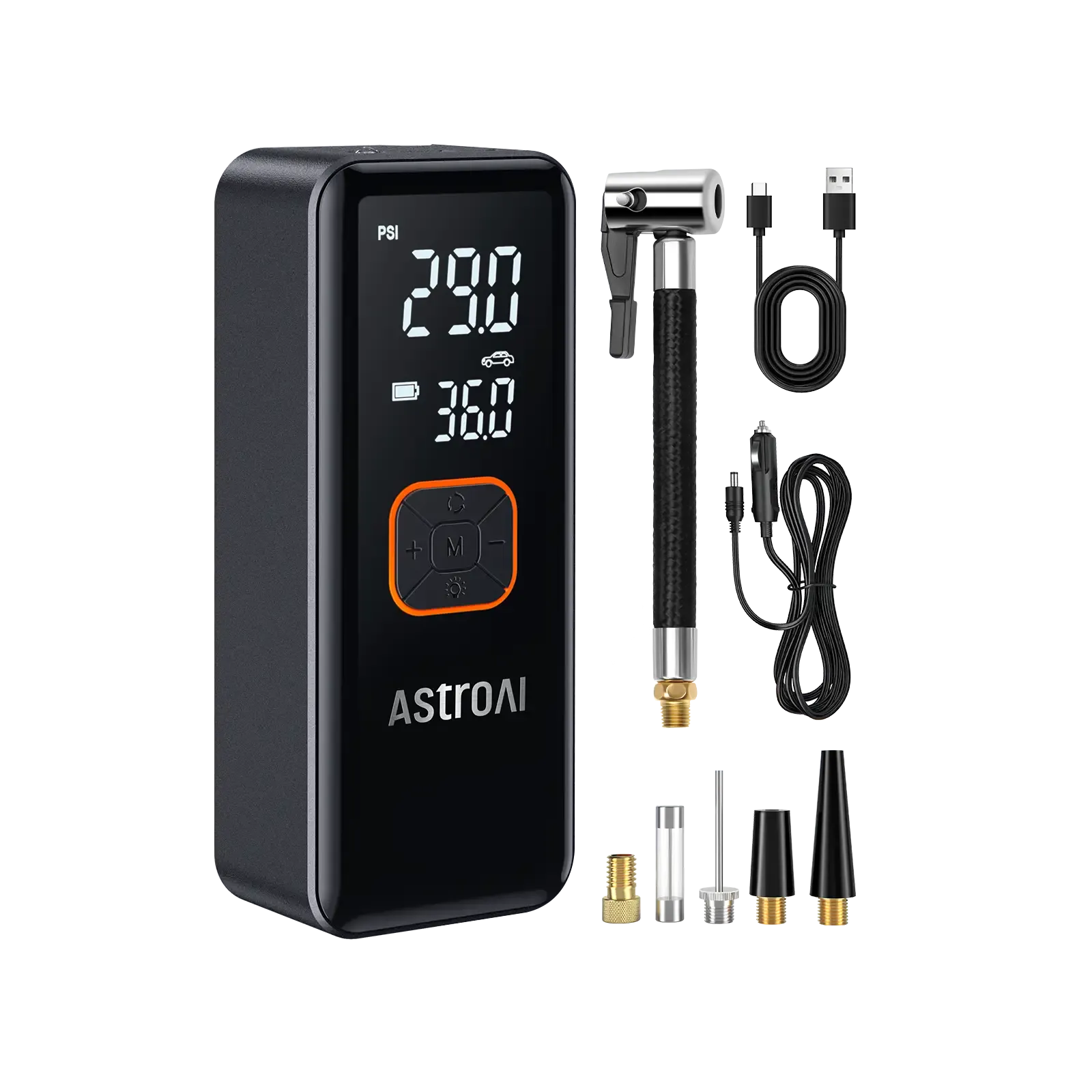
Your needs, this model
Does it fit your priorities?
Can the L2 inflate a passenger-car tire without using a 12V socket?
Yes. The exact ACAC21BK-US item page identifies the L2 as a 6,600mAh rechargeable model, and its CZK-3689 manual describes a built-in lithium battery and a car mode. The same manual documents stopping at a selected pressure and limits continuous use to 20 minutes followed by 15 minutes cooling. It gives no battery runtime, tires-per-charge, tire-size capacity or fill-time test, so these sources do not show how long a particular tire will take. Keep the battery charged, follow the vehicle's cold-pressure target, and confirm that the included package is the exact ACAC21BK-US configuration.
Explore this need in the finder →Does the 12V cigarette-lighter lead charge the L2 battery?
The manual describes two different routes. It says to charge the internal battery through the Type-C port using a 5V/2A charger, which it says is purchased separately; the listed package includes the USB cable. It says that if the battery is depleted, the cigarette-lighter cable can power the pump from the vehicle. It does not say that this 12V cable recharges the internal battery. The manual does not publish pump current draw, an outlet amp requirement or an engine-running instruction.
Explore this need in the finder →Which attachments and connection style are documented for a bicycle or ball?
The CZK-3689 manual names bicycle and basketball preset modes and its package table lists a Presta adapter and a needle valve adapter. Its hose instructions say to connect the built-in hose to a tire valve and tighten it, supporting a twist-on fitting. The manual does not label that main fitting Schrader, provide a bicycle or ball pressure range, or publish low-pressure accuracy. Confirm the exact seller's package and follow the tire or ball maker's target; 150 PSI is the item's stated maximum, not a suitable bicycle or ball target.
Explore this need in the finder →The AstroAI L2 is a compact, cordless-looking 150 PSI inflator whose documentation describes two ways to run it: an internal rechargeable battery, or a separate 12V vehicle lead when the battery is depleted. That distinction matters more than the headline maximum. This assessment uses AstroAI’s U.S. item record and the CZK-3689 manual; it is not a hands-on test, and the cited sources do not establish a tire-size rating, inflation-time benchmark or battery runtime.
Identify the actual L2 package
The U.S.-facing AstroAI storefront record identifies SKU ACAC21BK-US. Its item description gives the model name CZK-3689, which is also printed on the cover and specification page of the matching AstroAI manual. That bridge is useful because the larger AstroAI catalogue contains other cordless units with similar titles and different power arrangements. This L2 should not be confused with the blue JY16P160-18 model, whose manual documents an 18V pack, a 12V lead and a separate 15A socket requirement. The L2 manual instead describes a built-in battery, a 12V direct-power cable and no cross-tool battery platform.
The manufacturer’s item title states 150 PSI. Treat that as an equipment ceiling, not a target for a vehicle, motorcycle, bicycle or ball. The manual does not publish a preset-pressure range, pressure increment, gauge tolerance, pressure-specific flow rate or tire-size capacity. Its display shows current pressure and a preset value, and its procedure says the pump stops automatically at the set pressure, but those controls are not an accuracy claim.
Two distinct ways to power it
For untethered use, AstroAI identifies the unit as a 6,600mAh rechargeable model. The manual’s specification panel describes the battery as 2,200mAh × 3, and its maintenance section recommends storing the lithium battery at 50–80% charge and topping it up at least every three months during storage. The manual gives no operating minutes per charge, number of tires per charge or battery replacement procedure. Low temperatures can reduce battery capacity and service life, according to the same manual.
The USB Type-C lead in the package is for charging, but a separate 5V/2A charger is required; the manual says that charger is purchased separately. The 12V cigarette-lighter cable is not described as a way to recharge the battery. Rather, AstroAI says to use that cable to power the pump if the battery runs out. The item page calls it a “charging cable,” so the manual’s operating instructions are especially important: a 12V socket route is available, but it is a different operating plan from charging over Type-C. The exact manual does not specify a vehicle-socket amperage or pump current draw, and it does not state that the engine must be running.
Tasks, attachments and control
The manual names automobile, bicycle and motorcycle tires and various sports equipment; its five preset modes are basketball, bicycle, motorcycle, car and custom. It lists a Presta adapter and needle valve adapter in the package, plus swim-ring and air-mattress nozzles. This is a useful set for mixed household and roadside tasks, but the listed modes do not tell us a bicycle’s pressure range, the right target for a basketball or how quickly any particular tire will fill. Choose the pressure from the vehicle placard, equipment maker or ball maker—not the compressor’s maximum.
The manual instructs users to pull out the built-in hose, connect it to the tire valve and tighten it. That supports a threaded, twist-on connection. The manual does not name the integrated fitting “Schrader,” so buyers who require a specifically documented Schrader connector should confirm that exact interface before choosing it. Likewise, an item page photo and the manual diagram show an extension-hose coupling, but the item page’s “In the Box” list and the manual’s package table do not separately name it. Do not assume a separate extension is present in every seller’s box.
Work and cooling limits
The manual says not to operate continuously for more than 20 minutes and directs a 15-minute cooling period after 20 minutes of continuous use; it warns that extending operation can overheat the pump. The hose and connector can be hot after inflation, so wait before detaching them. Around 82 dB of operating noise is stated in the manual. These figures are practical constraints, not evidence that the pump will inflate a particular set of tires within a given time. If your regular job involves repeated high-volume tires, a large RV, or recovering several fully flat tires, the absent workload data makes this a poor model to select on a promise of speed or endurance.
Who should consider it?
The L2 is most relevant to someone who wants a small self-contained inflator for a car, bicycle, motorcycle or ball and values having a 12V fallback if its battery is depleted. The supplied Presta adapter and ball needle add documented use routes, and automatic stopping at a set pressure is more convenient than a purely manual shutoff. Its drawbacks are equally specific: the wall charger is not included, the 12V lead does not charge the battery, no runtime or tire-size capacity is stated, the available interface is described as twist-on rather than press-on, and the manual’s 20-minute / 15-minute work-rest guidance limits longer jobs.
Check the offer for the exact ACAC21BK-US / CZK-3689 identity and package, confirm which power route fits your routine, and set the target from the item maker’s recommendation. See the L2 guide to power, valve and task fit for supported combinations, or use the finder to compare alternatives. The sources support a reasoned fit assessment, not a claim that this unit has been used or tested by the author.
Key specifications
Key details at a glance
| Automatic stop at target | Yes |
|---|---|
| Documented accessories | AstroAI Smart Portable Air Pump with integrated air hose / Presta adapter / Needle valve adapter / Swim ring nozzle / Air mattress nozzle / 12V cigarette-lighter lead / USB Type-C charging cable / Replacement fuse (rating not specified) / Storage bag |
| Maximum working pressure | 150 PSI |
| Tire-chuck connection style | Twist-on tire chuck |
| Published duty-cycle condition | The manual says not to run continuously for more than 20 minutes and directs a 15-minute cooling period after 20 minutes. It warns of overheating with longer use and does not specify a pressure- or tire-size-specific work/rest test. |
Use the exact model’s instructions for operating limits, supplied equipment and version differences.
Sources for this review
Sources for this assessment
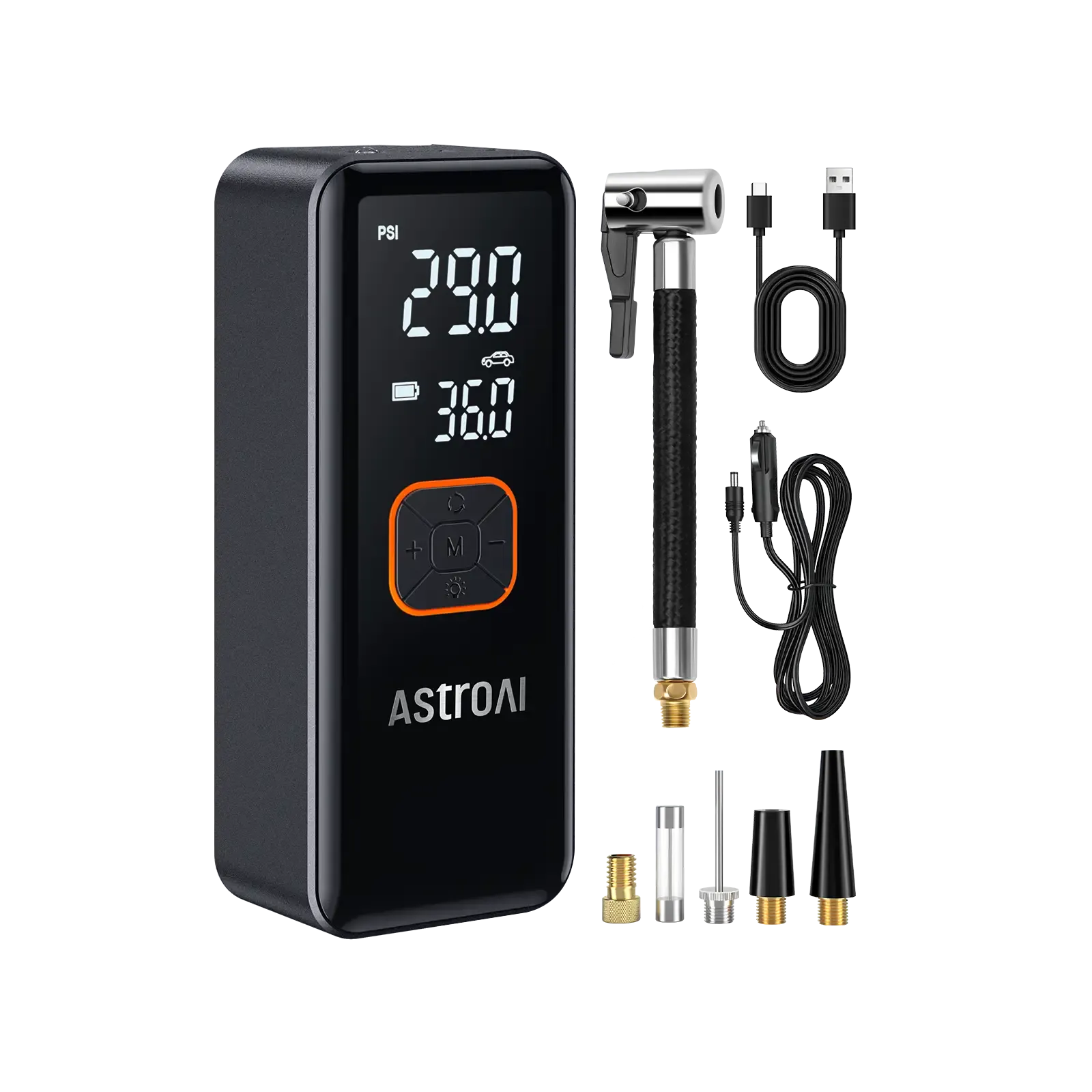
Match the inflator to your power and tire
Use the finder to check whether a reviewed model's documented power source, mode and accessories fit your requirements. It cannot prove an unlisted fit or predict actual fill time.