
Your needs, this model
Does it fit your priorities?
Can the exact yellow Quick Trick inflate a car tire away from both vehicle and wall power?
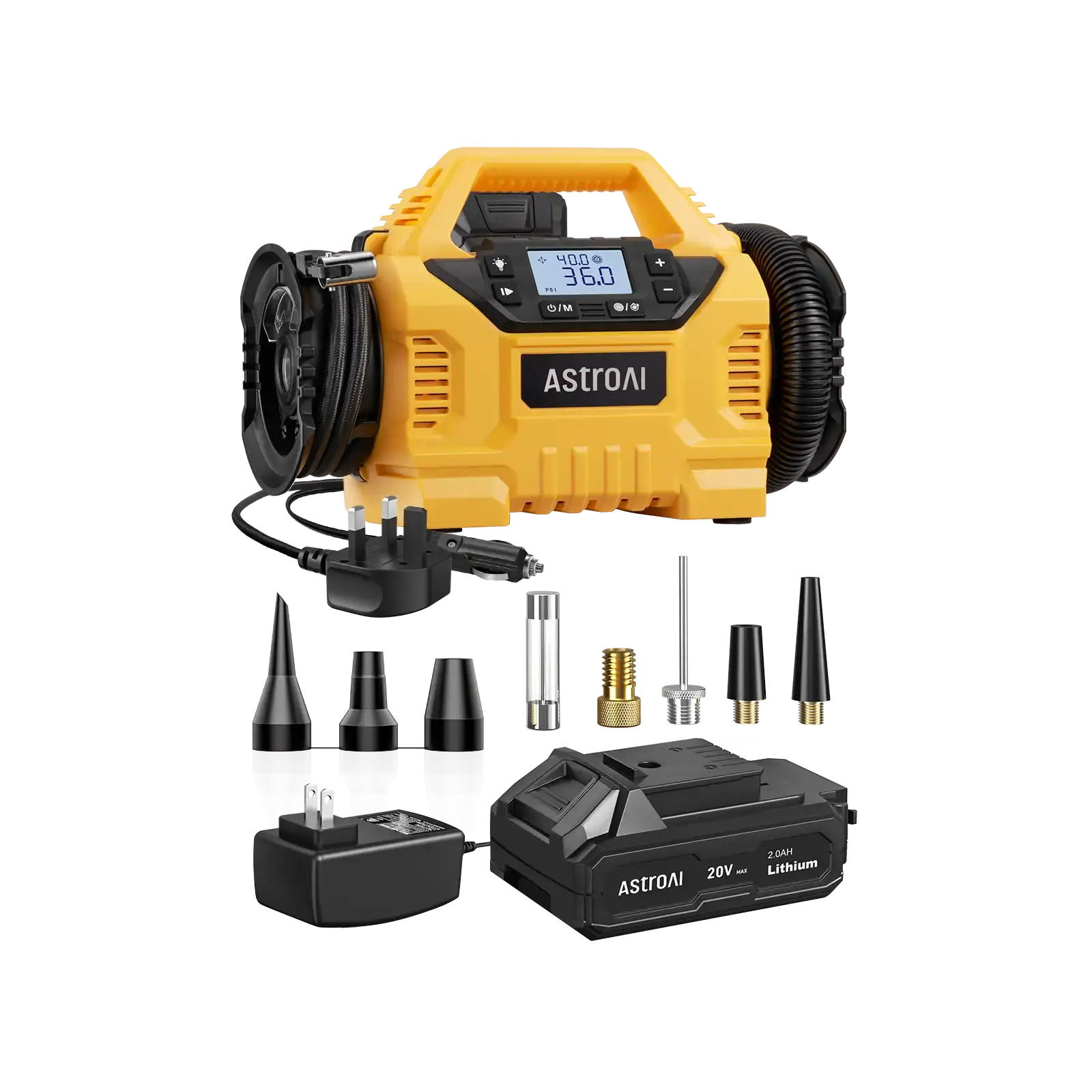
AstroAI's exact US item record and manual package table list a 2.0Ah rechargeable pack and charger, and the manual describes the battery-powered tire plan separately from 12V and AC operation. The same manual's battery-installation paragraph says the pack and charger are purchased separately, so confirm this exact item's package before relying on the battery route. AstroAI describes the pack as for emergency rather than routine power and says not to charge it while the pump is running; runtime and tires per charge are not published.
Explore this need in the finder →Can I use the Quick Trick for a bicycle with a Presta valve and preset stopping?
The exact manual names bicycle tires, Schrader compatibility and pressure-setting shutoff; its package list includes a Presta-to-Schrader adapter. The manual describes a lever-lock press-on tire fitting, not a dedicated Presta chuck. It supplies no bicycle pressure range or gauge tolerance, so follow the bicycle maker's target and verify important pressure independently. This answer uses the 12V tire plan only; battery and 120V AC are separate plans.
Explore this need in the finder →Does the included needle make the Quick Trick a documented sports-ball inflator?
No. The item page and manual list a needle valve adapter, but neither names sports balls as a supported use or states a ball-pressure interval or low-pressure accuracy. The manual instead names cars, small trucks, SUVs, motorcycles and bicycles for tire mode and lists rafts, air mattresses and floats for the separate large-volume hose. The needle's presence is not proof of ball compatibility; this assessment does not recommend the model for a sports-ball requirement.
Explore this need in the finder →This is a source-based assessment of the AstroAI Quick Trick, not a hands-on test. The US storefront identifies yellow SKU ACACJY23LYE-US; the official manual URL carries the matching ACACJY23LYE code and names pump model JY23P160-2301812. AstroAI labels the 160 PSI large-screen style “MC3.”
Three distinct ways to power one inflator
The Quick Trick's main distinction is its choice of 12V vehicle socket, 120V household AC, or a rechargeable pack. These are alternatives, not simultaneous inputs: the manual says to use one source at a time. For a car's accessory socket, AstroAI specifies 12V and a 15A outlet, instructs the user to run the engine, and says not to connect the pump to 24V vehicle power. The 15A rating is not a measured draw; check the vehicle manual and outlet fuse. The matching manual's US/Canada specification is 120V AC, 60Hz, while the exact storefront description uses “110V AC.” For a US wall outlet, the manual's regional rating is the better-supported value; check the instructions supplied with the exact item. The manual also identifies an 18V rechargeable pack; the pictured battery is labelled 20V MAX, and the exact item page lists a 2.0Ah pack and charger. However, the same manual says in its battery-installation text that the pack and charger are purchased separately, even though its package list names both. Treat the item-page package list as evidence for this SKU, but confirm the battery and charger are actually included in any offer before counting on cordless operation. The battery route is also described as emergency use, not a regular power supply. The manual says not to charge the pack while it is powering the inflator. The page does not establish a battery runtime or tires-per-charge figure, so the 2.0Ah label cannot answer how much work one charge will cover. This is a more flexible arrangement than the separate yellow AstroAI JY6P160-12, which is a 12V-only configuration, but it is not a direct battery-clamp or 7-way trailer setup.What it is documented to inflate
AstroAI's manual names passenger cars, small trucks, SUVs, motorcycles and bicycles for the tire nozzle, and says it fits Schrader valves. Its instructions describe pressing the fitting onto the valve and flipping a small lever to lock it, which supports a press-on connection rather than a threaded twist-on head. The manual and exact item list a Presta-to-Schrader adapter and a needle valve adapter. A Presta adapter can help with a bicycle valve, but it is not a dedicated Presta chuck. The manual also describes a separate large-volume mode and hose for low-pressure, high-capacity items such as rafts, air mattresses and floats, including a hose position for deflation. That mode is functionally different from setting a tire target. Although the package includes a needle adapter, neither the matching manual nor exact storefront listing names sports balls as a supported task; the presence of a needle alone does not establish ball use or low-pressure accuracy. AstroAI's product-page FAQ says the intended range is regular cars and SUVs and does not recommend this unit for RV tires. It supplies no tire-size threshold or pressure-specific fill-time test, so “160 PSI” should not be read as an RV rating, a promise of speed, or a target for any tire.Pressure stopping does not replace checking the target
In tire mode, the manual says the pump stops when it reaches the pressure selected with the plus and minus controls. It gives PSI, bar, kPa and kg/cm² as display units. That is useful for topping a tire to a chosen pressure, but neither a selectable preset interval nor gauge tolerance is published. The 160 PSI maximum working pressure is not a vehicle's recommended tire pressure. Use the vehicle placard or equipment maker's specified cold pressure, check the selected value before starting, and stay nearby while the inflator runs; automatic stopping is not evidence of pressure accuracy. The manual sets 20 minutes maximum continuous use in tire mode and 10 minutes in large-volume mode, with at least 10 minutes of cooling after every 20 minutes. These are manufacturer instructions, not independent duty-cycle tests. AstroAI labels MC3 at 350 L/min but gives no pressure point, test method or mode; do not treat it as a tire fill-time estimate.Reach, package checks and who should look elsewhere
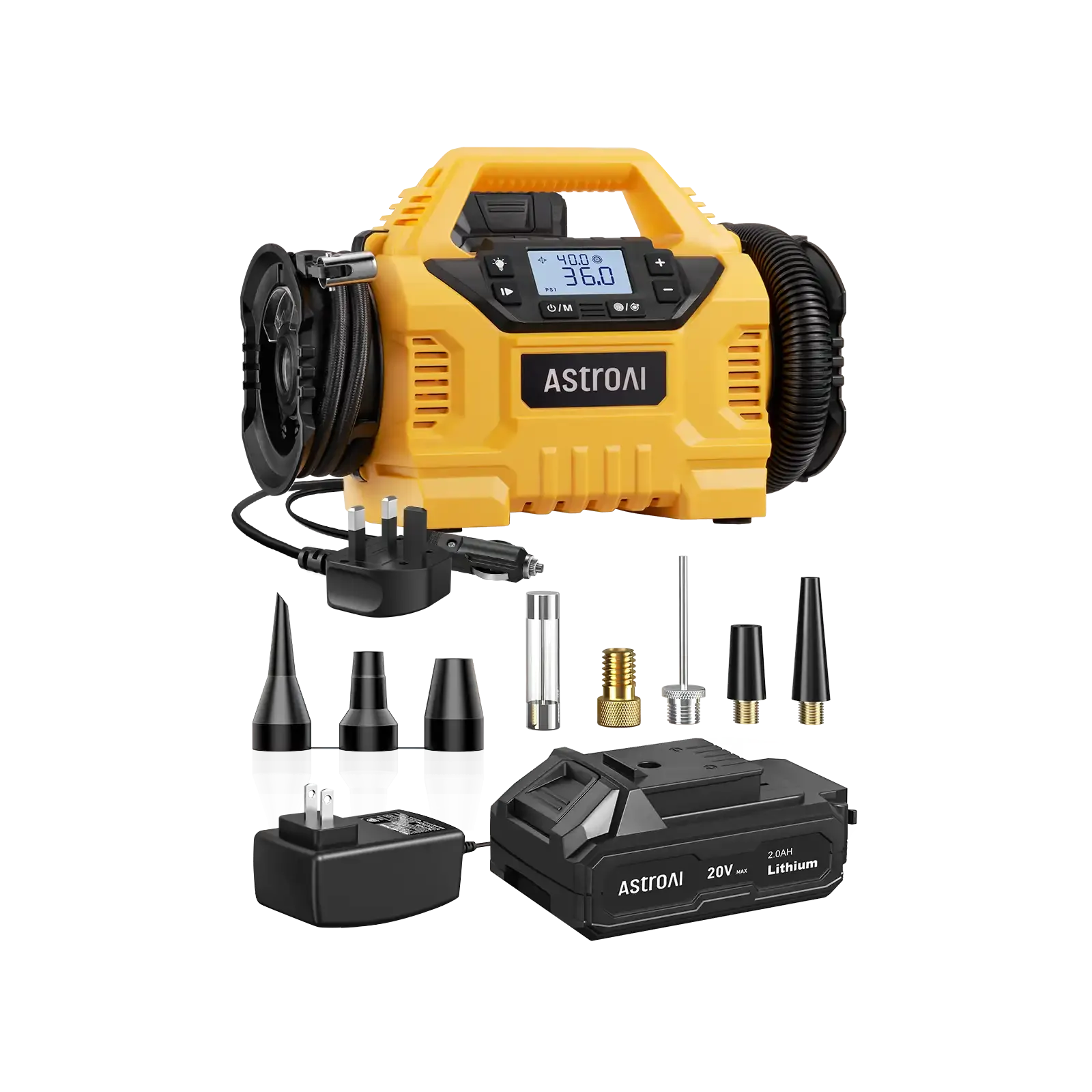
The manual gives a 2.91-foot tire hose and 9.84-foot 12V and AC power cords; plan the position of the pump before buying if the outlet or valve is hard to reach. It lists an 11.61 × 5.90 × 7.67-inch body. Its printed metric dimension line labels the corresponding 29.5 × 15 × 19.5 values as millimetres, which conflicts with the inch conversion; this assessment keeps the manual's inch values and does not rely on the mislabeled metric unit. The storefront and manual both list a pump, battery, charger, Presta and needle adapters and large-volume equipment, but accessory counts differ: the store says two fuses and single line items for nozzle/cap groups, while the manual lists one fuse, two air nozzles, two caps and three large-volume nozzles. The manual also says the battery and charger are sold separately. Verify the exact SKU and pieces; the photo cannot settle the package. The Quick Trick is worth comparing if access to wall power, a vehicle socket and an emergency battery in one machine matters, and the intended job is within the named car, small-truck, SUV, motorcycle or bicycle uses. Its limits are meaningful: no direct clamps or trailer auxiliary input, no documented ball use, no RV recommendation, no tire-size capacity, no accuracy tolerance and no battery-runtime evidence. Compare the yellow 150 PSI AC/DC Mini if a separate battery is not important, or the blue JY16P160-18 if a smaller battery-plus-12V arrangement is the actual need; their plans and packages are not interchangeable. Check the exact model, included battery/charger, cord reach, manual revision and vehicle outlet before choosing.Key specifications
Key details at a glance
| Product-page maximum-pressure claim | 160 PSI |
|---|---|
| Automatic stop at target | Yes |
| Documented accessories | 12V vehicle power cord / 120V AC power cord / 2.0Ah rechargeable battery pack (listed; verify exact package because manual text conflicts) / rechargeable battery charger (listed; verify exact package because manual text conflicts) / Schrader-compatible tire nozzle / Presta-to-Schrader adapter / needle valve adapter / large-volume hose and nozzles / replacement fuse(s; exact count differs by source) / tire-valve caps / user manual |
| Operating power arrangement | Multiple alternative power sources |
| Maximum working pressure | 160 PSI |
| Maximum current draw | 15 A |
| Tire-chuck connection style | Press-on tire chuck |
| Manufacturer pressure-rating conflict | No |
| Conflicting maximum-working-pressure claims | The exact item title and model manual both specify 160 PSI maximum working pressure. This is an equipment ceiling, not a recommended tire setting; the manual does not publish a selectable preset range, gauge tolerance or pressure-specific fill result. |
| Published duty-cycle condition | The matching manual sets 20 minutes maximum continuous use in tire mode and 10 minutes in large-volume mode, and calls for at least 10 minutes of cooling after every 20 minutes of use. These are manufacturer instructions, not independently tested duty-cycle results. |
| Manufacturer-listed tire-size reference | The manual names cars, small trucks, SUVs, motorcycles and bicycles; AstroAI's FAQ says the unit is intended for regular cars and SUVs and is not recommended for RV tires. No tire-size threshold is given. |
| Air hose length | 2.91 ft |
Use the exact model’s instructions for operating limits, supplied equipment and version differences.
Sources for this review
Sources for this assessment
Match the inflator to your power and tire
Use the finder to check whether a reviewed model's documented power source, mode and accessories fit your requirements. It cannot prove an unlisted fit or predict actual fill time.