
Your needs, this model
Does it fit your priorities?
Can I use the T2 from a vehicle accessory socket for a passenger-car tire?
The matching manual documents a 12V/15A accessory-socket route for tire pressures below 50 PSI, requires the vehicle engine to be running and describes preset-pressure shutoff. For tire pressure above 50 PSI it says to use the included battery clamps only; it does not specify the hookup at exactly 50 PSI. Check the actual vehicle socket, target pressure and exact kit rather than treating the 160 PSI maximum as a tire target.
Explore this need in the finder →What changes when the tire pressure is above 50 PSI?
For the T2, the manual says to connect directly to the vehicle battery using the supplied clamps when inflating heavy-duty tires above 50 PSI. The clamp setup remains 12V and the manual instructs the vehicle engine to be running; a 24V source is prohibited. The manual's continuous-use ceiling is 40 minutes, followed by at least 60 minutes cooling. It publishes no tire-size capacity or pressure-specific fill result, so the model name alone is not a fit guarantee for every truck tire.
Explore this need in the finder →Does the T2 manual document a Presta adapter for bicycle tires?
Yes. The matching manual names bicycle use and lists a Presta-to-Schrader adapter in its package table. The exact U.S. page's shorter in-the-box list does not name that adapter, so verify the offered ACACHDDCSL-US kit. The manual's 160 PSI maximum and unconditioned 23 L/min figure do not establish bicycle low-pressure accuracy or fill speed.
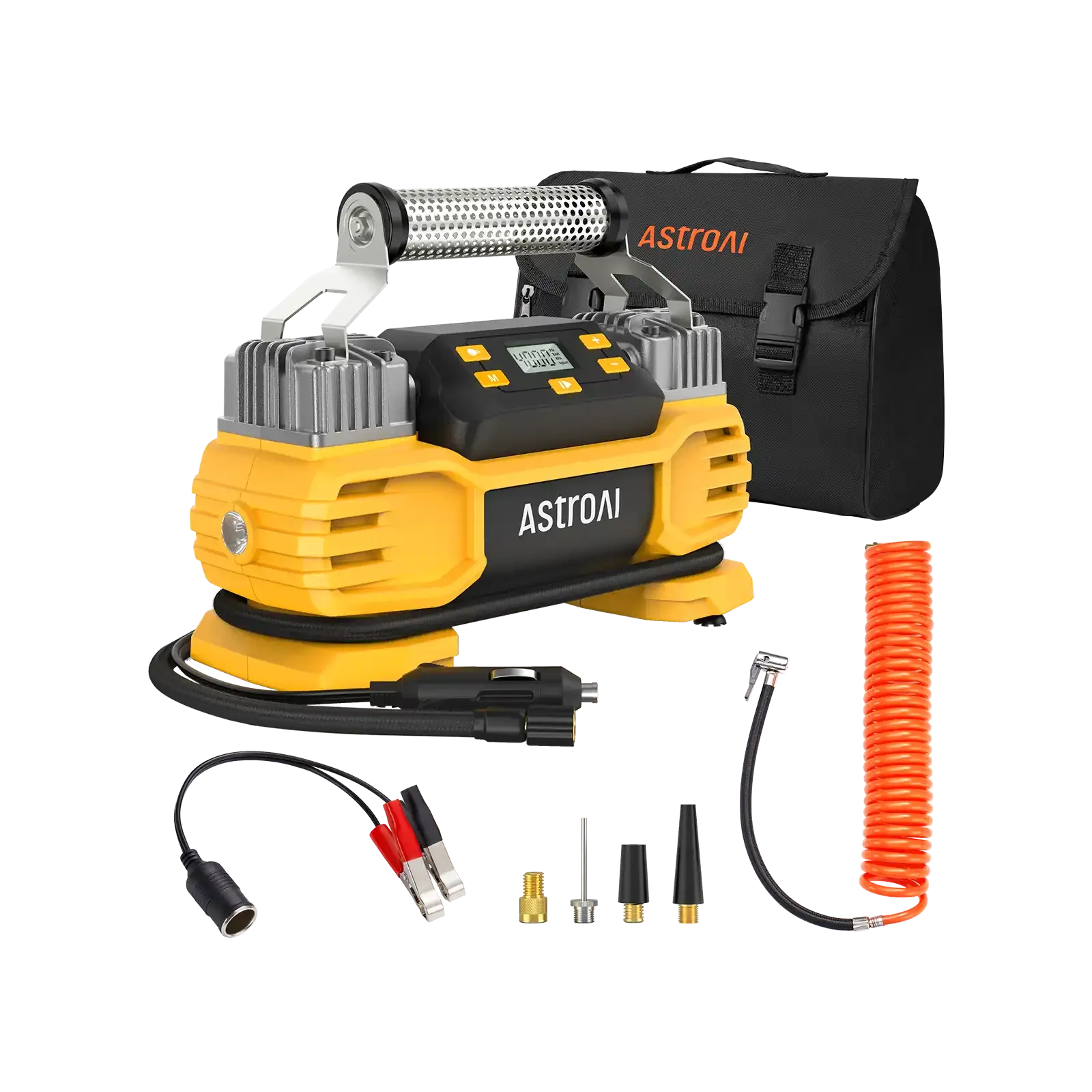
Explore this need in the finder →The exact AstroAI U.S. item page resolves the previously generic “Small Air Compressor for Truck Tires” row to SKU ACACHDDCSL-US. Its product text calls the yellow dual-cylinder, dual-motor unit the T2; the matching AstroAI-hosted manual cover identifies the AIRUN T2. This assessment is for that manual/listing bridge, not a claim that every similarly named AstroAI 160 PSI model is interchangeable.
Two vehicle-power routes, with a hard pressure distinction
This is not cordless in the battery-inflator sense. The manual shows a 12V cigarette-lighter lead and a direct battery-clamp connection; the U.S. item subtitle specifies 12V DC and does not identify an AC or internal-battery configuration. AstroAI says to have the vehicle engine running, prohibits 24V vehicle power, and specifies a 15A accessory connection. The two power options are not interchangeable at every tire pressure: the manual directs socket power below 50 PSI, but says to use battery clamps only above 50 PSI. It does not state which connection to use at exactly 50 PSI. That is a meaningful gap if your target sits at that point; confirm with AstroAI rather than guessing.
The manual also describes automatic shutoff at the selected pressure, which is useful for a setup that needs a preset stop. That feature does not choose the right pressure for you. AstroAI does not provide a preset range, adjustment increment or gauge tolerance in the matched manual, so use the vehicle or tire maker’s cold-pressure recommendation and remain present. The stated 160 PSI is the compressor’s maximum working pressure, not a suitable target for a passenger tire.
Its named use is broad; the performance evidence is not
The manual names cars, motorcycles, bicycles and trucks, while the product page markets the compressor for SUVs, RVs and ORVs as well. The package table includes a Schrader-compatible nozzle, a Presta-to-Schrader adapter and a needle valve adapter. Those details establish connections and listed uses; they do not establish an approved tire-size envelope. The manual gives no tire dimensions, pressure-specific fill time, low-pressure gauge accuracy or test scenario for its 23 L/min figure. The product page’s “4+ tires” statement is a manufacturer claim without a stated tire size and starting pressure, not a count this review independently verified.
There is useful cord length on paper: the manual lists an 11.48-foot DC lead, a 2.23-foot air hose and a separate 16.4-foot coiled hose. The product page shortens that to a 16.4-foot air hose and an 11.5-foot power cord. Treat the coiled hose as an included extension, not a measured total reach; vehicle layout, the valve location and exact kit contents matter. The manual’s maximum is 40 minutes of continuous operation followed by at least 60 minutes of cooling. Do not translate that ceiling into a promise that the unit can inflate any number or size of tires during one session.
Check the exact box contents before relying on the accessories
The exact U.S. product page’s short “In the Box” list names a compressor, manual, inflation needle, two tapered adapters, valve extender and replacement fuse. The manual’s package table additionally lists battery clamps, a storage bag, a Presta-to-Schrader adapter and a 5 m coiled air hose. Because those two manufacturer records describe different lists for the ACACHDDCSL/T2, check the offered ACACHDDCSL-US package for the clamps and adapters before buying. The manual instructs a press-on connection: align and press the quick connector onto the valve, then flip its small lever. Do not assume this is a threaded twist-on chuck.
The manual specifies a 205 W power rating and a 12V supply, but does not state current draw or the replacement-fuse rating. It calls for a 15A accessory socket below 50 PSI and direct clamps above 50 PSI; consult your vehicle’s instructions and do not substitute a 24V source. If you need a pump that can run from a removable tool battery, household AC, or a trailer’s seven-way auxiliary circuit, those arrangements are not documented for this configuration.
Who should shortlist it?
The T2 is worth comparing if you want a 12V vehicle-powered inflator, want both an accessory-socket route for lower-pressure work and clamp power for the manual’s above-50-PSI case, and can accept its substantial rest interval. Its dual cylinders and motors, 160 PSI maximum, selected-pressure stop and longer coiled hose are relevant documented features, not proof of speed on a specific tire. It is a poor fit if you need established battery operation, AC power, a known tire-size limit, a guaranteed 50 PSI hookup, an accuracy specification, or an unambiguous exact-package inventory without checking the seller’s offer.
This is a document-based assessment of manufacturer records and the matching manual. No hands-on use, ownership, timing, pressure measurement or independent testing is claimed.
Key specifications
Key details at a glance
| Product-page maximum-pressure claim | 160 PSI |
|---|---|
| Automatic stop at target | Yes |
| Documented accessories | AstroAI air compressor / 12V cigarette-lighter power lead / battery clamps (manual package table) / two air nozzles / needle valve adapter / two tapered adapters (exact product page) / valve extender (exact product page) / replacement fuse (rating not confirmed) / storage bag (manual package table) / Presta-to-Schrader adapter (manual package table) / 5 m / 16.4-foot coiled air hose (manual package table) / user manual |
| Operating power arrangement | Multiple alternative power sources |
| Maximum working pressure | 160 PSI |
| Minimum documented vehicle-port rating | 15 A |
| Tire-chuck connection style | Press-on tire chuck |
| Published duty-cycle condition | The T2 manual specifies 40 minutes maximum continuous operation and at least 60 minutes cooling after every 40 minutes. No pressure-specific duty schedule is given. |
| Power cord length | 11.48 ft |
| Air hose length | 16.4 ft |
Use the exact model’s instructions for operating limits, supplied equipment and version differences.
Sources for this review
Sources for this assessment
Match the inflator to your power and tire
Use the finder to check whether a reviewed model's documented power source, mode and accessories fit your requirements. It cannot prove an unlisted fit or predict actual fill time.