
Your needs, this model
Does it fit your priorities?
Can I power this T6 from a regular 12V accessory socket instead of connecting clamps to the battery?
The exact YD-127 manual documents a 12V battery-clamp connection and tells the operator to start the engine; it does not document an accessory-socket route. Treat the clamps, 45A electrical requirement and confirmed package contents as essential checks before considering this model.
Explore this need in the finder →Can the T6's airflow controller stop at my selected tire pressure automatically?
No preset-pressure auto-stop is described. AirCtrl lets you pause airflow at the gauge to check pressure, but the compressor keeps running while airflow is blocked; the manual tells you to switch it off at the tire maker's recommended pressure. Its over-temperature protection is not a target-pressure stop.
Explore this need in the finder →Does the matched manual support bicycle-tire use and an included needle fitting?
The manual names bicycle tires and lists a needle-valve adapter, so the reviewed plan records both those capabilities. It does not publish bicycle pressure accuracy, and a needle fitting does not itself establish that sports-ball use is approved; keep the bike maker's target in view and remain present.
Explore this need in the finder →The AstroAI T6 Offroad listing resolves to a specific U.S. configuration: the exact storefront item identifies ACAC127YE-US, and the model-matched manual is titled YD-127. That bridge matters because the manufacturer's U.S. page also places the T6 beside distinct T2, T3 and TC3 styles. This assessment is for the 12V T6, not those neighboring products.
Plan around battery clamps, not a dash outlet
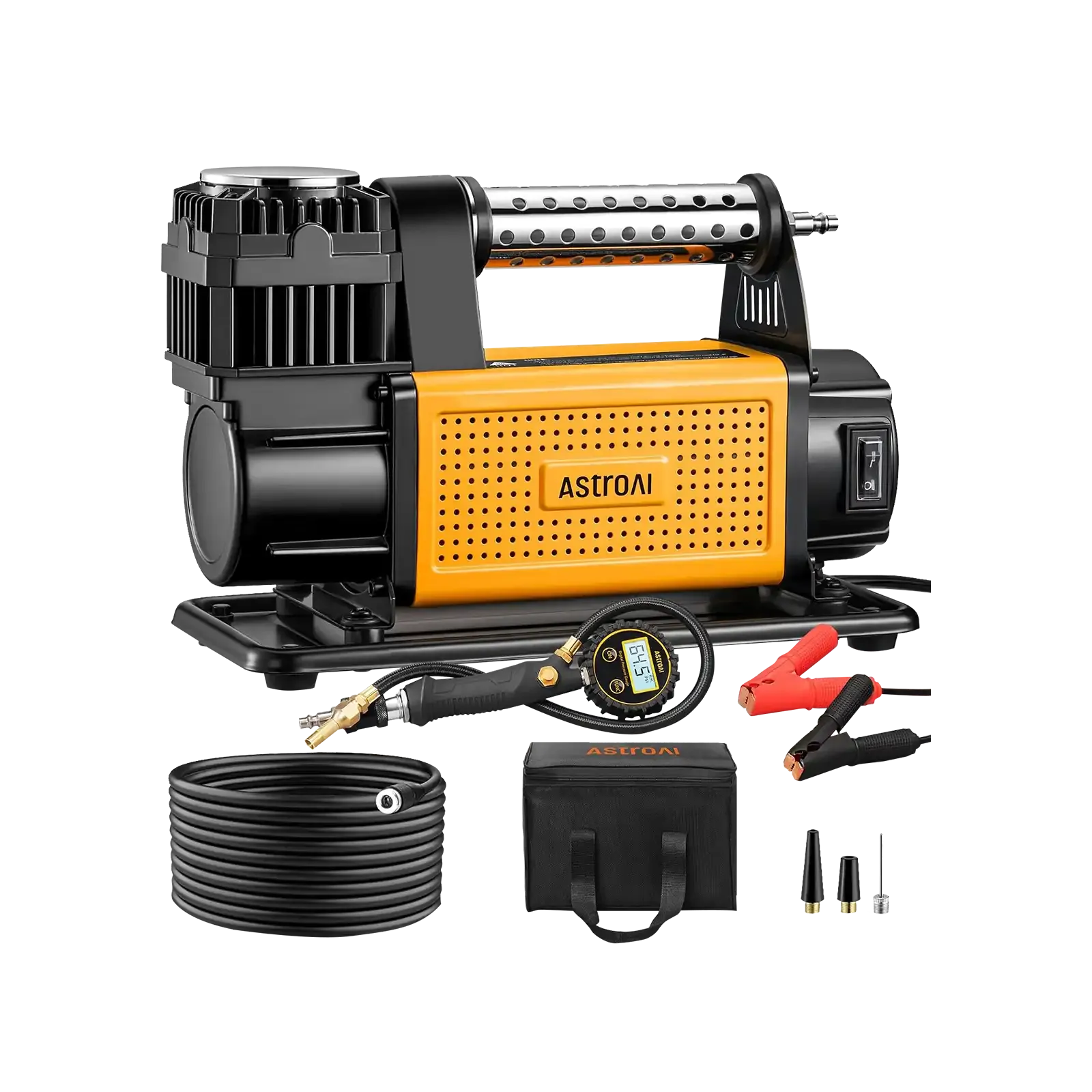
The YD-127 manual gives one operating route: connect red and black clamps to a 12V vehicle battery, start the engine, then switch the compressor on. It lists a 45A maximum current and 540W rating, so this is not a small accessory-socket inflator. The product page's written package summary does not list clamps, even though the manual instructs their use and the product photograph shows a red/black pair. Confirm that the exact ACAC127YE-US offer supplies the leads before purchase; don't substitute an unverified socket, AC adapter, cordless pack or trailer plug.
Its 150 PSI maximum working pressure is an equipment limit, not a target for a vehicle tire. Set pressure using the vehicle placard or tire maker's instructions. The manual's 45-minute continuous-use figure is specifically paired with a warning that below 40 PSI maximum working time is 45 minutes; it says to rest at least 20 minutes after that run. It also says to let the unit cool for 20 minutes if thermal protection trips or excessive use slows inflation. No pressure-specific schedule for a set of large tires is supplied.
AirCtrl is a manual measurement workflow
The T6's AirCtrl arrangement is more involved than a basic inflator head: the manual describes a digital pressure display, a valve that can pause airflow into the gauge for a reading, and a separate deflate valve. That gives the operator a way to check pressure without continuously forcing air through the measuring path. But the compressor itself keeps running while airflow is blocked. The instructions say to watch the display and switch the unit off at the maker's recommended pressure; they do not describe preset-pressure auto-stop. It is therefore not a set-and-walk-away pump, and the manual provides no gauge tolerance or pressure accuracy interval.
The product page advertises 7.06 CFM, while the exact YD-127 manual lists 160 L/min. Those are not equivalent figures, and neither source gives the pressure and test conditions needed to compare them. Rather than pick the more impressive number or infer an inflation time from either, treat the stated airflow as unresolved marketing/specification evidence. There is no independently measured fill time here.
Use claims and fittings need separate checks
The manual names cars, motorcycles, bicycles, SUVs, RVs, ATVs, ORVs and pickup trucks; the product title highlights 4×4 and SUV work. Those are the manufacturer's application examples, not a numeric tire-diameter or tire-volume capacity. No matching tire-size table or pressure-conditioned result is given. For a large off-road tire or a multi-tire airing-up routine, ask AstroAI for an exact recommended operating schedule rather than assuming that the 150 PSI ceiling or the CFM headline proves suitability.
The manual specifies an 8 m (26.24 ft) air hose and a 2 m (6.56 ft) power cord, helpful reach figures to compare with the distance from the battery to each wheel. They are listed lengths, not an installed measurement around your vehicle. The body dimensions are 13.14 × 8.93 × 5.90 inches; the sources reviewed do not give the unit's weight. The box list names an airflow controller, two nozzle cones and a needle-valve adapter. That needle attachment does not, by itself, prove sports-ball use; the manual does not name balls. It also does not identify a Presta adapter or specify the tire valve's standard. Check the exact fittings and wheel access you need rather than treating the ¼-inch NPT connector (the hose interface) as the tire-valve type.
Who should compare it?
The T6 merits a look when your documented need is a 12V clamp-powered compressor, you can meet the manual's 45A connection instructions, you want the long listed hose, and you are comfortable stopping manually while watching pressure. The separated AirCtrl gauge/airflow control and deflate button are practical features for an attended inflation-and-check routine. The source set does not establish a tire-size ceiling, a reliable comparison against smaller inflators, or how quickly this exact configuration fills a chosen tire.
It is a poor fit if you need a 12V socket plug, internal battery, 7-way auxiliary power, automatic preset shutoff, a confirmed Presta connection, documented sports-ball operation, a numeric tire-size rating or an exact-package guarantee without checking the offer. Before buying, verify the clamps, hose/controller and required vehicle setup, then compare the manual's 45A requirement with the vehicle and the intended tire task. Follow the maker's safe pressure target, remain present, and allow the stated cooling pauses.
This is a source-based assessment of the exact U.S. listing, its linked image and the ACAC127YE-US/YD-127 manual. No hands-on use, ownership, pressure reading, timing, personal measurement or independent performance test is claimed.
Key specifications
Key details at a glance
| Product-page maximum-pressure claim | 150 PSI |
|---|---|
| Automatic stop at target | No |
| Documented accessories | AstroAI compressor / rubber air hose (8 m / 26.24 ft) / AirCtrl airflow controller with digital pressure gauge and deflate valve / two air-nozzle cones / needle-valve adapter / storage bag / user manual |
| Operating power arrangement | Vehicle battery clamps |
| Maximum working pressure | 150 PSI |
| Maximum current draw | 45 A |
| Published duty-cycle condition | The manual says that below 40 PSI maximum working time is 45 minutes and requires at least 20 minutes of rest after 45 minutes continuous use. It also advises a 20-minute cooling pause if thermal protection activates or excessive use slows inflation. No pressure-specific multi-tire schedule is provided. |
| Manufacturer-listed tire-size reference | Product-page examples include 4x4, SUV, RV and ATV use; the exact manual gives no numeric tire-size envelope. |
| Power cord length | 6.56 ft |
| Air hose length | 26.24 ft |
Use the exact model’s instructions for operating limits, supplied equipment and version differences.
Sources for this review
Sources for this assessment
Match the inflator to your power and tire
Use the finder to check whether a reviewed model's documented power source, mode and accessories fit your requirements. It cannot prove an unlisted fit or predict actual fill time.