
Your needs, this model
Does it fit your priorities?
Does the “Battery Air Compressor” title mean this exact yellow SKU runs from its own battery?
The exact US storefront record identifies SKU ACACJY21DCYE-US and describes 12V DC operation. Its linked JY6P160-12 manual says to start the vehicle and use a 12V 15A accessory outlet; it prohibits 24V input, and household AC requires a separate converter. The sources do not document internal-battery operation for this SKU, so compare it as a corded vehicle-powered pump and check the exact label and manual.
Explore this need in the finder →Will the JY6P160-12 support a bicycle Presta valve?
The exact manual names bicycles and lists a Presta-to-Schrader adapter; it separately says the air nozzle is compatible with Schrader valves. Check that the exact package contains the adapter and use the bicycle or tire maker's pressure guidance. The manual gives no bicycle pressure range, tire-size capacity, gauge tolerance or pressure-specific fill test, and it does not identify a press-on versus twist-on tire chuck.
Explore this need in the finder →Does 160 PSI or 22 L/min tell me how fast it will fill my car tire?
No. The manual's 160 PSI is maximum working pressure, not a tire target; use the vehicle placard. It lists 22 L/min as inflation speed without a pressure point, tire size or test procedure, so that figure is not a fill-time estimate. AstroAI's manual instead gives a 20-minute continuous-use limit and at least 10 minutes of rest after extended operation.
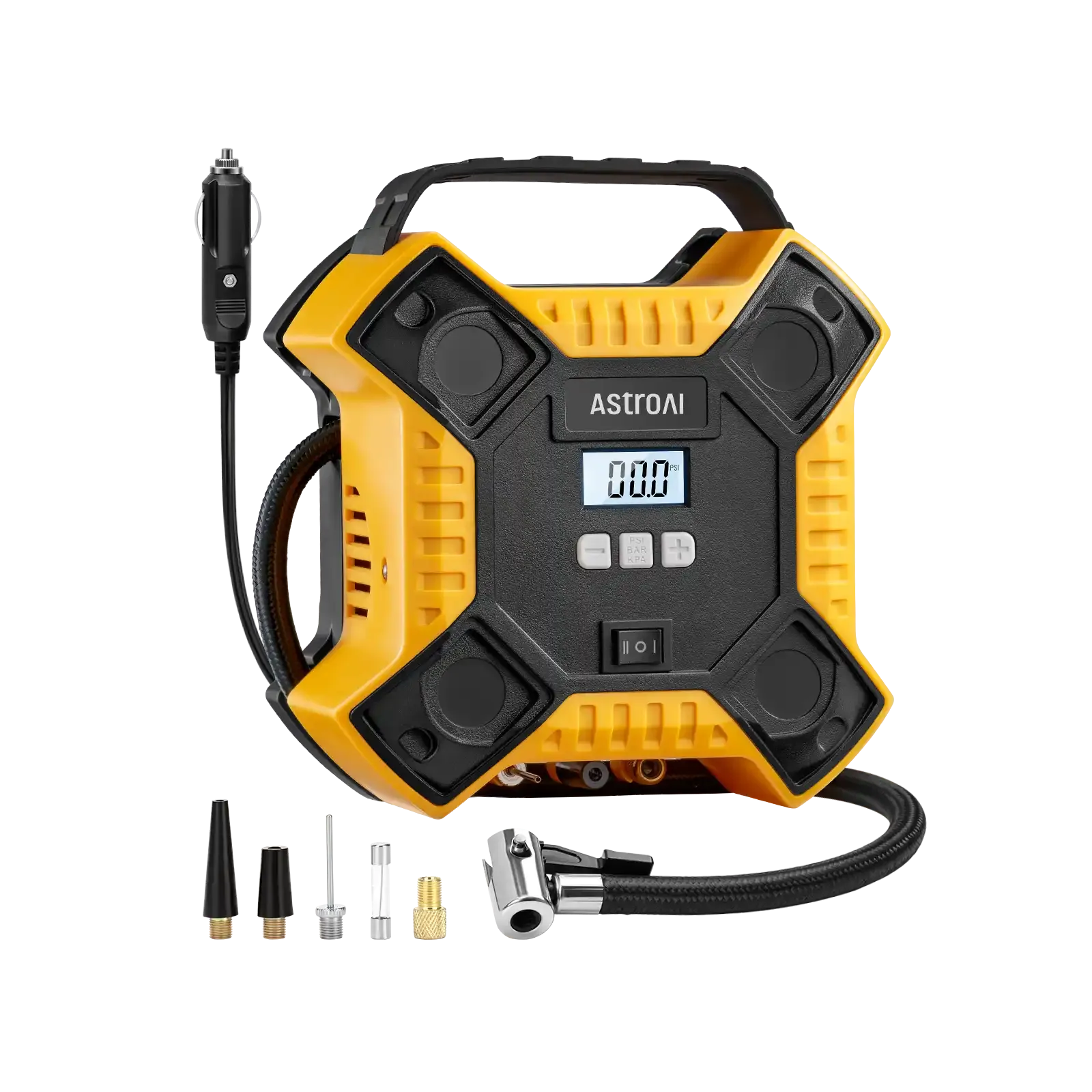
Explore this need in the finder →The AstroAI catalogue title calls this a “Battery Air Compressor,” but the exact US storefront record identifies SKU ACACJY21DCYE-US and names a 12V DC, 160 PSI yellow inflator. The linked AstroAI manual identifies its unit as model JY6P160-12. That manual describes a plug-in vehicle pump, not an internal-battery operating plan. Treat the SKU and manual code together when comparing an offer; a similar-looking AstroAI model is not interchangeable evidence.
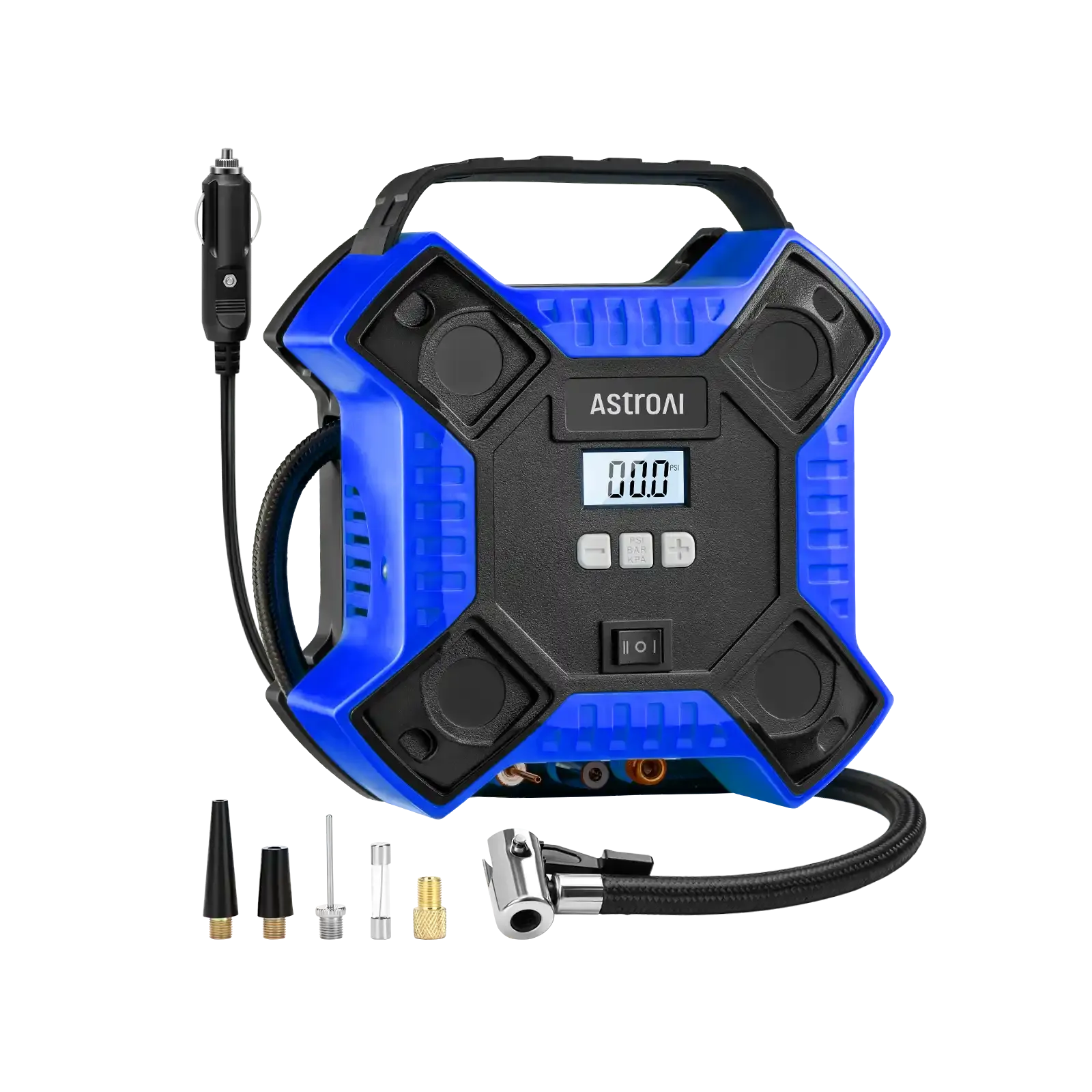
Blue is a separate SKU, not a documented different machine. AstroAI’s exact blue page identifies ACACJY21DCBU-US as a blue 12V DC, 160 PSI integrated-metal model. It shares the ACACJY21DC prefix with yellow ACACJY21DCYE-US; no functional difference is documented, so this review treats it as a finish variant. The blue page does not name JY6P160-12, and its manual could not be retrieved; the available manual is linked to yellow only. Treat its detailed limits as family-level evidence and verify the blue package/manual.
A 12V socket tool, not a self-contained battery pump
The manual directs the operator to start the vehicle, connect the compressor to its 12V outlet, and not use a 24V outlet. It says an AC-to-DC converter is needed for household AC, but no such converter appears in the documented package, so wall power is not a ready-to-use route. AstroAI specifies a 12V, 15A cigarette-lighter outlet; confirm that rating in the vehicle manual rather than assuming every accessory socket can supply it. The 60W figure is a power specification, not a pump-current test.
The manual lists a 9.84-foot (3 m) power cable, which is useful for planning where to park the vehicle relative to a tire. It does not give a separate hose-length specification, so do not treat the cord measurement as hose reach. The yellow finish and carrying handle make the unit easy to identify in the manufacturer image, but neither appearance nor the word “portable” makes it cordless.
Intended tire types—and the boundaries around them
For its model-specific use scope, the JY6P160-12 manual lists cars, small trucks, SUVs, motorcycles and bicycles. It explicitly says the pump is not intended for high-pressure or large-volume applications. The category examples therefore support ordinary tire maintenance, not every truck tire, a rapid recovery from flat, or inflating a large inflatable. AstroAI publishes no tire-size capacity or pressure-specific fill test in the exact manual. This is a better fit for a short, planned top-up from a compatible vehicle than for a buyer who needs repeatable time-to-pressure results or a large-volume workflow.
The manual says the nozzle is compatible with Schrader valves and its package list includes a Presta-to-Schrader adapter. It also lists an inflation needle and two cone adapters, but does not identify a sports-ball operating plan or a low-pressure accuracy range; this review does not count the needle as proof of a ball-use capability. Nor does the manual classify the tire chuck as press-on or twist-on. If a particular connection mechanism or accessory is essential, check the exact boxed equipment and instructions instead of inferring it from a product photo or the generic term “quick connector.”
Preset shutoff is useful only with the right target
The LCD is intended to show pressure while inflating, and the manual explains changing units and setting a target with the plus and minus controls. It says the compressor automatically shuts off when the preset pressure is reached. For a car, the manual directs the user to the tire-pressure guide inside the driver’s door, not to the tire sidewall maximum. A maximum working pressure of 160 PSI is an equipment ceiling—not an appropriate target for a vehicle, bicycle or other item. The sources do not provide the preset range, gauge tolerance or low-pressure accuracy, so the digital display and automatic stop should not be mistaken for a calibration statement.
Automatic stopping does not select the right target for you. Set the pressure from the vehicle or tire maker’s guidance, make a secure valve connection, and verify the result with a suitable tire gauge when accuracy matters. The manual also cautions that a preset below the existing tire pressure can prevent the pump from operating normally; it is intended to add air, not to correct an overinflated tire.
Runtime and stated flow are not a fill-time promise
AstroAI lists 22 L/min as an “inflation speed,” but the manual does not state a pressure point, tire size or test procedure for that number. It is not a measured car-tire fill rate, and it cannot be used to predict how long a low or flat tire will take. The manual’s separate limit is clearer: no more than 20 minutes of continuous operation, followed by at least 10 minutes of rest after extended use. It warns that the compressor becomes hot and remains hot for a while. Keep that run/rest boundary in mind for several tires; no source reviewed here promises a particular number of tires per session.
The manual also warns against rain or use near liquids and says to disconnect the unit from power when it is not in use. These are practical limitations for roadside placement and storage, not evidence of a weather rating. The reviewed sources do not provide an ingress-protection rating.
What to verify on the exact package
The JY6P160-12 manual’s package list names the 12V compressor, inflation needle, Presta-to-Schrader adapter, replacement fuse, two cone inflation adapters and user manual. The manual diagram also identifies the 12V plug, cord, hose and controls. For yellow, check SKU ACACJY21DCYE-US against that manual. For blue, check SKU ACACJY21DCBU-US and its supplied model-specific manual separately: the blue storefront page lists a 12V plug, hose, needle-valve adapter, Presta adapter, replacement fuse and other parts, but its exact manual bridge remains unverified here. Do not treat the image or sibling-color manual as a guarantee of the seller’s package. This assessment makes no claim about retailer stock or price.
Bottom line: this is a source-supported candidate for a driver who wants a 12V preset inflator for documented car, small-truck, SUV, motorcycle or bicycle tires and has a verified 15A-compatible vehicle outlet. Its useful safeguards are the selected-pressure stop, Schrader compatibility and listed Presta adapter. Its key limits are the vehicle-powered setup, 20-minute run/rest rule, lack of a chuck-style classification, and no pressure-specific speed or accuracy evidence. It is not the right evidence-backed choice for someone requiring an internal battery, a particular press-on/twist-on head, large-volume inflation or a guaranteed tire fill time.
Key specifications
Key details at a glance
| Automatic stop at target | Yes |
|---|---|
| Documented accessories | AstroAI 12 Volt Air Compressor / Inflation needle / Presta-to-Schrader adapter / Replacement fuse (amperage not specified) / Two cone inflation adapters / User manual |
| Operating power arrangement | 12V vehicle accessory port |
| Maximum working pressure | 160 PSI |
| Published duty-cycle condition | The exact manual says the ideal continuous-use period is 20 minutes and to let the pump rest for at least 10 minutes after extended use. The sources do not give a pressure- or tire-size-specific operating schedule. |
| Power cord length | 9.84 ft |
Use the exact model’s instructions for operating limits, supplied equipment and version differences.
Sources for this review
Sources for this assessment
- AstroAI official US Air Compressors collection snapshot
- AstroAI exact US storefront record for the yellow 160 PSI 12V inflator
- AstroAI JY6P160-12 Portable Electric Pump user manual (ACACJY21DCYE manual file)
- Exact-SKU-linked AstroAI yellow manufacturer product image
- AstroAI exact US storefront record for the blue integrated-metal 160 PSI variant
- Exact-SKU-linked AstroAI blue integrated-metal product image
Match the inflator to your power and tire
Use the finder to check whether a reviewed model's documented power source, mode and accessories fit your requirements. It cannot prove an unlisted fit or predict actual fill time.