
Your needs, this model
Does it fit your priorities?
Does the DCC020IB count as an inflator with a rechargeable battery inside?
No. The manual describes a removable 20V MAX or 60V MAX FLEXVOLT tool battery pack, and the tool-only page says the battery and charger are sold separately. The site's battery choice specifically means an internal rechargeable battery, so this model is not classified under that answer. Its separate 12V socket route may suit a vehicle setup only when the outlet is rated for at least 10A and the cord is fully extended.
Explore this need in the finder →Does the DEWALT preset shutoff work with the large-volume hose?
No. The Type 3 manual separates high-pressure inflation, where the unit stops at the selected pressure, from high-volume inflation and deflation, where it explicitly says there is no automatic shutoff. Do not treat the preset tire mode as a reason to leave the high-volume pump unattended.
Explore this need in the finder →Will the supplied 12V cord work from any vehicle accessory outlet?
Not on the evidence reviewed. The manual requires the vehicle's 12V DC accessory socket to be rated for at least 10A and says to fully extend the cord before use. Check the vehicle instructions and outlet rating; a nominal 12V label alone does not establish that the outlet meets the minimum.
Explore this need in the finder →Does the included Presta adapter prove that DCC020IB is intended for bicycle tires?
No. The manufacturer names a Presta valve adapter in the package, but the retrieved product page and Type 3 manual do not explicitly claim bicycle-tire use. The adapter can be recorded as included without turning that accessory into a verified bicycle-use recommendation.
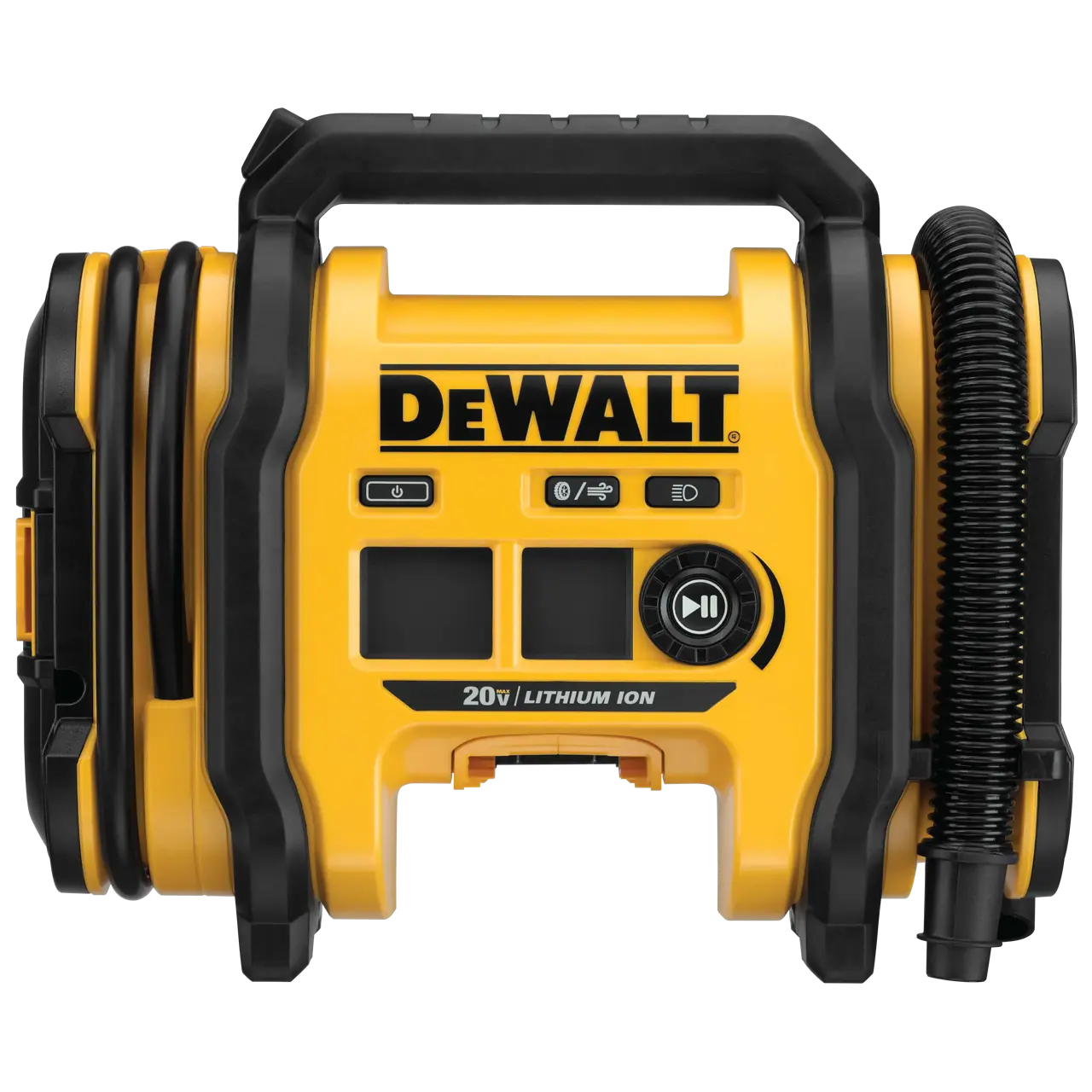
Explore this need in the finder →This assessment concerns the DEWALT DCC020IB, the current US-facing listing titled “20V MAX Corded/Cordless Air Inflator (Tool Only).” It is based on the manufacturer product page and the Type 3 North American manual—not a hands-on test. The word “cordless” can obscure an important distinction: the inflator takes a removable DEWALT battery pack, but a battery is not built into the body or included with this tool-only configuration.
Three power routes, with three different package checks
DEWALT documents operation from a 20V MAX battery, a 60V MAX FLEXVOLT pack, or a 12V DC vehicle accessory socket. The supplied 12V vehicle cord is listed in the box; the battery, charger and optional AC adapter are not. The manual identifies the approved AC accessory as N557514 and describes connection to a 120V wall outlet. That is not a reason to use an arbitrary power supply: DEWALT warns to use only the recommended external supply.
The 12V route has a meaningful electrical boundary. The vehicle socket must be rated for at least 10 amps, and the manual says to fully extend the cord before use. A socket marked “12V” without a sufficient current rating is not enough to establish a suitable setup. The manual does not require the engine to be running, so this assessment does not add that requirement. Nor is this a direct-clamp compressor or a 7-way trailer-plug model.
For shoppers already invested in DEWALT’s battery system, the removable-pack route may be convenient, but it is still a separate battery purchase if one is not already owned. Do not treat it as an inflator with an internal rechargeable battery: the pack slides into the tool, can be removed, and the inflator itself does not charge batteries. Those arrangements are different from the meaning of the “battery inside the inflator” finder choice.
Preset stopping is limited to the high-pressure mode
The DCC020IB has two distinct air paths. Its high-pressure hose is for tires and other higher-pressure items such as basketballs. In that mode, the operator sets a target on the digital display and the pump stops automatically when the item reaches the preset value. The manual also says that turning the main power off erases the settings, so a target must be re-entered after a full power-off. The pressure display shows inflation pressure in high-pressure mode; it is not an always-on gauge.
The separate high-volume hose is meant for large-capacity inflatables such as mattresses, rafts and pool floats, and it can be moved to the deflation port. This mode does not have automatic shutoff; the operator starts and stops it manually. A preset feature in the tire mode should not be mistaken for unattended protection in the high-volume mode. The manual cautions against leaving the inflator running unattended in either case.
Pressure and run limits need context
DEWALT’s current inflator category lists a 160 PSI maximum-pressure rating. That is a ceiling for the tool, not a recommended setting for a tire or ball. Follow the vehicle maker’s prescribed tire target and the item maker’s pressure limit. The manual says to use a separate ANSI-certified tire-pressure gauge to check tires after each use and before driving, and to check tire pressure before and during inflation.
One unusual numerical instruction is tied to the item, not expressed as a general work/rest schedule: when the pressure rating of the item being inflated is above 100 PSI, the manual gives a maximum run time of 10 minutes. This is not evidence of a 10-minute fill time, a tire-size capacity or a repeatable duty cycle for every pressure-maintenance job. DEWALT does not publish a tire-size benchmark, comparable fill-rate test, battery runtime per charge or gauge-accuracy tolerance in the material reviewed here. The manual also notes that the unit can become hot and calls for 30 minutes of cooling before storage.
Attachments are specific; the bicycle claim is not
The manufacturer identifies a threaded high-pressure chuck and lists a high-pressure tapered nozzle, Presta valve adapter and inflation needle. The Type 3 manual says these attachments fit the high-pressure hose and should be locked into place before the pump is switched on. A Presta adapter is useful only where the intended valve and connection are compatible, but the retrieved DEWALT material does not explicitly describe DCC020IB as a bicycle-tire inflator. This review therefore records the adapter without turning it into a bicycle-use claim. The listed “threaded chuck” also should not be silently relabeled as a verified Schrader connection based on the wording available here; confirm the exact interface if that is essential.
The high-volume mode arrives with a tapered nozzle on its hose, while the loose included attachments are for the high-pressure hose. These are not interchangeable: the needle and Presta adapter do not make the large-volume hose an auto-stop tire connection. The tool body stores the hoses and attachments, but the pictured body image is not proof of a battery or accessory bundle. Check that an offer is the DCC020IB tool-only item and verify the included cord and three loose attachments rather than assuming an online bundle is identical.
Operation details that affect the decision
DEWALT recommends recalibrating the pressure sensor for use above 5,000 feet. Calibration is not retained after the inflator is turned off, so high-elevation users need to repeat that step when restarting it. On the battery route, the pack must already be charged; the tool does not charge it. The manual’s instruction to keep the display facing upward on a flat surface when using a FLEXVOLT pack is another small but specific setup condition.
These details matter more than a marketing adjective such as “versatile.” The DCC020IB offers several power sources and two air modes, but each mode answers a different need. The automatic preset is relevant to high-pressure tire and ball tasks; the high-volume hose is for large inflatables and deflation, with no automatic stop. If the setup depends on an internal battery, an explicitly supported bicycle application, a 7-way auxiliary circuit, a specified tire size or a published fill-time result, those capabilities are not established by the evidence reviewed here.
Bottom line
The DCC020IB is worth considering when a buyer can use a compatible removable DEWALT pack, a verified 10A-or-higher 12V socket, or the separately sold approved AC supply, and wants preset stopping for high-pressure inflation. Its main advantages on paper are the choice of power routes, separate high-pressure and high-volume hoses, and automatic stopping in the correct mode. The tradeoffs are the tool-only purchase boundary, the 10A socket requirement, mode-specific shutoff, a 10-minute maximum run-time note for items rated above 100 PSI, and the absence of a supported tire-size or fill-rate benchmark. Confirm the power and valve setup before buying, use the right target pressure, and remain present while it operates.
Key specifications
Key details at a glance
| Product-page maximum-pressure claim | 160 PSI |
|---|---|
| Automatic stop at target | Yes |
| Documented accessories | 12V DC vehicle cord / High-pressure tapered nozzle / Presta valve adapter / Inflation needle / Integrated high-pressure hose / Integrated high-volume hose with tapered nozzle |
| Manual mode ranges (PSI) | High-pressure mode: digital target setting and automatic stop when the preset is reached / High-volume mode: manual start/stop and deflation; no automatic shutoff |
| Operating power arrangement | 12V vehicle accessory port |
| Maximum working pressure | 160 PSI |
| Minimum documented vehicle-port rating | 10 A |
| Tire-chuck connection style | Twist-on tire chuck |
| Published duty-cycle condition | Manual states a maximum run time of 10 minutes when the item being inflated is rated above 100 PSI; it does not provide a comparable tire fill-time or repeated-work benchmark. |
Use the exact model’s instructions for operating limits, supplied equipment and version differences.
Sources for this review
Sources for this assessment
Match the inflator to your power and tire
Use the finder to check whether a reviewed model's documented power source, mode and accessories fit your requirements. It cannot prove an unlisted fit or predict actual fill time.