
Your needs, this model
Does it fit your priorities?
Can the pump in the X9 APEX + T10 bundle inflate a car tire from the pump's own battery and stop at a selected pressure?
The exact combined listing names the X9 APEX pump and links its model manual. That manual specifies a built-in 11.1 V / 28.86 Wh rechargeable pump battery, a car-mode adjustment span of 26-50 PSI and selected-target stopping. Use the vehicle placard or handbook rather than the pump's 150 PSI ceiling or the 36 PSI example setting. The pump cannot be used while charging, and its USB charger is sold separately. The T10 is a separate jump starter, not a documented pump power source.
Explore this need in the finder →Do the T10's included jump-starter clamps let the X9 APEX pump run from the vehicle battery?
No clamp-powered X9 pump plan is documented. The exact page identifies a separate T10 jump starter; the linked X9 APEX manual describes the inflator's own rechargeable battery and says it cannot pump while charging. Do not connect the T10 clamps to the pump based on a bundle photo or the word 'clamps'.
Explore this need in the finder →Can the X9 APEX pump cover a sports-ball task, and what happens below 5 PSI?
The linked X9 APEX manual names ball use and lists a needle adapter in the pump package panel. It also says automatic inflation is unavailable below 5 PSI. That exception matters for low-pressure targets: the setting range and auto-stop feature do not promise automatic inflation at every ball pressure. Follow the ball maker's instructions and remain present.
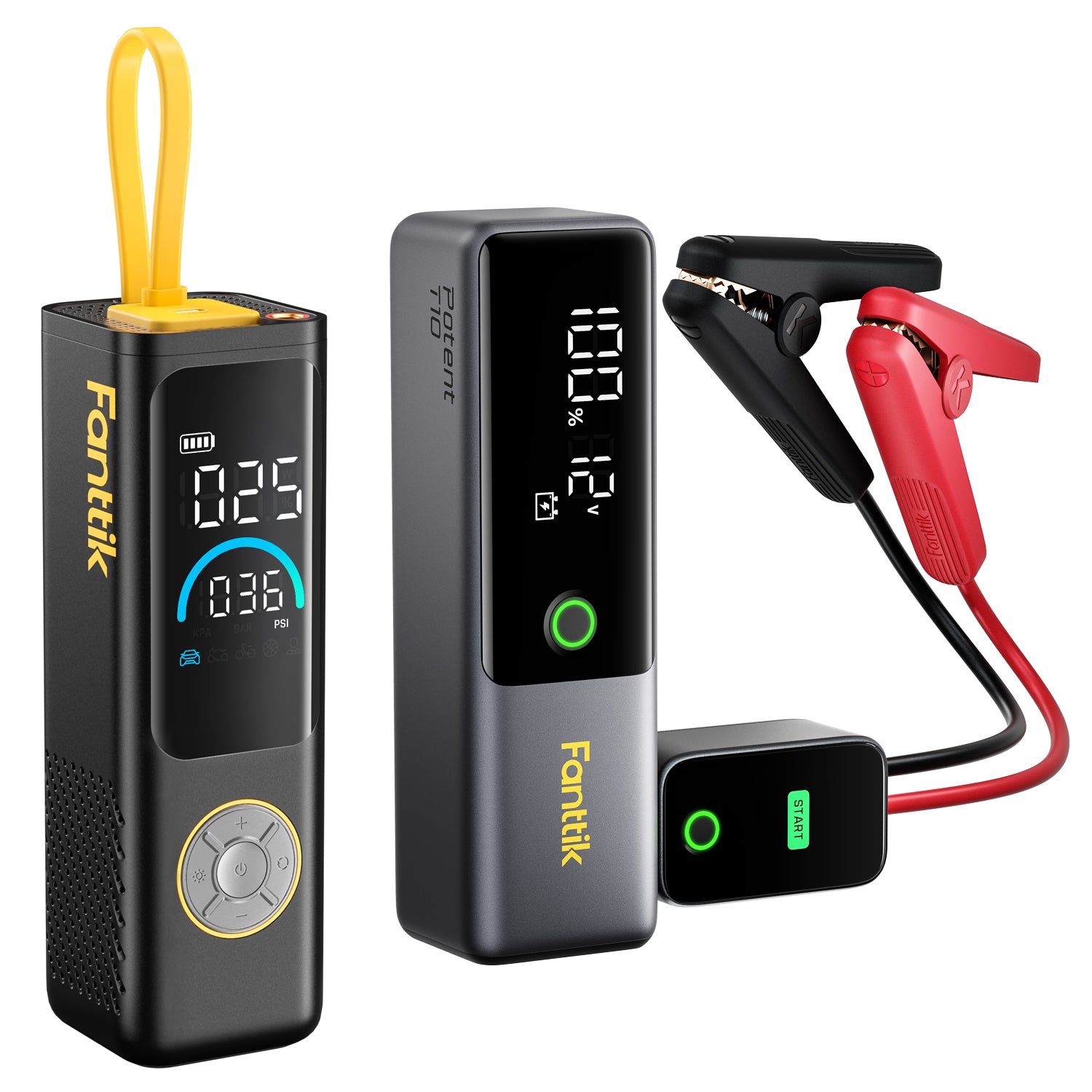
Explore this need in the finder →This assessment is for the exact Fanttik listing that pairs an X9 APEX tire inflator with a Potent T10 jump starter, outer SKU EXE260127000015. It treats the pump as the only tire-inflation device in the bundle. I have not physically used or tested either unit; the useful distinction here comes from the exact combined listing, its one-variant outer record, the pump manual linked from that listing, and its exact gallery image.
Two separate devices do not make one hybrid compressor
The product page names two products: an X9 APEX pump and a separate T10 1800 Amp jump starter. The page-linked manual is specifically for the X9 APEX pump. It gives that pump its own 11.1-volt, 28.86-watt-hour rechargeable battery and says the pump cannot inflate while charging. It does not document a 12-volt accessory-socket input, a direct battery-clamp pump arrangement, or a seven-way trailer connection. The T10's clamps belong to the jump starter; their presence in the same bundle does not show that they connect to or power the inflator.
That distinction matters more than the bundle's emergency-ready appearance. If the reason for buying is to have a pump that can run from a vehicle battery after its own charge is depleted, this listing does not establish that capability. If the reason is to keep two separate cordless functions together—tire top-offs from the pump battery and a jump starter for a different task—the named combination may be relevant, subject to verifying the exact offer and contents.
What the X9 APEX pump manual supports
The linked X9 APEX manual names car, motorcycle, bicycle and ball tasks. Its pump-level package panel lists a needle-valve adapter and a Schrader-to-Presta adapter, supporting the matching library's Schrader, Presta and ball-needle classifications. It also describes a selected-pressure stop and several modes. The manual's car mode can be adjusted from 26 to 50 PSI; the device's 150-PSI maximum and manual-setting span are limits on the control, not tire-pressure advice. Use the vehicle placard or equipment maker's recommendation for the target.
The manual has a consequential low-pressure exception: it says automatic inflation is unavailable below 5 PSI. Its wider manual setting range does not make that low-pressure automatic-stop feature work at every setting. For a sports ball or any other low-pressure item, check its own instructions and remain present rather than assuming the preset-stop label guarantees hands-off inflation. The manual also says not to leave the inflator unattended and warns that the hose/body junction can get hot.
The manual reports a 35-minute no-load runtime at 25 °C. That is not a promise of 35 minutes of tire work, a tire count or a repeated-job schedule. Likewise, the exact combined listing's claim of 27 fills from 28 to 33 PSI is a manufacturer scenario, not a standardized independent result. Tire starting pressure, size, temperature, duty and the definition of a completed fill would matter to a real comparison; those conditions are not supplied as a repeatable test here. Fanttik's stated ±1-PSI sensor figure is also a manufacturer specification, not independent calibration.
Package identity is the unresolved buying check
The outer listing's one-variant record identifies SKU EXE260127000015. It does not disclose an inner X9 pump SKU or a separate T10 SKU. The pump manual's contents panel helps identify the X9 pump-level fittings and charge cable, but the combined listing provides no full two-device carton checklist. Do not assume that the manual's pump package panel inventories the jump starter, its cables, storage case, charger or every item in the outer carton.
Before choosing this precise bundle, confirm that the seller is supplying EXE260127000015 and ask for a written list of both devices and accessories. The gallery image is useful for recognizing the pump and separate booster, but it is not a packing list. If you need a press-on or twist-on tire head, the X9 APEX manual does not classify that tire-end connection. Check the exact connector and whether your tire valve and wheel layout are accessible; the listed hose length is not an assembled-reach measurement for a particular vehicle.
Who should compare this bundle—and who should not
The strongest reason to consider the X9 APEX + T10 is a real desire for the two named functions together, alongside a pump that uses its own charged battery and has the manual-listed fittings for several task classes. The weakest reason is seeing clamps in the product photo and concluding that the inflator can use them. It cannot be classified as a clamp-powered pump from this evidence. A vehicle-powered plan, a particular chuck style, a documented high-volume workload or an exact repeated-tire duty schedule would call for a different, better-specified configuration.
This is a source-based fit assessment, not a performance ranking. No price, availability, review score or seller condition is inferred from the manufacturer page. Read the combined-needs guide and use the finder to separate pump-power, tire-use and included-fitting requirements before comparing exact offers.
Key specifications
Key details at a glance
| Product-page maximum-pressure claim | 150 PSI |
|---|---|
| Battery energy | 28.86 Wh |
| Automatic stop at target | Yes |
| Manual mode ranges (PSI) | Manual target: adjustable 3-150 PSI. / Car mode: 36 PSI default, adjustable 26-50 PSI. / Motorcycle mode: 35 PSI default, adjustable 26-43 PSI. / Bicycle mode: 45 PSI default, adjustable 30-145 PSI. / Ball mode: 8 PSI default, adjustable 4-16 PSI. |
| Operating power arrangement | Internal rechargeable battery |
| Maximum working pressure | 150 PSI |
Use the exact model’s instructions for operating limits, supplied equipment and version differences.
Sources for this review
Sources for this assessment

Match the inflator to your power and tire
Use the finder to check whether a reviewed model's documented power source, mode and accessories fit your requirements. It cannot prove an unlisted fit or predict actual fill time.