
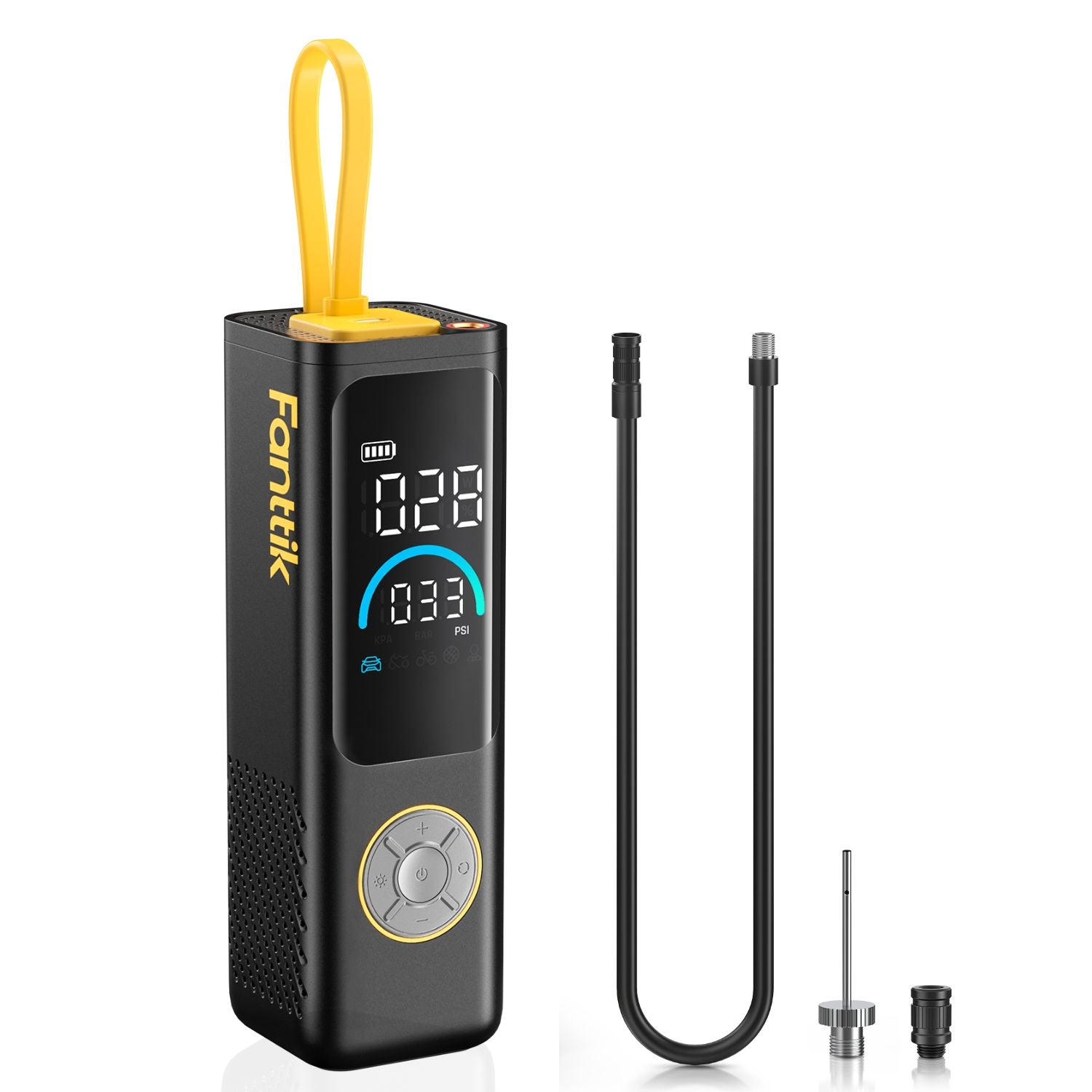
Your needs, this model
Does it fit your priorities?
Can the X9 APEX top up a passenger-car tire from its own battery and stop at a target?
The exact page-linked X9 APEX manual specifies one 11.1 V / 28.86 Wh internal battery, Car mode adjustable from 26 to 50 PSI, manual setting from 3 to 150 PSI, and automatic stopping at the selected target. The 150 PSI maximum is not your tire setting: use the vehicle's cold-pressure placard or handbook. The manual says the pump cannot run while charging and that its USB charger is sold separately. Its 35-minute battery line is a no-load statement at 25 C, not a tire workload, and the product page's 35-second fill figures have differing starting pressures and no independent test protocol.
Explore this need in the finder →Does the X9 APEX cover bicycle tires that use a Presta valve?
The exact model manual names bicycle use, lists a 30-145 PSI Bicycle-mode setting range and includes one Schrader-Presta valve adapter in the model's package panel. This is a documented adapter path, not a guarantee that it fits every rim, valve stem or tire. The manual warns that automatic inflation is unavailable below 5 PSI and says to use the tire maker's actual pressure guidance; a road tire's recommendation can exceed this model's Bicycle-mode ceiling. The required press-on versus twist-on tire-head style and the full tire-valve reach remain unspecified.
Explore this need in the finder →Is a needle included for a ball, and does preset stopping work at every ball pressure?
The X9 APEX manual's package panel lists one needle-valve adapter, and its Ball mode can be set from 4 to 16 PSI with an 8 PSI default. The same manual says the pump cannot automatically inflate targets below 5 PSI, so do not assume preset stopping at the bottom of that range; remain present and use manual operation cautiously if the target is under 5 PSI. Follow the ball maker's pressure, not the inflator maximum or a generic preset. Fanttik's +/-1 PSI sensor specification is not an independent low-pressure accuracy test.
Explore this need in the finder →Document-based review · exact U.S. item: USAWEBFTKN1064896
The Fanttik X9 APEX is a compact, rechargeable inflator whose appeal is breadth: its model manual documents car, motorcycle, bicycle and sports-ball modes, an internal battery, target-pressure stopping and a package with Schrader, Presta and needle attachments. That combination makes it worth considering for someone who wants one charged device for more than one kind of top-off. The trade is dependence on that battery: the manual explicitly says the pump cannot run while charging, and it does not identify the tire-end fitting as press-on or twist-on. This is a source-based assessment of the exact U.S. listing and its page-linked X9 APEX manual, not a hands-on test.
Power and pressure: useful settings, not a universal fit promise
The item record identifies a single U.S. storefront variant, SKU USAWEBFTKN1064896. Its linked manual names X9 APEX, and describes one 11.1-volt, 28.86-watt-hour rechargeable battery. Fanttik lists USB-C input and output, but those ports do not make it a corded inflator: the manual says it cannot inflate during charging. The package panel includes a charging cable, while a USB charging supply is sold separately. Plan to charge it before a trip, and do not treat the power-bank feature as a backup power source for the compressor.
The manual's manual-setting range is 3–150 PSI, but the mode ranges are more useful boundaries: Car is 26–50 PSI with a 36 PSI default; Motorcycle 26–43 PSI with a 35 PSI default; Bicycle 30–145 PSI with a 45 PSI default; and Ball 4–16 PSI with an 8 PSI default. Those are the tool's selectable values, not recommendations for a vehicle or ball. Use the cold-pressure figure specified by the vehicle maker, tire maker or ball maker, check the screen's units, and confirm that the required pressure falls within the relevant mode's range before starting.
Fanttik says the pump stops at a selected target, and the manual supports automatic stopping for ordinary inflation. There is an important exception: it says items requiring less than 5 PSI cannot be automatically inflated and must be handled manually with caution. That matters for some low-pressure balls even though Ball mode's displayed range starts at 4 PSI. Choose the correct setting, remain present, and do not mistake a selectable number for a safe operating recommendation. The manual also prints ±1 PSI sensor accuracy; that is a manufacturer specification, not an independent calibration result.
Attachments are better documented than the tire-head style
The manual's package diagram lists one air tube, USB cable, needle-valve adapter, Schrader–Presta valve adapter, storage bag and manual. Its instructions identify Schrader valves for many car, motorcycle and bicycle tires, explain using the supplied adapter for Presta valves, and show a needle for balls. This gives the listing more documented attachment flexibility than a box that only says “multiple nozzles.” Still, it is not a guarantee that every adapter fits every rim, stem or ball. The instructions describe a threaded connection where the air tube attaches to the pump; they do not say whether the tire-end head itself is press-on or twist-on. If that exact connection style is essential, ask the seller to confirm the supplied head rather than inferring it from the pump-side thread.
The manual's reference table spans a wide set of bicycle examples, including 700c road clinchers at 100–130 PSI and tubulars at 120–145 PSI. It labels its table for reference and tells users to follow the item being inflated. That distinction is crucial: a 150 PSI headline does not make every road tire a fit, and the Bicycle-mode ceiling is 145 PSI. Check the tire sidewall or manufacturer instructions, and make sure the required target is within the X9 APEX's actual mode range.
Read the speed and runtime claims as marketing examples
Fanttik's product page gives several distinct tire scenarios rather than one repeatable benchmark. A comparison table says 35 seconds for a 25-inch tire from 30 to 35 PSI and lists four fills from 0 to 35 PSI; another narrative claims a 35-second top-up from 28 to 33 PSI and as many as 27 such top-ups per charge. The page does not provide a common, independent test protocol that reconciles those different scenarios. Treat them as manufacturer examples, not this site's measurements or a promise for a different tire. The manual's battery-duration figure—about 35 minutes running without a load at 25°C—is also not a loaded tire-runtime estimate. No repeated-inflation cooldown schedule is published.
Heat, care and who should consider it
The manual warns that the hose/body junction can become hot after a long run, requires attended operation, and says to stop for unusual heat or noise. It gives a 0–45°C working range, calls for a clean, dry environment, and warns against prolonged storage in a hot car. These cautions are more actionable than assuming that automatic shutoff makes the job unattended. If a long fill or repeated workload is central to your use, ask for a documented operating schedule rather than turning a no-load battery figure into a duty-cycle rating.
The X9 APEX is a plausible shortlist candidate when you value a self-contained battery, multiple documented tire/ball tasks, preset stopping, and the named valve attachments—and can charge it before use. It is a poor match if you need a 12V socket, direct battery clamps, or a pump that can continue operating while its battery charges. It also cannot be recommended on an exact press-on or twist-on requirement from the available manual. Compare the pressure-mode boundaries and actual package, then use the X9 APEX fit guide to check the same documented choices in the finder.
Key specifications
Key details at a glance
| Product-page maximum-pressure claim | 150 PSI |
|---|---|
| Battery energy | 28.86 Wh |
| Automatic stop at target | Yes |
| USB power-bank output | Yes |
| Documented accessories | air tube (one) / USB charging cable (one) / needle-valve adapter (one) / Schrader-Presta valve adapter (one) / storage bag (one) / user manual (one) |
| Manual mode ranges (PSI) | Manual target: adjustable 3-150 PSI. / Car mode: 36 PSI default, adjustable 26-50 PSI. / Motorcycle mode: 35 PSI default, adjustable 26-43 PSI. / Bicycle mode: 45 PSI default, adjustable 30-145 PSI. / Ball mode: 8 PSI default, adjustable 4-16 PSI. |
| Operating power arrangement | Internal rechargeable battery |
| Maximum working pressure | 150 PSI |
Use the exact model’s instructions for operating limits, supplied equipment and version differences.
Sources for this review
Sources for this assessment
- Fanttik U.S.-facing Tire Inflators collection, page 1 of bounded 33-card capture
- Exact Fanttik U.S.-facing X9 APEX product page
- Exact X9 APEX Shopify product record
- X9 APEX manual linked from the exact Fanttik product page; image-based pages visually reviewed
- First gallery image linked by the exact X9 APEX item page; visually inspected

Match the inflator to your power and tire
Use the finder to check whether a reviewed model's documented power source, mode and accessories fit your requirements. It cannot prove an unlisted fit or predict actual fill time.