
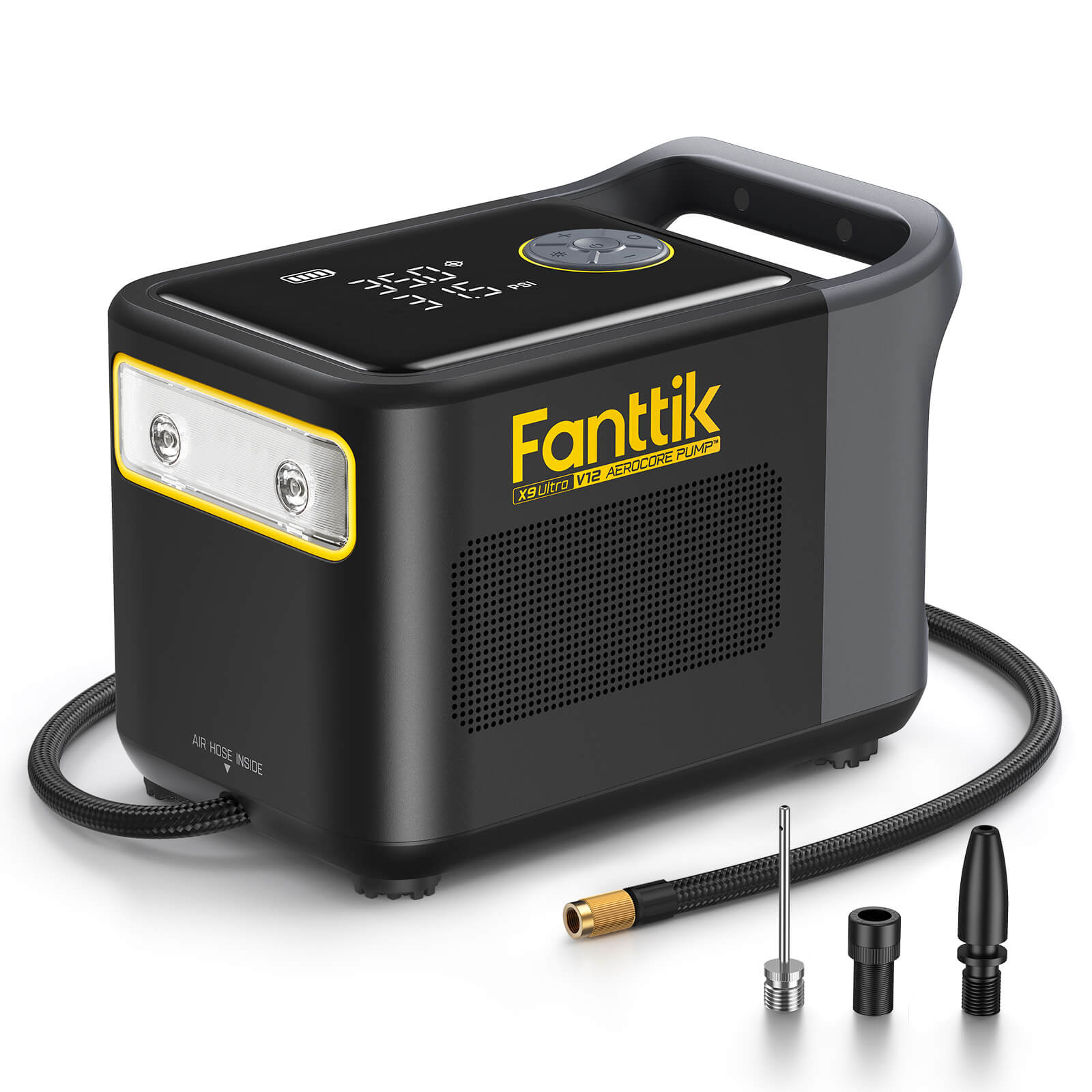
Your needs, this model
Does it fit your priorities?
Can the X9 Ultra handle a pickup or passenger-car tire without a vehicle outlet?
The exact X9 Ultra manual documents a built-in 92.5 Wh battery, a 3–150 PSI user target and automatic stopping at the selected value; its connection table names car tires. Fanttik's product page uses a 33-inch pickup example and claims different 30–35 PSI times in its copy and gallery, so neither figure is an independent result or a prediction for your tire. Charge it before leaving: the manual says it cannot inflate while charging, and a USB charger is sold separately. Follow the vehicle placard or tire maker rather than the 150 PSI equipment ceiling.
Explore this need in the finder →Does this model support a bicycle with a Presta valve?
The model-linked manual lists a separate Presta valve adapter for road bicycles and certain mountain bikes, and it documents a rechargeable battery with selected-target stopping. It does not establish universal bicycle-wheel fit or label the tire-end hose connector press-on versus twist-on. Confirm that your exact wheel and the adapter procedure match, use the bicycle maker's pressure, and remember that the pump cannot inflate while charging.
Explore this need in the finder →Can the X9 Ultra inflate a sports ball with a needle?
The manual's connection table names a needle valve for balls and its package diagram lists a needle adapter, so ball use is documented. It does not give a ball-specific pressure range or accuracy statement, and the pressure sensor's lowest listed range starts at 3 PSI; very-low-pressure items may be below its measurement floor. Follow the ball maker's instructions, stay with the pump, and treat the published sensor tolerances as manufacturer claims rather than an independent low-pressure test.
Explore this need in the finder →Document-based review · exact U.S. item USAWEBFTKN1047602
The Fanttik X9 Ultra is a substantial, rechargeable inflator built around a large internal battery and a second life as a USB power source. That combination is more consequential than the headline maximum: the same unit can sit away from the car while topping up a pickup tire, then charge a device between jobs. The tradeoff is a roughly 8.81-pound package with a charging-only USB-C supply, no documented 12-volt pump connection, and limits that matter if you expect repeated heavy inflation. This assessment follows the exact individual X9 Ultra listing and its linked model manual. It is research-based, not a hands-on test.
One integrated battery is the main reason to consider it
Fanttik lists an 18.5-volt, 5-Ah pack; the manual gives its energy as 92.5 Wh. The manual also describes consumer-device outputs, including a USB-C1 output up to 65 W, but those ports are a separate power-bank function—not an alternate way to run the compressor from a vehicle. The pump's documented inflation plan is its own battery. There is no cited 12-volt accessory-socket, direct-clamp, or seven-way trailer arrangement.
That makes the X9 Ultra a plausible fit for someone who wants an all-in-one unit ready for a remote tire top-up and may use its light or USB outputs at camp. It is less appealing as a small emergency glovebox tool: Fanttik lists 8.81 pounds and dimensions of about 10.1 by 6.2 by 7.1 inches. Those are manufacturer figures rather than measurements made for this review. A 92.5-Wh specification also is not a promise of a certain number of tires. Fanttik's page gives pickup-per-charge examples, but no independent protocol supports using them to plan a real workload.
Charging is a separate task. The manual's accessory drawing lists a cable, not a wall charger, and says the compressor cannot inflate while charging. Its stated recharge times vary with charger power—1.8 hours at 65 W, 3 hours at 30 W, or 5 hours at 20 W. Confirm that a suitable USB-C supply is available and charge before departure; do not treat the output ports as a way to power another device during inflation, either.
The pressure control is useful, but the number on the casing is not a target
The manual provides a user-set range of 3 to 150 PSI and says inflation stops when the chosen value is reached. Its four memory positions store user-set values. That can simplify repeating a pressure task, but neither the 150-PSI maximum nor a stored mode tells you what pressure belongs in a vehicle or bicycle tire. Use the vehicle placard or the tire maker's guidance and remain with the pump while it runs.
Pressure claims deserve more care than Fanttik's broad marketing shorthand suggests. The manual's specification table assigns different claimed sensor tolerances by range: ±1 PSI from 3–50 PSI, ±1.5 PSI from 50–100, and ±2 PSI from 100–150. The product page elsewhere says ±1 PSI without those bands. These are manufacturer claims, not calibration results from an independent gauge comparison. For a sports ball, the manual lists a needle connection but does not give ball-specific accuracy or a low-pressure operating guarantee; it also notes that some very-low-pressure inflatables can be below the measurement floor.
Timing claims are similarly not a substitute for evidence. The page and gallery give different times—38 and 58 seconds—for a 33-inch pickup tire changing from 30 to 35 PSI. A separate image says 20 minutes of continuous work for a 0-to-35-PSI condition. They are promotional examples, not a repeatable test or a full rest schedule. The manual warns that the hose-to-body junction can become hot, describes temperature protection, and supplies no minimum cooldown interval for consecutive jobs. It says not to leave the running unit unattended.
Valve support is broader than a car-only inflator, with one important unknown
The manual's connection chart names Schrader for car tires, motorcycles, e-bikes, and most mountain bikes. It separately lists the included Presta adapter for road bikes and certain mountain bikes, plus a needle valve for balls. Its accessory page also shows a plastic nozzle. Those labels establish intended task paths, not universal fit for every vehicle, tire, wheel, or ball. Check your exact valve and target before choosing a setup.
Do not assume the X9 Ultra has a press-on or twist-on tire chuck. The manual identifies the Schrader connection and a pump-side hose, but does not classify the tire-end mechanism as lever-lock or threaded. If that detail is essential to you, ask the seller for a clear view or procedure for the exact configuration rather than inferring it from a product render. Hose length is also inconsistent across the sources: the manual lists 120 cm while a page image states 45.66 inches. Neither figure proves total reach with adapters installed.
Who should keep it on the shortlist?
The X9 Ultra makes the most sense when the large integrated battery, saved target, named Schrader/Presta/needle connections, and power-bank role solve a real need—and its carrying weight is acceptable. Its distinct 92.5-Wh specification is larger than the 57.72-Wh battery Fanttik lists for the separate X9 Cross, but that comparison alone does not establish greater field performance or a predictable fill count. Choose by task and operating limits, not a brand's “faster” label or the highest pressure printed on a display.
Before buying, verify the exact X9 Ultra SKU, the charging supply and seller's included contents; confirm the hose actually reaches your valve; and decide whether the unknown chuck style is acceptable. There is no independent accuracy or fill-time test here, no repeat-job cooldown schedule, and no model-specific recall determination in this assessment. The exact page's offer-state labels also conflict, so this review makes no price or stock claim.
Key specifications
Key details at a glance
| Product-page maximum-pressure claim | 150 PSI |
|---|---|
| Battery energy | 92.5 Wh |
| Automatic stop at target | Yes |
| USB power-bank output | Yes |
| Documented accessories | charging cable / Presta valve adapter / needle valve adapter / plastic nozzle / user manual |
| Manual mode ranges (PSI) | Manual target setting is adjustable from 3 to 150 PSI; four memory settings M1–M4 can store custom pressure values. / The manual displays default stored values of 42, 65, 75 and 33 PSI for M1–M4; these are device settings, not recommended pressures for any tire or ball. / Inflation stops when the user-selected target is reached. |
| Operating power arrangement | Internal rechargeable battery |
| Maximum working pressure | 150 PSI |
Use the exact model’s instructions for operating limits, supplied equipment and version differences.
Sources for this review
Sources for this assessment

Match the inflator to your power and tire
Use the finder to check whether a reviewed model's documented power source, mode and accessories fit your requirements. It cannot prove an unlisted fit or predict actual fill time.