
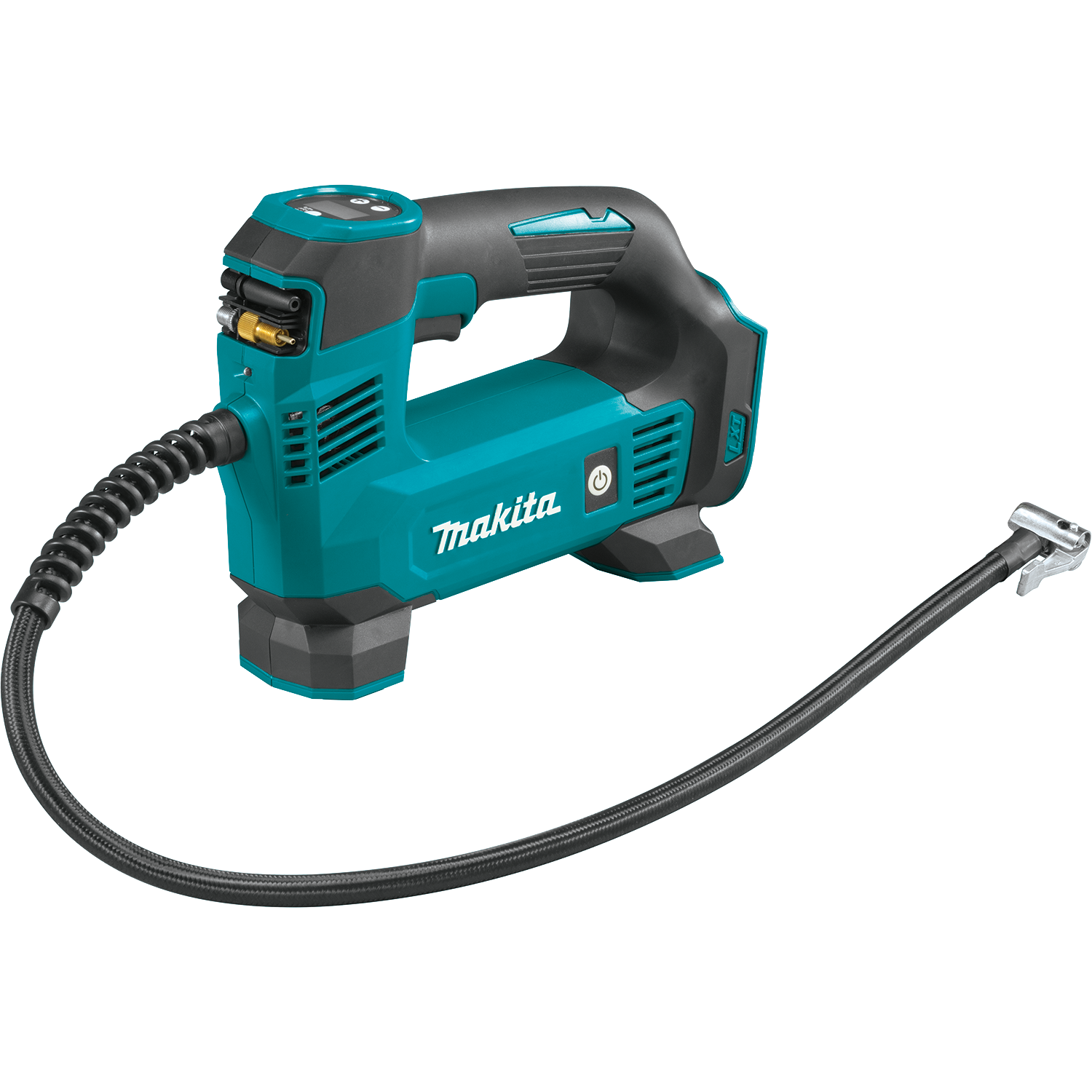
Your needs, this model
Does it fit your priorities?
Does the DMP180ZX include a Makita battery and charger?
No. Makita identifies this exact DMP180ZX as tool only and says battery and charger are not included. It uses a compatible removable 18V LXT pack rather than an internal rechargeable battery; confirm the pack and charger needed for your setup before comparing a seller package.
Explore this need in the finder →Which tire and ball connections are documented for DMP180ZX?
Makita's page identifies car tires, bicycle tires and sports balls and lists a Presta adapter, sports-ball needle and tapered adapter. The manual shows the Schrader chuck with a fold-over press-on clamp and gives a separate Presta procedure. It does not identify motorcycle-tire use; check the relevant item's pressure instructions and use a separate reliable gauge for the final tire reading.
Explore this need in the finder →What pressure and cooling limits apply to DMP180ZX?
Makita's page states up to 120 PSI while the manual lists 830 kPa (121 PSI); treat this as the tool ceiling, not a tire target. The manual specifies five minutes on and five minutes off for cooling and calls for a reliable calibrated measuring device after inflation. No gauge tolerance, tire-size range, test fill time or per-charge yield is published.
Explore this need in the finder →The Makita DMP180ZX is an 18V LXT tool-only tire inflator: it is the bare pump body, not a rechargeable inflator with its own sealed battery and not a vehicle-socket compressor. Makita’s US page lists car tires, bicycle tires and sports balls, a 120 PSI product-page ceiling, preset-pressure stopping and a 25½-inch hose. The linked DMP180 manual gives a closely corresponding 830 kPa (121 PSI) maximum and a five-minute-on/five-minute-off duty cycle. This is a source-based assessment, not a hands-on test.
Start with the actual power package
The “ZX” suffix matters. Makita identifies this exact listing as tool only and says its 18V LXT battery and charger are not included. The DMP180ZX therefore makes most sense for someone who already has a compatible Makita 18V LXT slide-style pack and a way to charge it. A new buyer would need to account for both separately. The removable tool pack is not equivalent to an internal battery, and neither the official product page nor the DMP180 manual documents a 12V accessory-socket lead, direct battery clamps or a trailer 7-way connection.
Do not assume that another Makita inflator suffix has the same box contents. The DMP180SYX is separately listed as a kit; the Outdoor Adventure ADMP180ZX is a discontinued predecessor configuration; the higher-pressure DMP181 is a different pump. Similar housings and a shared battery platform do not make their limits or package contents interchangeable.
A useful connection set, with a compact operating ceiling
The manual gives a specific clamp procedure for a Schrader valve: unfold the air-chuck clamp, seat the chuck on the valve stem and fold the clamp firmly. That is a press-on, lever-clamp arrangement rather than a twist-on hose. For Presta, the manual instructs the user to loosen the locking nut, attach the separate Presta adapter and then secure the air chuck to that adapter. The DMP180ZX page lists the Presta adapter, sports-ball needle and tapered adapter as included. These documented fittings support car and bicycle tire tasks and a ball-needle connection, but no motorcycle-tire use is identified on the exact product page reviewed here.
Makita’s page advertises up to 120 PSI while the manual lists 121 PSI after unit conversion. Treat these as the pump’s maximum output specification, not a recommendation for any tire or ball. Set a vehicle tire to the vehicle maker’s specified cold pressure and a bicycle or ball to the relevant maker’s target. The manual specifically tells the operator to verify inflation with a reliable, calibrated measuring device; it publishes no gauge-accuracy tolerance. No tire-size limit, comparative fill time or number of tires per charge is established by the sources reviewed.
Preset stopping does not remove supervision or cooling
The product page advertises an auto-stop function when the desired pressure is reached. In the DMP180 manual’s tire procedure, the operator sets the appropriate pressure and keeps pulling the trigger until the tool stops. That supports a preset-pressure stopping function for the tire-inflation arrangement, but it is not permission to leave the pump unattended. Makita says not to leave the tool unattended while the hose is connected and advises checking pressure after inflation with a separate reliable gauge.
The five-on/five-off rule is a meaningful limit for repeated work: after five minutes of continuous use, stop for five minutes so the tool can cool. The instructions also caution that the tool, hose, air chuck and adapter may be hot after inflating. This is better understood as a compact top-off tool with planned pauses, not evidence that it can handle a large tire from flat or a continuous workshop queue. Makita does not state a repeatable fill-time test, supported tire dimensions or runtime under a named workload.
Where it fits in the Makita lineup
For an LXT owner who wants a basic preset-stop inflator for documented car or bicycle maintenance and sports-ball top-ups, the DMP180ZX offers a familiar removable-pack arrangement and a straightforward 25½-inch hose. The trade-off is the tool-only package and the lower 121-PSI manual ceiling with a five-minute duty interval. If a kit battery and charger are needed, compare the exact DMP180SYX package instead of assuming a bare-tool offer includes them. If the task calls for the DMP181’s 160-PSI rating, three speed settings, pressure-release button or longer continuous interval, evaluate that model separately; those are materially different specifications, not an upgrade that should be inferred from the DMP180 name alone.
Before purchase, verify the exact DMP180ZX suffix, the pack and charger required for your setup, and the included Presta/ball/tapered accessories in the offer. Follow the manual, use the pressure recommended by the item maker, observe the five-minute cooling schedule and independently check the final pressure. The available manufacturer evidence does not establish a fill-time guarantee, battery yield, pressure-gauge tolerance or compatibility with a particular tire size.
Key specifications
Key details at a glance
| Automatic stop at target | Yes |
|---|---|
| Documented accessories | Presta valve adapter / sports-ball needle / tapered adapter |
| Operating power arrangement | Removable 18v lxt battery |
| Tire-chuck connection style | Press-on tire chuck |
| Published duty-cycle condition | The manual specifies five minutes on followed by five minutes off for cooling. |
Use the exact model’s instructions for operating limits, supplied equipment and version differences.
Sources for this review
Sources for this assessment

Match the inflator to your power and tire
Use the finder to check whether a reviewed model's documented power source, mode and accessories fit your requirements. It cannot prove an unlisted fit or predict actual fill time.