
Your needs, this model
Does it fit your priorities?
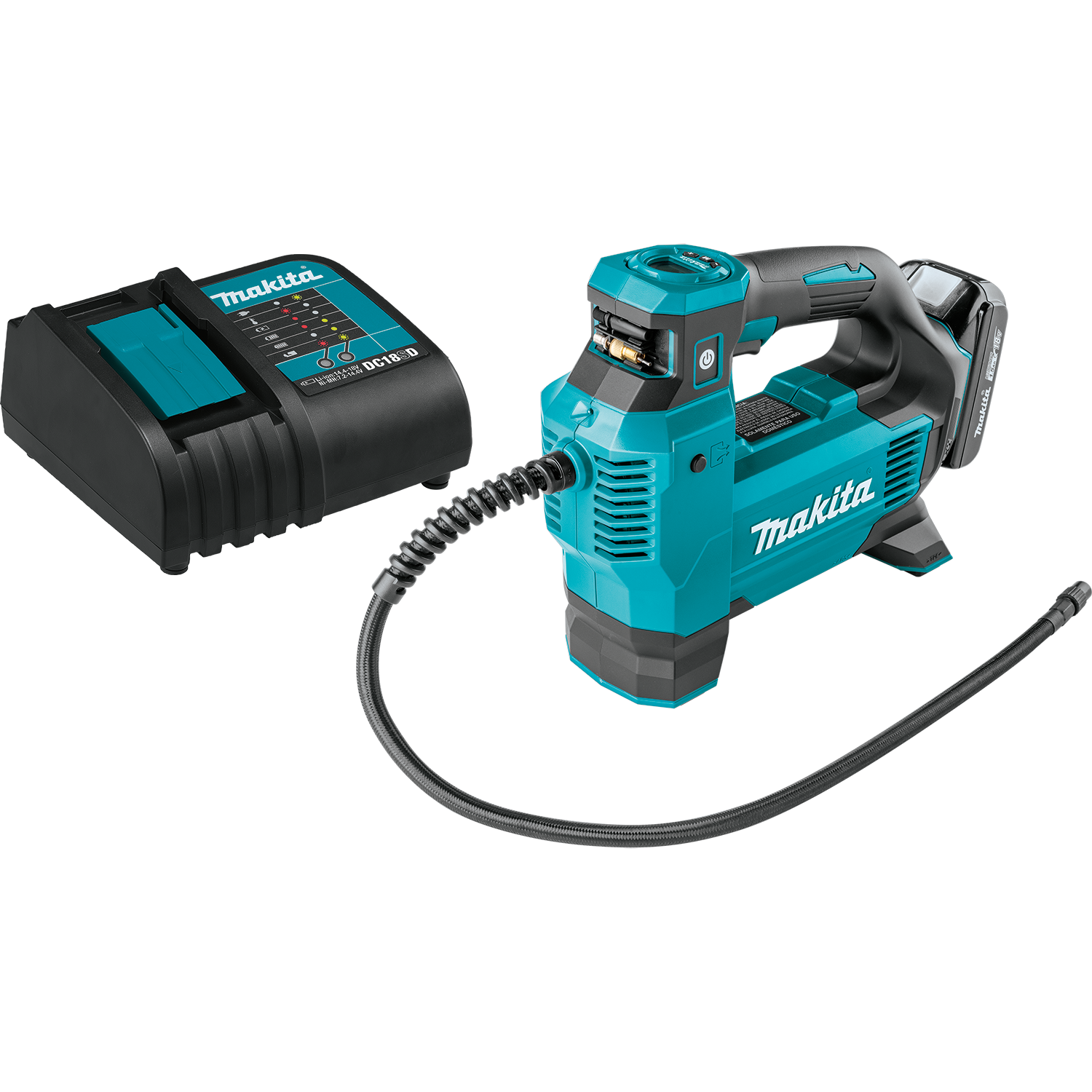
Does DMP181SYX include the LXT battery and charger?
Yes. The exact kit page describes a 1.5Ah battery and charger and itemizes BL1815 and DC18SD. It is a removable 18V tool battery, not an internal battery or a 12V vehicle-socket lead.
Explore this need in the finder →Which valve connections are included with DMP181SYX?
The exact kit lists a Presta adapter, sports-ball needle and tapered adapter. The DMP181 manual shows the Schrader air chuck folding onto the stem, a press-on clamp procedure, and tells the user to select ball mode when using the needle.
Explore this need in the finder →How should I interpret DMP181SYX pressure and duty numbers?
The manual sets a 5–160 PSI range and 5–16 PSI ball mode, with ten minutes on followed by five minutes off. 160 PSI is the inflator maximum, not a tire recommendation; use the maker target and a reliable calibrated gauge. Makita gives no gauge tolerance, tire-size, fill-time or per-charge yield specification.
Explore this need in the finder →The Makita DMP181SYX is the kit version of the 18V LXT DMP181 high-pressure inflator. Its exact US product page lists a 1.5Ah battery and charger along with the pump, Presta adapter, sports-ball needle and tapered adapter; the contents section names battery BL1815 and charger DC18SD. The linked DMP181 manual specifies a 160 PSI maximum and a ten-minute-on/five-minute-off cooling schedule. The same pump is sold tool-only as DMP181ZX, so the kit suffix materially changes what must be supplied before use. This is an evidence-based assessment, not a hands-on test.
What the DMP181SYX kit supplies
Unlike the bare DMP181ZX, the SYX listing includes a removable compact 18V LXT battery rated 1.5Ah and a charger. Makita's itemized contents identify the battery as BL1815 and charger as DC18SD. That is useful if the intended buyer needs a complete initial battery-and-charging package rather than another tool for an existing LXT shelf. It is not an internal-battery inflator: the pack slides onto the tool and remains a separate, removable platform battery. Nor does the kit provide a 12V vehicle socket lead, direct vehicle-battery clamps or a seven-way trailer connector.
The included battery's amp-hour rating is a package fact, not a tested measure of how many tires it will inflate. Makita publishes no defined tire-size fill trial, pressure-change workload or per-charge tire count for this kit. Battery condition, temperature and the task all matter, and the exact product materials do not quantify them. Do not compare “1.5Ah” with another kit as if it were a fill-time result.
Higher-pressure body with useful controls
Makita's page lists car and light-truck tires, bicycle tires and sports balls, a backlit display, target-pressure stop, three speed settings, an air-release button and a 25½-inch hose. The manual's pressure adjustment spans 5–160 PSI and its ball mode covers 5–16 PSI. Those are documented features of the DMP181 pump body, not proof that a particular tire or ball can be safely inflated to its equipment limit. Use the pressure specified by the vehicle, bicycle or ball maker.
The DMP181's 160 PSI maximum is higher than the DMP180 family's manual maximum of 121 PSI, and the DMP181 manual allows ten minutes of continuous operation before a five-minute cooling break rather than five-on/five-off. These are real specification differences; they do not establish that DMP181 will inflate every tire faster. The manuals do not offer a shared tire, starting pressure or workload test that would support a speed comparison.
Valve work, ball mode and checking the result
The manual describes a press-on Schrader air chuck: seat the head on the valve and fold the clamp down to secure it. For Presta, it explains loosening the locknut and using the separate adapter. The kit page lists that adapter, a sports-ball needle and a tapered adapter. The manual instructs the operator to choose ball mode with the needle. Below 5 PSI, it says the built-in gauge does not display a precise current pressure, so a low-pressure ball needs especially careful checking against its maker's instructions.
Makita gives no numerical accuracy tolerance for the display. Its manual directs the user to confirm tire pressure with a reliable calibrated measuring device. Target-pressure stopping can reduce the need to keep watching a rising number, but it does not authorize unattended inflation: the manual says not to leave the tool with the hose attached, and it warns that an already damaged tire can burst while being inflated. The air-release button is a useful correction control if pressure goes above the desired value, not a substitute for choosing the correct target in the first place.
When the SYX package is the better comparison
Consider DMP181SYX if the documented car, bicycle or sports-ball tasks and the higher-pressure DMP181 body suit the plan, and the buyer also wants one included 1.5Ah battery and charger. If a compatible LXT battery and charger are already on hand, the separate DMP181ZX tool-only package avoids duplicating that power equipment. If the pump's intended task is a lower-pressure top-off with a shorter operating window, DMP180SYX is another distinct kit, but its maximum, pressure controls and five-on/five-off interval are different. A model family name alone is not enough to choose among them.
Confirm DMP181SYX, battery BL1815, charger DC18SD and the listed attachments against the exact seller offer. Read the DMP181 manual, use the tire or ball maker's target, remain present, observe ten minutes on followed by five minutes off, and verify the final tire pressure independently. The available sources do not establish gauge tolerance, a tire-size limit, a repeatable fill time or battery yield.
Primary references: Makita USA DMP181SYX product page and the DMP181 instruction manual.
Key specifications
Key details at a glance
| Automatic stop at target | Yes |
|---|---|
| Documented accessories | Presta valve adapter / sports-ball needle / tapered adapter |
| Operating power arrangement | Removable 18v lxt battery |
| Tire-chuck connection style | Press-on tire chuck |
| Published duty-cycle condition | The manual specifies ten minutes of continuous operation followed by five minutes off for cooling. |
Use the exact model’s instructions for operating limits, supplied equipment and version differences.
Sources for this review
Sources for this assessment

Match the inflator to your power and tire
Use the finder to check whether a reviewed model's documented power source, mode and accessories fit your requirements. It cannot prove an unlisted fit or predict actual fill time.