
Your needs, this model
Does it fit your priorities?
Does DMP181ZX include a battery, and can it run from a car's 12V socket?
No to both on the reviewed evidence. The exact ZX page identifies a tool-only 18V LXT configuration with battery and charger sold separately. It uses a removable Makita tool-platform battery, not an internal rechargeable inflator battery; no 12V vehicle socket lead or direct-clamp setup is documented.
Explore this need in the finder →Does DMP181ZX stop at the chosen pressure, and is it safe to leave connected?
Makita's exact page documents an auto-stop at the preset pressure and the manual describes the pressure setting and completion indicator. However, the manual says never to leave the tool unattended with the hose attached and instructs users to check tire pressure with a reliable calibrated measuring device. Target stopping is not a substitute for supervision or a final check.
Explore this need in the finder →What do the DMP181's 160 PSI maximum and duty cycle mean?
The manual lists a 5–160 PSI target-setting range, a 5–16 PSI ball mode, and ten minutes on followed by five minutes off for cooling. The product ceiling does not set the tire's correct pressure; follow the item maker's target and use an independent gauge. Makita does not publish an exact tire fill time, size range, gauge tolerance or battery yield.
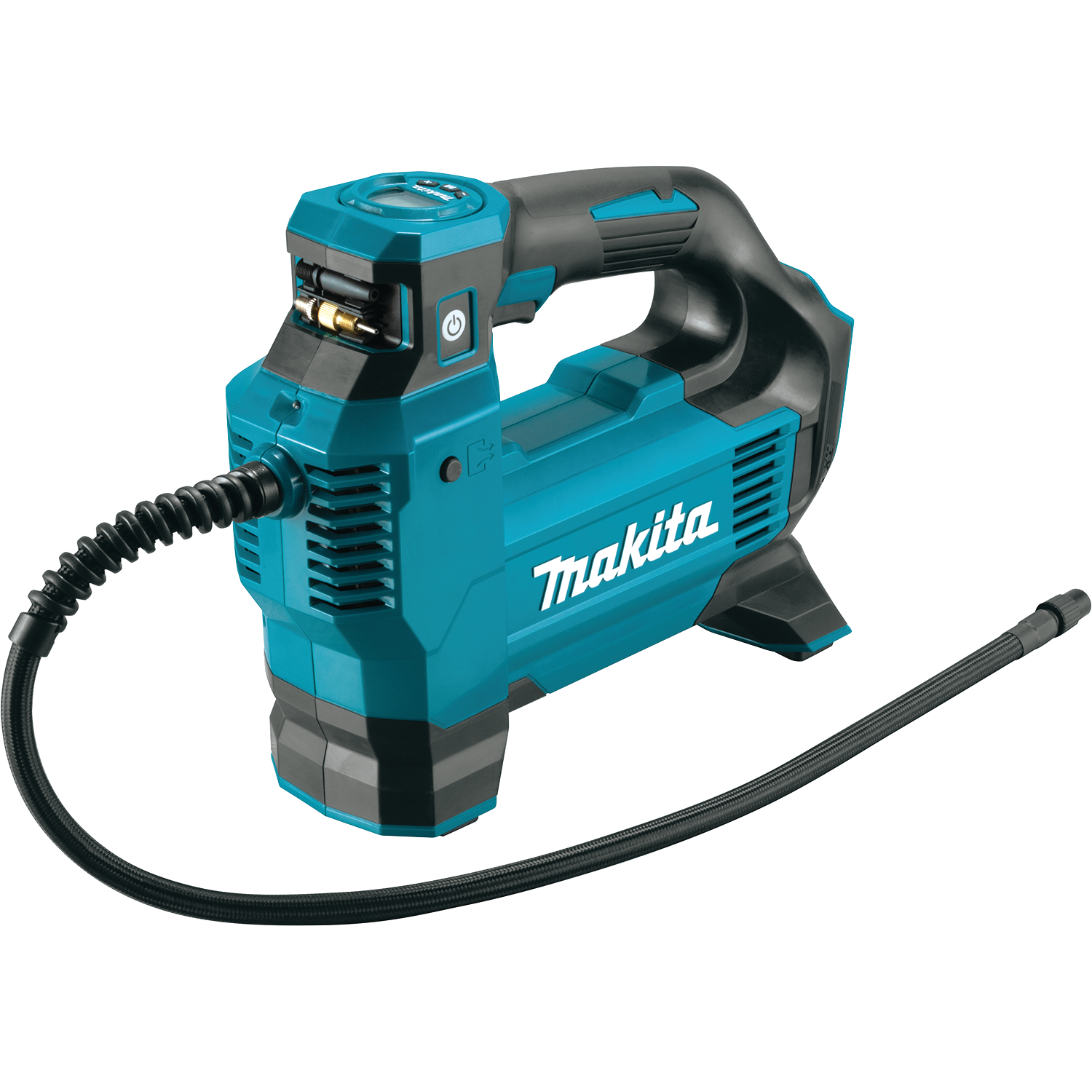
Explore this need in the finder →The Makita DMP181ZX is a tool-only 18V LXT high-pressure inflator, distinct from the lower-pressure DMP180 family. Makita’s US product page rates it to 160 PSI and lists car/light-truck and bicycle tires plus sports balls, with preset shutoff, three speeds, an air-release button and a 25½-inch hose. Its linked manual confirms the 1,100 kPa (160 PSI) maximum and a ten-minute-on/five-minute-off duty cycle. This is a source-based assessment of manufacturer material, not a hands-on test.
Do not confuse the ZX package with a kit
The exact DMP181ZX listing is tool only: the 18V LXT battery and charger are not included. Power comes from a compatible removable Makita slide-style battery pack, not an internal battery. Makita does not document a vehicle accessory-socket lead, direct battery clamps or a seven-way trailer connection for this configuration. It may be a logical match for a buyer already equipped with LXT batteries; a new platform buyer should add the compatible pack and charging equipment to the total system cost. The separately named DMP181SYX kit is not the same retail package, even though it shares the pump body.
The model has features that go beyond the DMP180ZX. Makita identifies three speeds and an air-release button for bleeding pressure after an overfill. The DMP181 page calls it a high-pressure unit and the manual gives a target-adjustment range of 5–160 PSI. Those additional settings and controls are not evidence of a specific tire-fill speed: no repeatable tire-size or fill-time test is provided.
Documented tire and accessory connections
For a Schrader valve, the manual tells the user to unfold the air-chuck clamp, attach the chuck to the stem and fold the clamp firmly. That is a press-on lever clamp, not a twist-on chuck. A Presta adapter is also listed; the manual describes loosening the valve locknut and connecting the adapter before securing the air chuck. Makita lists a sports-ball needle and tapered adapter with the tool-only configuration. The page describes vehicle tires, bicycle tires and sports balls. It does not specifically name motorcycle tires, so this assessment does not tag that use merely because the pump reaches a high pressure.
The manual divides settings into a ball mode adjustable from 5–16 PSI and low- and high-speed modes. It says the ball needle should be used in ball mode; a reading below 5 PSI is not a precise current-pressure measurement. A tire’s correct pressure comes from the vehicle, bicycle or tire maker, not the pump’s 160-PSI ceiling. Makita instructs the operator to use a reliable calibrated measuring device to verify tire pressure; no numerical accuracy tolerance for the built-in gauge is stated.
Automatic stopping with operator oversight
Makita says the DMP181 stops when the preset air pressure is reached. The manual’s high-pressure procedure sets a pressure target, starts inflation and describes completion when the progress indicator reaches the end; it also identifies the selected tire pressure and stop behavior. A separate air-release button is available if the tire is overinflated. These features can simplify a top-off, but they do not justify unattended use: the manual expressly warns never to leave the tool unattended with the hose attached, says to check pressure after inflation, and cautions that damaged tires can burst while being inflated.
The duty cycle is a specific numeric distinction from the DMP180. DMP181’s manual permits ten minutes of continuous operation before a five-minute cooling stop; after that, continue only within the manual’s instructions. The DMP180 manual calls for a shorter five-minute run followed by five minutes off. This makes DMP181’s published operating schedule longer, but it still does not establish how long any particular tire will take, or how many can be serviced per charge. The operator must also keep the pump, hose and chuck away from anything that obstructs cooling air and avoid touching hot parts immediately after use.
Who should consider this version
DMP181ZX is worth comparing when an existing Makita LXT owner wants a preset-stop pump with three selectable speeds, documented bicycle and vehicle-tire use, and the higher 160-PSI equipment ceiling. The trade-offs are a tool-only power package, a five-minute cooling interval after each ten minutes of continuous use, and the need for independent final pressure checks. The exact sources do not quantify the gauge tolerance, a supported tire-size range, fill time, battery endurance or a suitable target for any individual tire. Check the vehicle or bicycle maker’s cold-pressure specification, verify the included adapters and the ZX suffix, and choose a compatible battery before relying on the pump roadside.
Key specifications
Key details at a glance
| Automatic stop at target | Yes |
|---|---|
| Documented accessories | Presta valve adapter / sports-ball needle / tapered adapter |
| Operating power arrangement | Removable 18v lxt battery |
| Tire-chuck connection style | Press-on tire chuck |
| Published duty-cycle condition | The manual specifies ten minutes of continuous operation followed by five minutes off for cooling. |
Use the exact model’s instructions for operating limits, supplied equipment and version differences.
Sources for this review
Sources for this assessment

Match the inflator to your power and tire
Use the finder to check whether a reviewed model's documented power source, mode and accessories fit your requirements. It cannot prove an unlisted fit or predict actual fill time.