
Your needs, this model
Does it fit your priorities?
Does MP001GZ01 include its battery and charger, and will it run from a 12V vehicle outlet?
No. Makita's exact MP001GZ01 page identifies a tool-only 40V max XGT configuration and says the battery and charger are not included. Its manual names BL4025/BL4040 battery cartridges and the DC40RA charger as applicable. That removable XGT pack is not an internal inflator battery or a vehicle-socket lead; no 12V socket, clamp or trailer-7-way plan is documented.
Explore this need in the finder →What attachments and item types does Makita document for MP001GZ01?
The exact page documents car/light-truck tires, bicycles and sports balls, and lists a Presta adapter, sports-ball needle and tapered adapter. The manual gives a direct Schrader air-chuck procedure and a Presta procedure, but does not name a press-on or twist-on tire-head subtype. Its ball mode is required with the ball needle; verify the exact market package because the manual says standard adapters can vary by country.
Explore this need in the finder →Does the 160 PSI rating make MP001GZ01 suitable for any tire or ball pressure?
No. Makita's page and manual state a 160 PSI equipment maximum, while the manual's target range is 5–160 PSI and its ball mode is only 5–16 PSI. Below 5 PSI it warns that the ball gauge does not show a precise current value. The duty limit is ten minutes on/five minutes off. Follow the item's own pressure specification, stay with the inflator and verify with reliable calibrated equipment; Makita gives no gauge tolerance, tire-size envelope, measured fill time or battery yield.
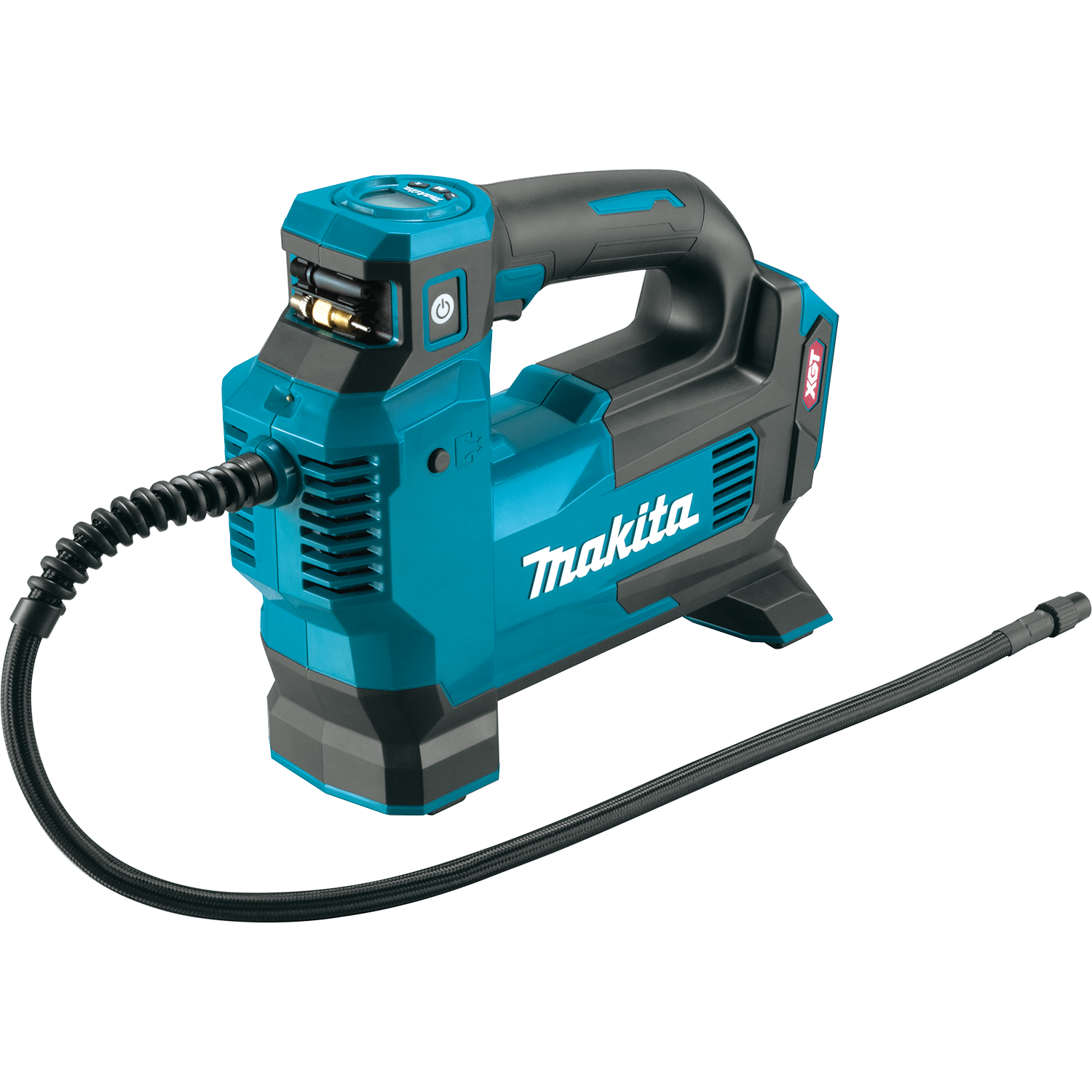
Explore this need in the finder →Makita’s MP001GZ01 is a 40V max XGT cordless high-pressure inflator in a tool-only package. It makes sense to assess it as one specific battery-platform pump, not as a generic “160 PSI compressor” or a self-contained emergency kit. The manufacturer’s US page lists car and light-truck tires, bicycles and sports balls, plus a selected-pressure stop and three speeds. That is a useful breadth of documented tasks, but neither the maximum rating nor the marketing description supplies a tire-size limit, fill-time guarantee or per-charge capacity.
Start with the XGT package boundary
The exact MP001GZ01 page says the battery and charger are not included. This is a removable XGT tool battery, not an inflator with a battery built inside and not a pump powered by a car’s 12V socket, battery clamps or a trailer’s auxiliary circuit. The MP001G manual names BL4025 and BL4040 cartridges and the DC40RA charger among the applicable power equipment, while cautioning that regional availability can vary. Check the exact offer and the current manual before assuming an existing XGT pack or charger is suitable.
Makita lists the bare tool at 4.9 pounds and 12⅝ × 4¼ × 9⅛ inches; its page gives 6.4 pounds with a separately sold battery. It is therefore a portable power-tool-sized device rather than a tiny glovebox pump. The page’s 40V max label describes the battery platform; the manual lists a 36V rated voltage. The page identifies a brushed motor. These details describe the specific body, not run time or how many tires a charge will handle.
Pressure control is useful, but bounded
The manufacturer rates the pump to 160 PSI, and the manual’s target setting range runs from 5 to 160 PSI. That is the unit’s equipment ceiling—not a recommended pressure for a vehicle, bicycle or ball. Set the pressure for the object’s manufacturer, not to the pump’s maximum. Makita describes a preset stop, a pressure-release button and three speed settings. The manual separates ball mode from the low- and high-speed modes; with the ball needle attached it requires ball mode, whose stated range is 5–16 PSI. Below 5 PSI, it warns that the displayed ball pressure is not precise.
The manual’s duty limit is ten minutes of continuous operation followed by five minutes off for cooling. That boundary is more useful for planning than a headline maximum, particularly if several tires need attention. The manufacturer does not publish a controlled fill-time comparison, a tire-size envelope, battery yield, airflow figure or numeric gauge tolerance in the sources reviewed here. Its description of a high-volume pump is not a rated airflow measurement, and the manual specifically warns against inflating large-capacity objects. The stated small floating-tube use is not evidence that it is suitable for air mattresses or other high-volume inflatables.
Attachments and operating plan
The exact product page lists a Presta adapter, a sports-ball needle and a tapered adapter. The manual also shows the standard Schrader-valve procedure. It notes that standard adapters may vary by country, so check the exact kit rather than assuming every retail bundle contains the same pieces. For a tire, the manual directs the operator to attach the air chuck to the valve, set the object’s appropriate target and hold the trigger until the tool stops. For a ball, it calls for the dedicated ball mode and the ball maker’s pressure. The automatic stop does not make the inflator safe to leave unattended: the manual says to stay with it and verify the result with reliable calibrated measuring equipment. It gives no numeric accuracy tolerance. The reviewed manual identifies an air chuck, but does not classify its tire-end connection as press-on or twist-on, so this assessment leaves that subtype unconfirmed.
Who this assessment fits—and what to verify
MP001GZ01 is a plausible candidate for an XGT owner who wants one portable high-pressure tool with documented car/light-truck, bicycle and sports-ball uses, a preset stop and the listed attachments. It is less compelling if the buyer expects a battery in the box, vehicle-socket power, a specific chuck mechanism, a published fill time or a single charge to cover a particular set of tires. Makita’s broad usage categories do not confirm fit for every tire, valve or pressure target.
Before purchase, confirm the full MP001GZ01 tool-only suffix, the battery and charger requirements, the supplied adapters and the exact manual for the intended market. Check the vehicle or item maker’s pressure specification, inspect the tire for damage, observe the ten-on/five-off cooling schedule, remain present while connected, and use a separate reliable gauge for the final check. This is a source-based assessment of the published configuration; it is not a hands-on test.
Key specifications
Key details at a glance
| Product-page maximum-pressure claim | 160 PSI |
|---|---|
| Automatic stop at target | Yes |
| Documented accessories | Presta valve adapter / sports-ball needle / tapered adapter |
| Operating power arrangement | Removable 40v xgt battery |
| Published duty-cycle condition | The MP001G manual specifies ten minutes on followed by five minutes off for cooling. |
| Pressure gauge scale | 160 PSI |
Use the exact model’s instructions for operating limits, supplied equipment and version differences.
Sources for this review
Sources for this assessment

Match the inflator to your power and tire
Use the finder to check whether a reviewed model's documented power source, mode and accessories fit your requirements. It cannot prove an unlisted fit or predict actual fill time.