
Your needs, this model
Does it fit your priorities?
What power equipment does the MP100DWRX1 package list?
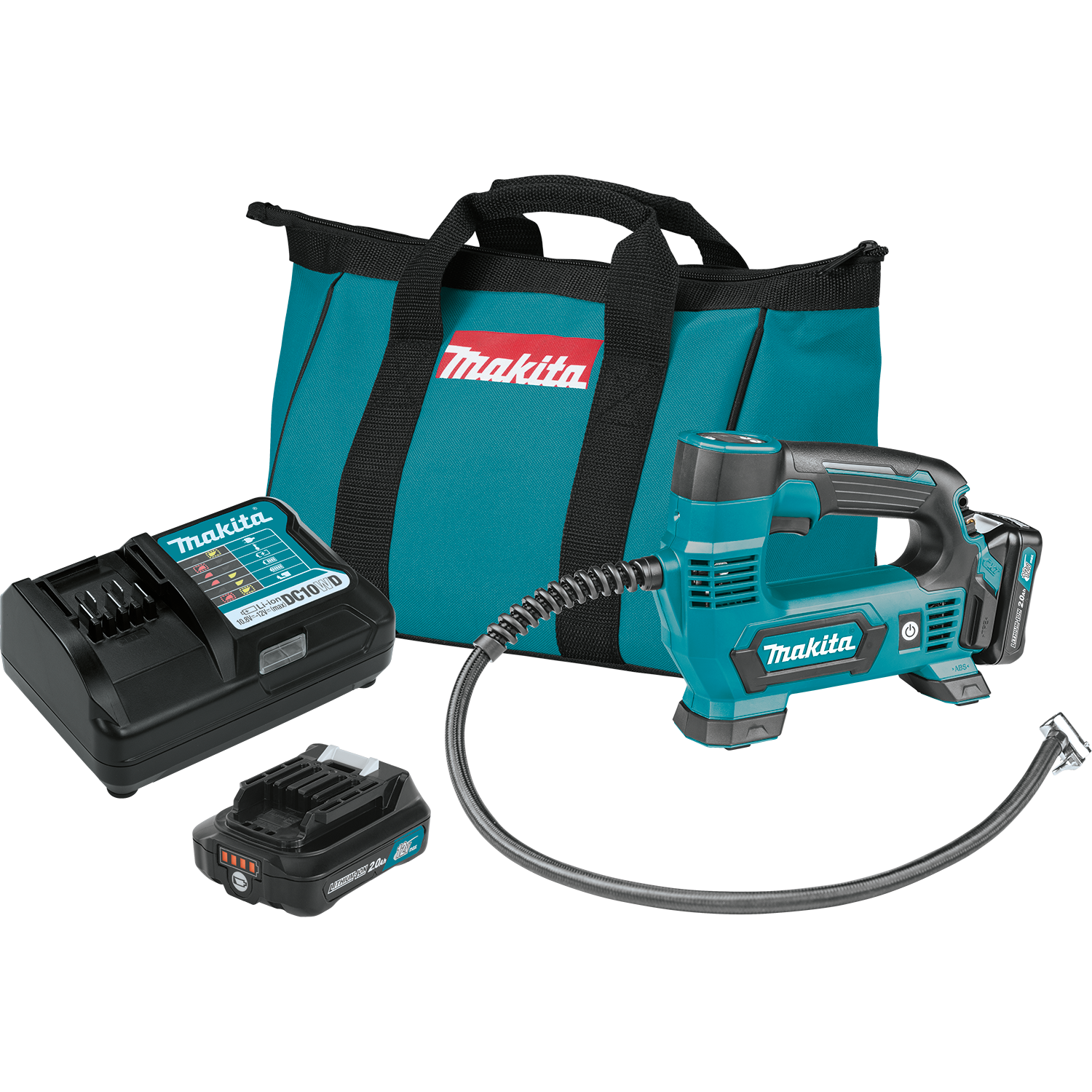
Makita's exact written kit list names two 12V max CXT 2.0Ah BL1021B batteries and a DC10WD charger, plus a tool bag. The image depicts one pack, so check the exact seller offer rather than deriving quantity from the picture. The packs are removable, not internal to the inflator.
Explore this need in the finder →Is the MP100DWRX1 a vehicle-socket inflator?
No 12V vehicle-accessory power path is documented. MP100DWRX1 is the removable-battery version of Makita's 12V max CXT inflator; its kit lists battery packs and a charger, not an accessory-socket cord. A 12V max CXT pack is a tool-platform battery, not an internal battery or a vehicle outlet.
Explore this need in the finder →Which MP100DWRX1 attachments and operating boundaries matter for bicycle and ball use?
The kit page lists a Presta adapter, sports-ball needle and tapered adapter. The manual provides the Presta and ball-needle procedures, selectable pressure from 3 to 121 PSI, and a five-minute-on/five-minute-off cooling schedule. It gives no bicycle pressure range or numeric gauge tolerance; use the relevant tire or ball maker's target and verify final pressure reliably.
Explore this need in the finder →The useful distinction with MP100DWRX1 is the kit, not a different pump mode. Makita’s exact US page calls it a 12V max CXT Inflator Kit (2.0Ah) and lists the same MP100DZ inflator body used in the tool-only package. Its written included list names two 2.0Ah BL1021B batteries, a DC10WD charger, a tool bag and the same Presta, sports-ball and tapered adapters. The product image depicts one battery pack; because a picture need not show every included item, the package count should be confirmed from the exact offer rather than inferred from the illustration. The separate tool-only MP100DZ page says battery and charger are not included.
The kit’s value is the ready-to-charge CXT package
MP100DWRX1 suits a buyer who wants the pump plus power equipment in one Makita package, especially if the existing CXT battery drawer is empty. It is not a sealed, internally rechargeable inflator. The packs detach from the tool and the kit belongs to Makita’s 12V max CXT slide-battery family. Makita says this inflator is incompatible with 12V max pod-style tools, batteries and chargers, so an old battery that happens to say “12V” is not enough to establish fit. Nor does the 12V max label mean that the pump plugs into a vehicle’s 12V accessory outlet; the reviewed manual specifies battery operation, not socket power.
According to the exact MP100DWRX1 product listing, the kit contains two BL1021B 2.0Ah batteries, the DC10WD charger and a tool bag. The Makita page also lists a 70-minute charging time, but that figure is not a per-tire runtime or an inflation benchmark. The manual lists BL1016, BL1021B and BL1041B as compatible battery cartridges and several compatible charger models; the exact kit page, rather than the shared manual’s compatibility table, establishes this package’s DC10WD. No source gives an estimated number of tires per charge, so two included packs cannot be translated into a guaranteed number of top-offs.
One shared MP100D pump body
The documented use categories are passenger-car/light-truck tires, bicycle tires and sports balls. The kit does not gain higher pressure, different cooling limits or an added vehicle power cable over MP100DZ. Makita’s manual is for the MP100D body. It describes a clamp-folding Schrader connection, a separate Presta adapter procedure, and use of the sports-ball needle or tapered adapter for small items. The page lists all three attachments in the package. For a bicycle, confirm the included Presta adapter is in the exact seller box and follow the valve maker’s instructions; the sources give no bicycle pressure range or wheel-specific clearance statement.
The ball needle is a documented accessory, but that alone does not prove the right pressure for a ball. Use the ball maker’s limit and do not overinflate. For a tire, the page says the preset-stop function ends inflation at the selected target; the manual directs the user to remain present and to check the final reading with a reliable calibrated measuring device. Auto-stop does not remove the need to supervise a connected pump or verify the result.
Read the numbers as limits, not as promises
The exact kit page lists 120 PSI maximum, while the MP100D manual lists 830 kPa (121 PSI) maximum and a target-setting range of 20 kPa (3 PSI) through 830 kPa (121 PSI). The sources therefore differ by one PSI at the top; this assessment keeps both numbers and does not choose an averaged rating. The ceiling is not a tire recommendation. Follow the cold-pressure value specified for the vehicle, tire or ball. The manual’s 3-PSI floor also means that the displayed preset range does not make every low-pressure object suitable for this pump.
The manual states five minutes of continuous operation followed by five minutes off to cool. It also warns that the gauge reading is inaccurate with its English-valve-adapter procedure, so that indication cannot stand in for a reliable pressure check. No numeric gauge tolerance, independent fill-time test, maximum tire size, airflow figure or battery-run yield appears in the reviewed sources. For hose reach, the kit page’s features text says 25-1/2 inches while its specification table says 25 inches; those inconsistent page values remain unresolved instead of being quietly converted into a single clearance claim.
When the kit is the better comparison
Compare this package with MP100DZ only after deciding whether the two written-list battery packs, charger and bag are useful to you. If a compatible CXT charger and batteries are already owned, the tool-only SKU may avoid redundant equipment. If they are not, the kit lists the initial power hardware; it still does not show whether a specific retailer’s offer matches Makita’s current bundle. Check that the seller identifies the exact MP100DWRX1 suffix, verifies the battery count and charger model, and includes the listed attachments. The page does not substantiate an exact sale price, stock status or a universal CXT warranty in a particular offer.
This is a source-based comparison, not a hands-on test. The practical case for MP100DWRX1 is its stated package completeness and the manufacturer-documented tire and small-item routes. The practical cautions are equally specific: removable CXT power, not a vehicle-socket lead; a five-on/five-off operating schedule; a 120/121-PSI page/manual discrepancy; and no published accuracy, tire-size, fill-time or battery-yield figure. Confirm the correct target and exact package before use.
Key specifications
Key details at a glance
| Product-page maximum-pressure claim | 120 PSI |
|---|---|
| Automatic stop at target | Yes |
| Documented accessories | (2) 12V max CXT 2.0Ah BL1021B batteries / DC10WD charger / tool bag / Presta valve adapter / sports-ball needle / tapered adapter |
| Operating power arrangement | Removable 12V max CXT slide battery |
| Tire-chuck connection style | Press-on tire chuck |
| Manufacturer pressure-rating conflict | Yes |
| Conflicting maximum-working-pressure claims | Makita's MP100DWRX1 page advertises 120 PSI while its shared MP100D manual specifies 830 kPa (121 PSI) maximum and a 3–121 PSI selected-target range. Preserve both source values; neither is a tire target. |
| Published duty-cycle condition | The MP100D manual specifies five minutes on followed by five minutes off for cooling. |
| Pressure gauge scale | 121 PSI |
Use the exact model’s instructions for operating limits, supplied equipment and version differences.
Sources for this review
Sources for this assessment

Match the inflator to your power and tire
Use the finder to check whether a reviewed model's documented power source, mode and accessories fit your requirements. It cannot prove an unlisted fit or predict actual fill time.