
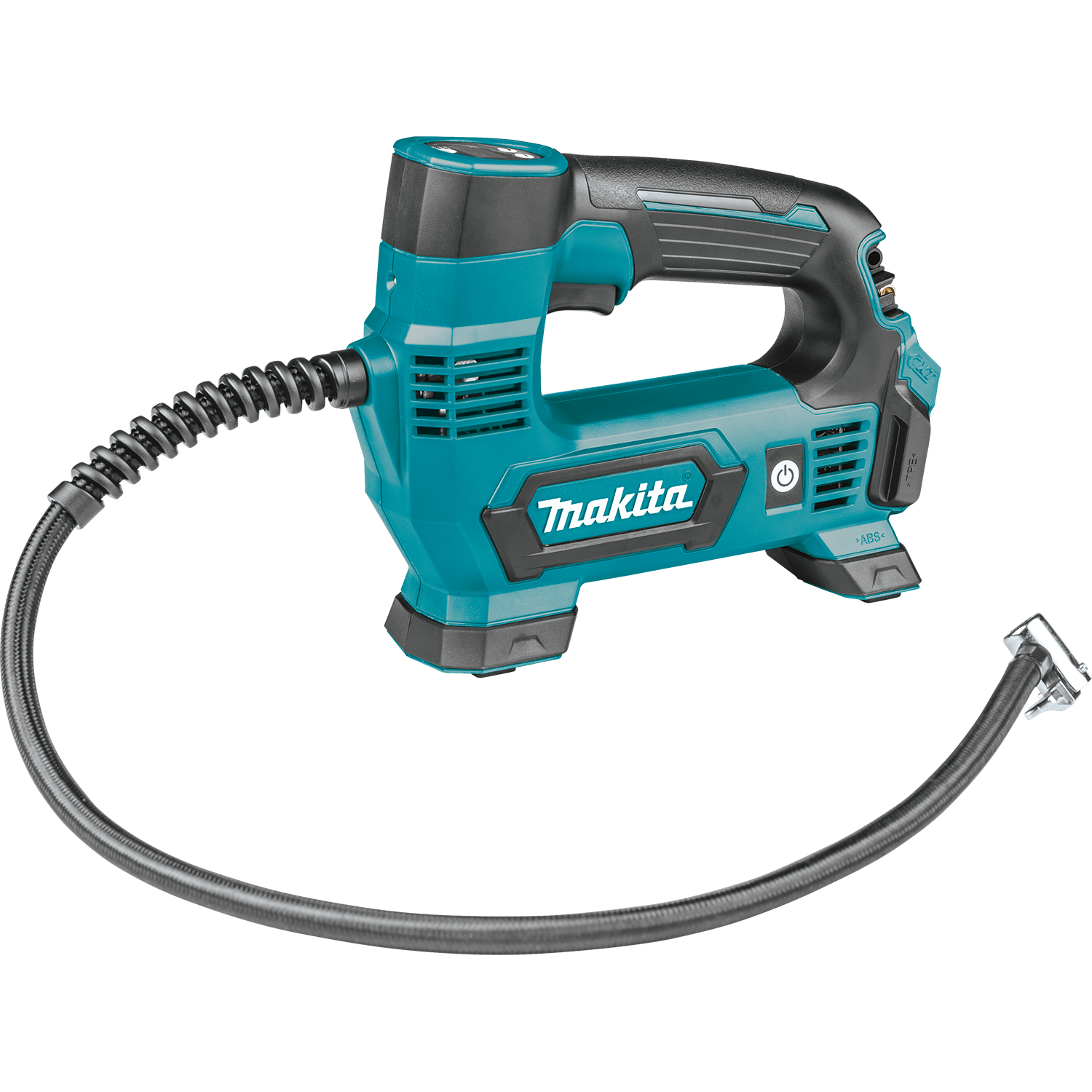
Your needs, this model
Does it fit your priorities?
Does the MP100DZ tool-only package include a battery or charger?
No. Makita's exact MP100DZ page says tool only and explicitly says battery and charger are not included. The inflator uses a removable 12V max CXT slide battery, not a built-in rechargeable cell; verify the exact CXT pack and charger needed for the offer.
Explore this need in the finder →Can MP100DZ run from a 12V vehicle socket?
No vehicle-accessory socket route is documented. The exact page places MP100DZ on Makita's 12V max CXT battery platform, and the manual shows a removable battery cartridge. A 12V max tool battery is not the same connection as a 12V vehicle accessory socket.
Explore this need in the finder →Which tire and small-item tasks and pressure controls are documented for MP100DZ?
Makita lists car/light-truck tires, bicycles and sports balls, with a Presta adapter, sports-ball needle and tapered adapter. The product page claims a 120 PSI ceiling; the manual specifies 121 PSI maximum and 3–121 PSI selectable targets, plus five minutes on/five minutes off. Use the item's proper target, stay present and verify pressure with reliable calibrated equipment.
Explore this need in the finder →The MP100DZ is the CXT-platform version to assess when the exact offer is the tool-only package. Makita identifies it as a 12V max cordless inflator and explicitly says its battery and charger are not included. That package distinction is more consequential than the pump body’s shared features: a buyer who already has a compatible 12V max CXT slide battery may be able to use the bare tool as listed, while someone expecting a sealed rechargeable pump or a vehicle-accessory plug would be looking at the wrong power arrangement.
Choose it for the CXT battery platform, not a 12V socket
The exact Makita USA MP100DZ page places the inflator in the 12V max CXT family and says the tool-only package omits both battery and charger. It describes the compatible pack as a slide-style CXT lithium-ion battery and warns that the inflator is not compatible with Makita’s 12V max pod-style tools, batteries or chargers. That is a removable tool battery, not a battery built into the pump. It is also not a 12V vehicle accessory-socket lead, a clamp-powered compressor or a seven-way trailer connection. The finder deliberately does not treat a removable CXT pack as one of those other power routes.
For an owner who already has the right CXT battery, the bare package can avoid buying another set of power equipment. For anyone starting from zero, compare the cost and exact battery/charger requirements of the whole setup before treating the tool-only suffix as the smaller purchase. The product page names compatible 2.0Ah and 4.0Ah packs sold separately, but it gives no number of tires per charge, runtime or battery-yield test. A higher amp-hour number is not a manufacturer fill-count guarantee.
Three documented inflation tasks, with different attachment steps
Makita identifies passenger-car and light-truck tires, bicycle tires and sports balls as intended tasks. The exact package lists a Presta valve adapter, sports-ball needle and tapered adapter. Those are separate connections, not interchangeable promises. The shared MP100D instruction manual shows the air-chuck clamp being folded onto a Schrader stem, and gives a distinct procedure for the included Presta adapter. That makes this a useful adapter set to check if a bicycle valve is part of the routine; it does not establish a road-bike pressure range or precision suitable for every tire.
For balls, the manual assigns the sports-ball needle to small sports items and cautions against inflating objects beyond their own pressure limits. The page’s support for a sports ball is a documented task, not a claim that the display is accurate for every small ball or that the tool includes a ball-specific pressure mode. The tapered adapter serves a different low-volume inflatable task. Do not force an attachment or use it for an application the manual does not identify.
Pressure setting and cooling boundaries
Makita’s product page advertises up to 120 PSI; the manual specifies 830 kPa, or 121 PSI, as the maximum and allows a selected target from 20 kPa (3 PSI) to 830 kPa (121 PSI). The one-PSI difference is preserved rather than averaged. Neither figure is the correct setting for a vehicle tire. Use the vehicle or item maker’s prescribed pressure. The page describes an automatic stop at the chosen target, and the manual’s tire procedure says to set an appropriate pressure and keep the trigger pulled until the tool stops. That is a convenience feature, not permission to leave a connected inflator unattended.
The manual specifies five minutes on followed by five minutes off for cooling. That is a real operating boundary for repeated top-offs; it is not a predicted fill time. The manual also says to verify inflated pressure with reliable calibrated measuring equipment. In its English-valve-adapter procedure, it specifically warns that the gauge will not display an accurate value because of the valve’s characteristics and directs users to judge the tire rather than use that reading. No numeric gauge tolerance, tire-size envelope, measured fill time, airflow rate or battery yield is published for this assessment.
What remains unknown on the exact tool-only page
The product page promotes a 25-1/2-inch hose, but that is not a reach measurement for a complete vehicle setup and it does not resolve how the hose routes around a wheel. Makita’s kit-page specification later prints a different whole-inch value for the closely related CXT package; the two figures are not silently treated as one measurement here. The sources also do not establish the pressure gauge’s numeric accuracy, a safe tire-size cutoff, a full-to-flat workload or a repeatable inflation time. Nothing in this review is a hands-on test; the comparisons are based on the exact listing, its linked manual and the specific tool-only configuration.
In short, MP100DZ is a documented car/bicycle/ball inflator for someone prepared to supply a compatible CXT battery and charger, with a 5/5 duty interval and a manual-mandated pressure check. Confirm the exact suffix and package before ordering: the reviewed MP100DZ listing is not the two-battery MP100DWRX1 kit, and neither product page proves the contents of an unrelated seller bundle.
Key specifications
Key details at a glance
| Product-page maximum-pressure claim | 120 PSI |
|---|---|
| Automatic stop at target | Yes |
| Documented accessories | Presta valve adapter / sports-ball needle / tapered adapter |
| Operating power arrangement | Removable 12V max CXT slide battery |
| Tire-chuck connection style | Press-on tire chuck |
| Manufacturer pressure-rating conflict | Yes |
| Conflicting maximum-working-pressure claims | Makita's MP100DZ page advertises 120 PSI while its shared MP100D manual specifies 830 kPa (121 PSI) maximum and a 3–121 PSI selected-target range. Preserve both source values; neither is a tire target. |
| Published duty-cycle condition | The MP100D manual specifies five minutes on followed by five minutes off for cooling. |
| Pressure gauge scale | 121 PSI |
Use the exact model’s instructions for operating limits, supplied equipment and version differences.
Sources for this review
Sources for this assessment

Match the inflator to your power and tire
Use the finder to check whether a reviewed model's documented power source, mode and accessories fit your requirements. It cannot prove an unlisted fit or predict actual fill time.