
Your needs, this model
Does it fit your priorities?
Does the 2475-20 have a rechargeable battery inside the inflator?
No. Milwaukee's manual describes a removable M12 battery pack. The 2475-20 is tool-only, so its battery and charger are separate; it should not be classified as an inflator with an internal battery.
Explore this need in the finder →Can the 2475-20 use preset stopping for sports-ball inflation?
Do not assume so. The manual says setting a target is not recommended with accessory nozzles. The included ball needle documents sports-equipment use, but the recommended ball plan is manual control using the item's pressure instructions.
Explore this need in the finder →Can the 2475-20 automatically stop below 10 PSI?
The manual lists 10 PSI as the minimum setting for automatic stopping. That does not establish a target stop below 10 PSI; check the item's own pressure instructions and use the prescribed manual control if the target is below that floor.
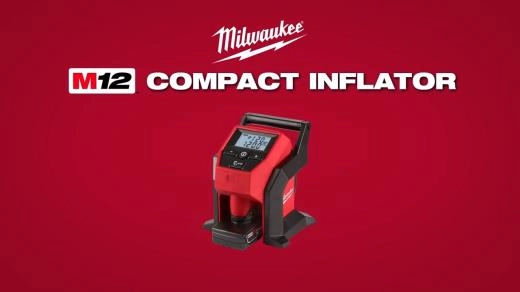
Explore this need in the finder →This is a source-based review of Milwaukee’s M12 Compact Inflator, model 2475-20, in the tool-only configuration. The official product page and the model-specific operator manual describe a compact high-pressure inflator, but this is not a hands-on test: no fill-time measurements, noise observations, durability trial or battery-runtime test were performed for this review.
Tool-only means a removable battery, not a battery inside the inflator
The 2475-20 takes a removable Milwaukee M12 battery pack. That is different from an inflator with a built-in rechargeable battery, and the tool-only package does not include a battery or charger. It is most straightforward for someone who already has a suitable M12 pack and charger. A buyer starting from scratch should compare the full cost and contents of the separate 2475-21XC kit rather than assuming that “cordless” means ready to use out of the box.
Milwaukee lists the pump and four attachments: a Schrader chuck, a Presta attachment, a sports-ball needle and an inflator nozzle. The manual’s vehicle-tire directions say to screw the Schrader chuck onto the tire valve and make the connection secure. Its Presta directions describe loosening the valve-stem locknut before inflation and tightening it afterward. Those are distinct setups. For a bicycle with a Presta stem, check the valve procedure and thread connection before starting; for a car tire, the manual identifies the Schrader route.
Preset stopping is a tire-mode feature with a 10 PSI floor
The manual describes a digital actual-pressure reading and target-pressure setting. Once inflation starts, the pump stops when it reaches the selected target. The target-stop feature has a minimum setting of 10 PSI, so the manual does not establish automatic stopping below that point. That distinction matters for very low-pressure items or a completely flat tire: do not assume that every number shown on the screen is a valid shutoff target.
Milwaukee specifically says that setting a target is not recommended when using the accessory nozzles. The included ball needle and tapered inflator nozzle therefore should not be presented as a preset-stop sports-ball arrangement. Use the appropriate sports-equipment pressure instructions and remain with the pump. In fact, the manual explicitly warns not to leave the inflator unattended during operation. The automatic stop is useful for the tire plan documented here, not permission to walk away.
Pressure and duty figures need to be read together
The operator manual lists 120 PSI maximum pressure, output of 0.88 CFM at 0 PSI and 0.63 CFM at 35 PSI, and an operating-temperature range of 0–125°F. It also says to let the inflator cool for 10 minutes after each 10 minutes of continuous use. Those figures identify a short-run tool; they are not a published result for filling a particular tire from flat. The 26-inch hose listed by Milwaukee is another practical constraint to check against where the valve sits and where the tool can rest.
The product page advertises a car top-off in under one minute for a stated pressure range and a light-truck example under four minutes. These are Milwaukee’s claims, not timings from this review. The source does not give a full independent test protocol with matching tire volume, starting pressure, ambient conditions and battery state, so those examples should not be treated as a universal promise. A matching number on a display also does not substitute for the vehicle placard or owner’s manual when choosing the target pressure.
Where it fits—and where the documentation draws a line
Milwaukee’s manual lists car and truck tires, bicycle tires, lawn-equipment tires, sports equipment, air mattresses, beach toys and other inflatables. It also expressly excludes filling air tanks or shocks, breathing-device use and spraying chemicals. Its output limit is 120 PSI; the tire or item maker’s marked limit and inflation instructions still control.
The M12 package is attractive on paper when portability, a removable battery already in the buyer’s system, and a preset stop for ordinary tire pressure maintenance matter more than a long duty window. The manual’s 10-minute run/10-minute cooling instruction and the short hose should be considered for repeated jobs. The product page and manual do not provide a complete from-flat capacity table or a tire-size-specific comparison test, so do not infer suitability for every large truck, RV or high-volume job from the maximum-pressure figure alone.
Bottom line
Consider the 2475-20 if you already have a compatible M12 pack and need a compact, source-documented tire inflator with Schrader and Presta routes and a target stop for tire inflation. Its clearest limitations are the bare-tool package, 120 PSI ceiling, 10-minute continuous-use interval, 10 PSI minimum auto-stop setting and the manufacturer’s caution against target setting with accessory nozzles. Compare the kit separately if you need a battery and charger; verify your valve, target and work pattern against the manual before buying.
Key specifications
Key details at a glance
| Product-page maximum-pressure claim | 120 PSI |
|---|---|
| Automatic stop at target | Yes |
| Documented accessories | Schrader chuck / Presta attachment / Sports-ball needle / Inflator nozzle |
| Operating power arrangement | Milwaukee m12 removable battery |
| Maximum working pressure | 120 PSI |
| Tire-chuck connection style | Twist-on tire chuck |
| Published duty-cycle condition | The operator manual says to allow 10 minutes of cooling after every 10 minutes of continuous use. No comparable tire-size fill-time or tires-per-charge benchmark was established. |
| Pressure gauge scale | 120 PSI |
Use the exact model’s instructions for operating limits, supplied equipment and version differences.
Sources for this review
Sources for this assessment
Match the inflator to your power and tire
Use the finder to check whether a reviewed model's documented power source, mode and accessories fit your requirements. It cannot prove an unlisted fit or predict actual fill time.