
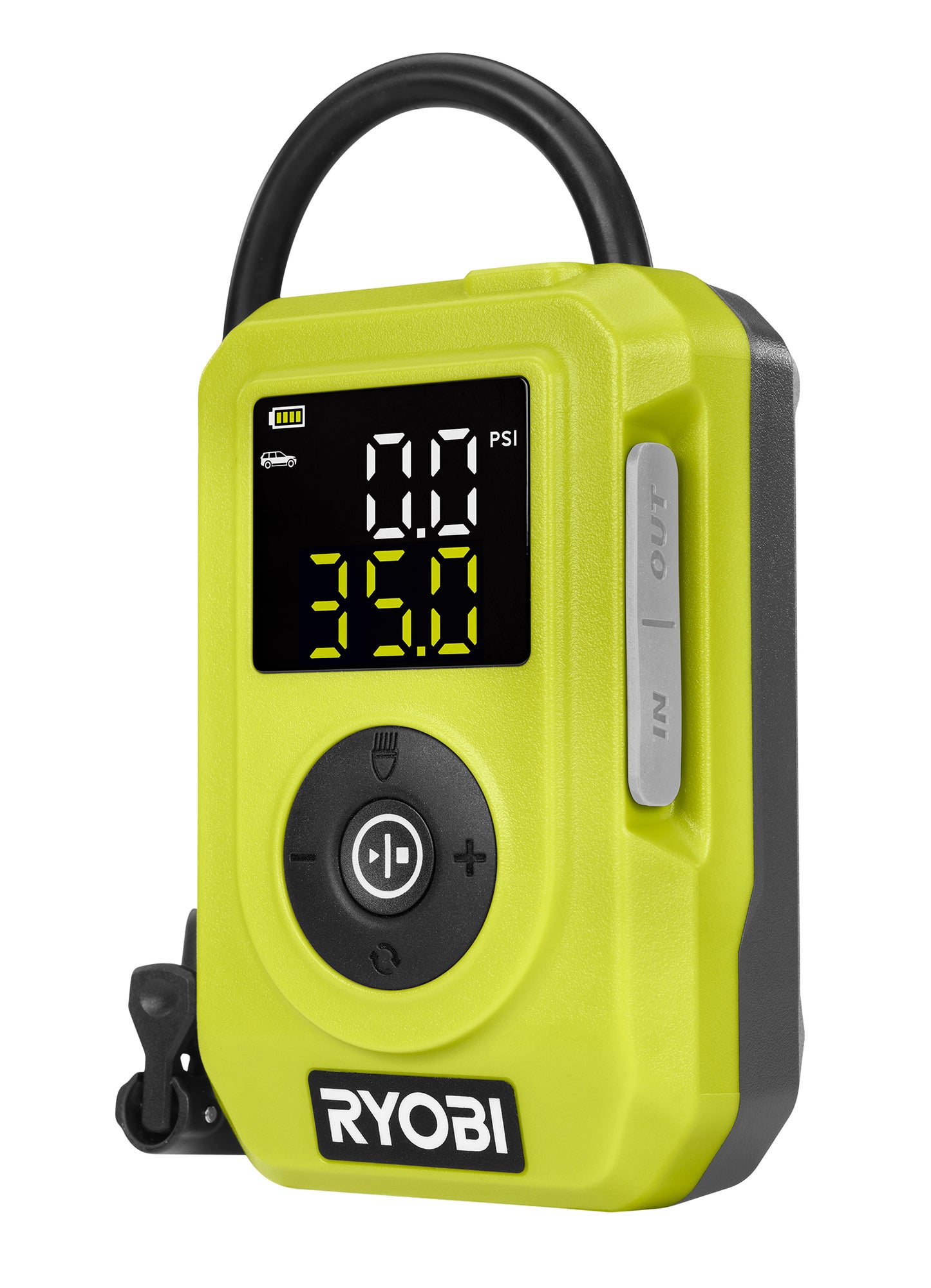
Your needs, this model
Does it fit your priorities?
Does the FVIF01K include the battery it needs to inflate?
The exact RYOBI product details identify an 8V internal battery, unlike the FVIF51 configurations built around a separate USB Lithium pack. The product page also lists a USB-C charging cable. It does not confirm that inflation works while charging, and the exact manual has not been reviewed; check its instructions before planning a charging/pumping setup.
Explore this need in the finder →Will the FVIF01K stop at a selected pressure?
RYOBI's product page describes hands-free operation with precise automatic shutoff and lists preset modes. This is a product-page feature claim; the exact FVIF01K operator manual and its operating/supervision directions were not obtained. Use the vehicle or equipment maker's target and do not assume that an auto-stop feature authorizes leaving inflation unattended.
Explore this need in the finder →Does the FVIF01K package list a Presta adapter and a ball needle?
Yes. The exact manufacturer product page lists both a Presta valve adaptor and a sports needle, and it separately identifies bicycle and sports-ball modes. It does not name the base tire-head type, give a bicycle/ball pressure range, or establish gauge accuracy; verify the exact seller package and the supplied instructions.
Explore this need in the finder →Can I plan on eight full tire fills or a universal 90-second fill?
No. RYOBI's page says up to eight tire top-offs per charge and under 90 seconds for a car-tire top-off, but it does not identify the tire size, starting/ending pressure or complete procedure there. Those are maker claims, not this site's independent measurements or a promise for a larger or flatter tire.
Explore this need in the finder →The RYOBI FVIF01K takes a different route from the brand’s tool-platform inflators: its product detail identifies an 8V battery inside the unit, rather than a removable USB Lithium or 18V ONE+ pack. RYOBI lists a digital pressure display, preset modes for car, bicycle, motorcycle and sports-ball use, and automatic shutoff at the selected pressure. Its package list names a USB-C charging cable, sports needle, pinch-valve adaptor and Presta adaptor. That makes the central choice fairly clear: a self-contained compact unit with several use modes, versus a larger platform inflator whose battery may already be part of a buyer’s tool collection.
Start with the exact power arrangement
The manufacturer’s product-detail data calls out an 8V internal battery. That is a meaningful difference from RYOBI’s FVIF51B/FVIF51K and FVIF52K, which use separately removable USB Lithium packs, and from the PCL inflators built around 18V ONE+ batteries. A built-in pack means there is no separate battery SKU to attach to the FVIF01K assessment, but the public page does not state battery capacity, charging time, or whether the pump can inflate while it is connected to USB-C power. “Rechargeable” should not be stretched into an unsupported run-while-charging claim.
RYOBI describes dual USB-C ports as serving the inflator and mobile devices. The exact page does not publish the port ratings or charging arrangement in enough detail to establish a particular phone-charging output, fast-charge standard, or inflator operating mode during charging. Treat the cable and ports as a useful travel feature, not a substitute for those missing electrical specifications.
Four named use modes do not set four target pressures
The FVIF01K’s product page expressly lists car tires, bicycle tires, motorcycle tires and sports balls. That is broader published use language than the bicycle-and-ball-specific FVIF51 body. The page also claims automatic shutoff at the selected pressure and shows a digital display. Those features can help reduce the need to hold a button while air is flowing, but they do not choose the right target. Use the pressure specified by the vehicle, tire, rim or ball maker, and keep the task supervised until the exact operator instructions have been checked.
The page’s 150 PSI figure is a maximum-pressure claim, not a recommended value for a car tire, motorcycle, bike component or ball. RYOBI does not give a separate operating pressure range for any of the four listed modes, a gauge tolerance, or a tire-size envelope on the reviewed page. Without those details, a high number on a product specification should not be read as evidence that every item will be filled accurately or appropriately.
Its named attachments answer some valve questions, not all
The FVIF01K package list includes a Presta valve adaptor and a sports needle, so the manufacturer identifies specific equipment for bicycle and ball tasks. It also lists a pinch-valve adaptor, which is distinct from the tire-valve options in this site’s finder. However, the product page does not name the base tire head as Schrader, press-on or twist-on. A car or motorcycle preset tells the buyer that the manufacturer identifies those kinds of tires; it does not by itself resolve the connection style. Check the exact manual and the actual seller package before assuming that an adapter or head shown elsewhere in the product family is included here.
Read the fill-time and battery figures as claims with open conditions
RYOBI says the unit can top off a car tire in under 90 seconds and up to eight tire top-offs on a charge. The exact product page does not state the tire size, starting pressure, target pressure, or full procedure behind those claims. They therefore do not predict how long a larger, lower tire will take, and they are not independent measurements by this site. Likewise, the 150 PSI maximum does not establish a useful tire-volume rating or a number of complete fills.
The compact, glove-box-and-backpack positioning and onboard light point toward carrying the unit for occasional top-offs, rather than treating it as a documented high-volume or long-duty-cycle compressor. The exact hose reach, maximum continuous run, required cooling interval, gauge accuracy and permissible unattended operation remain unknown in the material reviewed here. The product page says the retail package includes an operator’s manual, but the captured RYOBI support landing only offered a generic model-number lookup; the FVIF01K-specific manual was not obtained. Read the manual supplied with the exact unit before use and do not infer a duty cycle from the product-page claims.
Who should compare it with platform inflators?
The FVIF01K is worth considering when an integrated rechargeable battery and the manufacturer-listed car/bike/motorcycle/ball modes matter more than sharing a battery with existing tools. A buyer already equipped with USB Lithium batteries may prefer to compare the FVIF51 or FVIF52 configurations, but those have removable packs and distinct package contents; they are not the FVIF01K. The FVIF51 manual supports manual pressure control for that earlier pump body, while the FVIF52K page identifies its own selected-pressure-stop feature. Do not transfer their accessories, duty limits, or operating directions to FVIF01K.
The tradeoff is the depth of documentation. RYOBI’s page presents a versatile compact feature set but leaves important practical checks—base head type, exact hose reach, use-specific pressures, gauge accuracy, charge conditions and duty-cycle instructions—open until the exact manual is read. The product page’s auto-stop and convenience claims are a useful starting point, not proof of compatibility with a particular tire or permission to leave a running inflator unattended. This is an assessment of published product information, not a hands-on test or ownership report.
Key specifications
Key details at a glance
| Product-page maximum-pressure claim | 150 PSI |
|---|---|
| Automatic stop at target | Yes |
| Documented accessories | FVIF01 internal-battery inflator body (FVIF01K retail configuration) / Sports needle / Pinch valve adaptor / Presta valve adaptor / USB-C charging cable / Operator's manual (listed in the product-page package contents; exact manual not obtained) |
| Operating power arrangement | Internal rechargeable battery |
| Maximum working pressure | 150 PSI |
Use the exact model’s instructions for operating limits, supplied equipment and version differences.
Sources for this review
Sources for this assessment

Match the inflator to your power and tire
Use the finder to check whether a reviewed model's documented power source, mode and accessories fit your requirements. It cannot prove an unlisted fit or predict actual fill time.