
Your needs, this model
Does it fit your priorities?
Does the FVIF51B kit include a rechargeable battery?
No. RYOBI labels FVIF51B as tool-only and says the USB Lithium battery is sold separately. The FVIF51K is the related kit configuration, so verify the SKU and included pack before ordering; this review does not treat the removable USB Lithium pack as an integral battery.
Explore this need in the finder →Can the FVIF51B stop by itself at a chosen bicycle pressure?
The FVIF51 manual directs the operator to release the power button when the target pressure is reached. It documents a digital PSI gauge, not a selected-pressure stop. Remain present and use the bicycle tire maker's pressure guidance; the 100 PSI maximum is not a riding pressure recommendation.
Explore this need in the finder →Is a Presta adapter included for bicycle valves?
The FVIF51 manual identifies a supplied Presta adapter and explains using it with the press-on clamp head. It does not publish a bicycle pressure range or gauge tolerance. Check the exact tool-only package and the bicycle maker's pressure target.
Explore this need in the finder →Is the FVIF51B's gauge suitable for a sports ball?
RYOBI documents sports-ball use and a supplied needle, but the manual says most sports-ball pressures are too low for accurate readings on the tool gauge. For items at 10 PSI or less, use short bursts and a separate measuring device; do not assume automatic stopping or unattended operation.
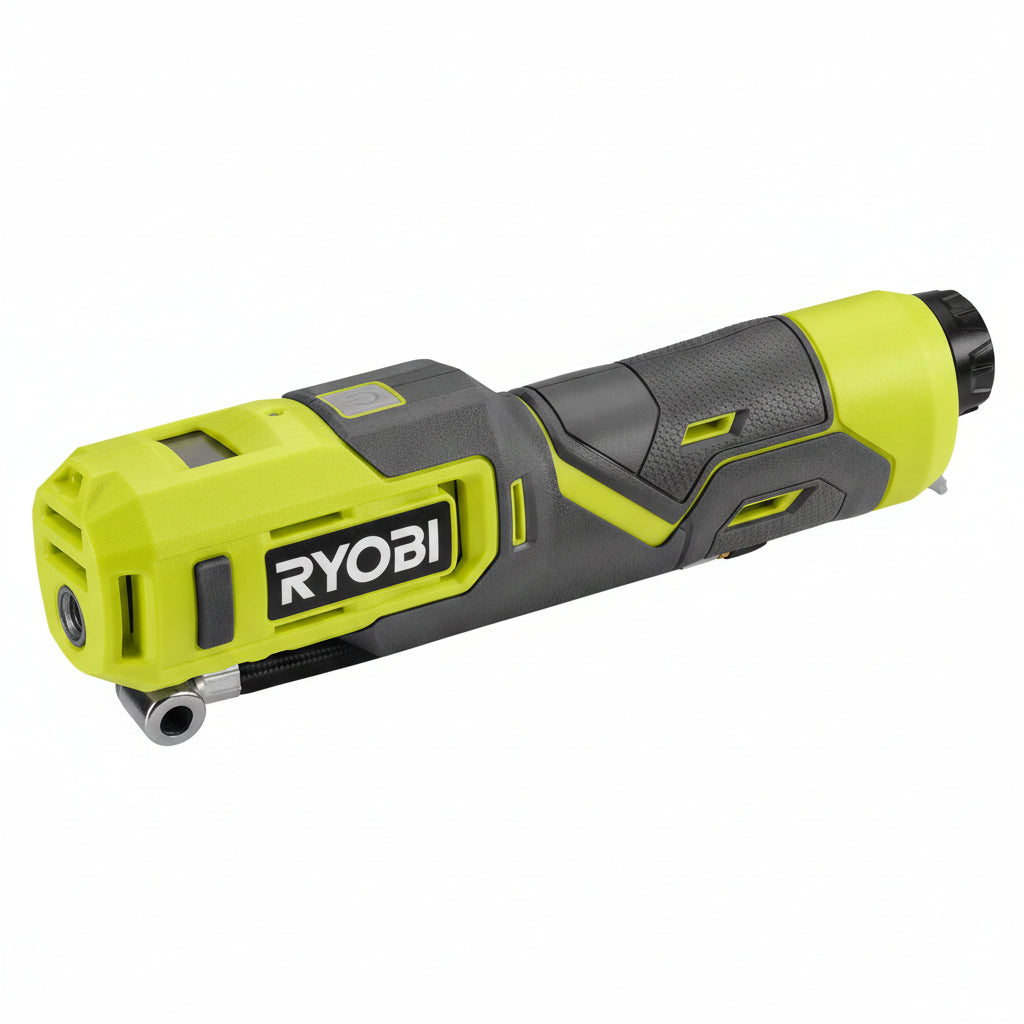
Explore this need in the finder →The FVIF51B is the tool-only member of RYOBI's USB Lithium bike-and-ball inflator line. Its useful distinction is not a special filling mode but the buying package: the manufacturer describes this exact B model as tool-only and says the battery is sold separately. The product page identifies bicycle tires and sports balls, a digital PSI gauge, an onboard light, storage for the hose and accessories, and a 100 PSI maximum. That makes it a small, cordless top-up tool for a buyer who already has a compatible USB Lithium battery—not a general-purpose car inflator by default.
What the 100 PSI rating does—and does not—mean
RYOBI's FVIF51 manual gives a maximum pressure of 100 PSI, and the product page repeats that ceiling. A maximum pressure is not a recommended bicycle pressure, a promise about how quickly a tire will fill, or evidence of gauge accuracy. Use the tire maker's limit and check the pressure target on the bicycle or component maker's instructions. The manual names small tires, bicycle tires, and sports balls as applications, while the current product page emphasizes bicycles and balls. It does not give a tire-size range, a car- or motorcycle-specific setting, a fill-time scenario, or a number of tires per battery charge. Those gaps matter more than the big maximum-pressure number if the task is a larger tire or repeated inflation.
Manual pressure control is the main tradeoff
The display is digital, but this is not a documented preset-pressure auto-stop pump. The FVIF51 instructions say to turn the tool on, read the pressure, and release the power button when the desired pressure is reached. The gauge also reads pressure while the pump runs, when air pressure fluctuates; the manual says to release the button and wait for the reading to settle for a more accurate observation. In practice the design asks the user to remain at the wheel, watch the gauge and stop the motor manually. That routine is different from RYOBI's separately reviewed FVIF52K, whose own page advertises a selected-pressure shutoff. Do not transfer that newer model's feature to this FVIF51B.
Valve work: a short hose, a lever-lock head and named adapters
The included high-pressure hose is six inches long and stows on the body. The manual's basic procedure places the air chuck over the valve stem, then presses its clamp down until the lever is parallel with the hose. That is a press-on, lever-lock connection. The source does not identify the base head as Schrader by name, so this assessment does not treat a generic product photo as proof of a named valve standard. RYOBI's manual does identify a supplied Presta valve adapter and explains that the adapter can be fitted at the pump outlet, though it recommends using it with the hose. It also lists a sports-ball needle. The needle and adapter are useful distinct functions, not evidence that the display can accurately read every very-low-pressure ball.
Sports balls need a separate pressure check
The manual cautions that most sports-ball pressures are too low for an accurate reading on the tool gauge. For an item at 10 PSI or below, it advises short bursts and using another measuring device to determine pressure. The practical implication is straightforward: the small pump and included needle can add air, but a ball's published pressure should come from its maker and a suitable gauge, not the FVIF51 readout. The pump also has no documented ball-specific stop feature, so supervise every burst rather than letting it run unattended.
Budget for the battery and the cooling breaks
FVIF51B is explicitly the tool-only SKU; the manufacturer says the USB Lithium battery is sold separately. A compatible pack is therefore an additional requirement, not an included kit item. The related FVIF51K is the kit configuration and is a better starting point for someone who needs the battery and charging cable as part of the package. Neither exact page publishes battery life for a specific tire, charge time, or tested fill count, so the battery's 2Ah label on a separate kit should not be turned into a runtime promise.
RYOBI also gives a clear thermal boundary: after five minutes of continuous use, let the pump cool for five minutes. The manual says never to leave the inflator unattended with its nozzle attached and instructs the user to keep the outlets unobstructed. These are meaningful limits on a convenience tool: this is a measured, supervised top-up routine with pauses, not a set-and-forget or extended continuous-duty compressor. The 100 PSI product limit never overrides the maximum pressure of the tire, ball or attachment.
Who should consider it?
The FVIF51B can make sense for a household already using the RYOBI USB Lithium system that wants a compact pump for bicycle tires and sports balls and is comfortable holding the control button and watching the gauge. Check the exact tool-only label, compatible battery and the six-inch hose before choosing it. If the battery is not already in your kit, compare the FVIF51K package instead. If automatic target stopping is essential, the FVIF51 manual does not support that requirement. If you need a documented passenger-car inflator, higher-volume work, a long hose, or a precise low-pressure ball gauge, this page does not establish that the FVIF51B meets it. This assessment is based on the manufacturer pages and the FVIF51 operator manual; it is not a hands-on test or ownership report.
Key specifications
Key details at a glance
| Product-page maximum-pressure claim | 100 PSI |
|---|---|
| Automatic stop at target | No |
| Documented accessories | FVIF51 high-pressure inflator body / 6-inch high-pressure hose / Presta valve adapter / sports-ball needle / hook-and-loop mounting straps / operator's manual |
| Operating power arrangement | Removable usb lithium battery pack |
| Tire-chuck connection style | Press-on tire chuck |
| Pressure gauge scale | 100 PSI |
Use the exact model’s instructions for operating limits, supplied equipment and version differences.
Sources for this review
Sources for this assessment
- RYOBI US Inflators collection
- RYOBI USB Lithium Bike Tire and Ball Pump Inflator / FVIF51B
- RYOBI USB Lithium High-Pressure Inflator FVIF51 operator's manual (manufacturer document mirrored by Manuals+)
- RYOBI product-page image for the FVIF51B tool-only product page
- RYOBI USB Lithium Bike Tire and Ball Pump Inflator Kit / FVIF51K

Match the inflator to your power and tire
Use the finder to check whether a reviewed model's documented power source, mode and accessories fit your requirements. It cannot prove an unlisted fit or predict actual fill time.