
Your needs, this model
Does it fit your priorities?
Does FVIF51K include a battery that is ready to use?
RYOBI labels FVIF51K a kit and its exact product page offers a 2Ah battery/charging-cable package selection; the separate FVB02 system pack is a 2Ah USB Lithium battery. Confirm that your exact seller's FVIF51K box contains that selection, because the page also exposes a tool-only choice and does not state the bundled battery's exact part code.
Explore this need in the finder →Can FVIF51K stop automatically at the selected bicycle pressure?
No target-pressure stop is documented in the FVIF51 manual. Its instruction is to release the power button at the desired reading. The digital PSI display is not the same feature as the selected-pressure shutoff on the newer FVIF52K; remain present and use the bike maker's prescribed pressure.
Explore this need in the finder →Can I use the FVIF51K with a Presta bicycle valve?
Yes, the FVIF51 manual identifies a supplied Presta adapter and shows the press-on air chuck locking onto that adapter. It gives no bicycle pressure range or gauge-accuracy tolerance, so follow the tire maker's limit and do not equate the pump's 100 PSI maximum with a target.
Explore this need in the finder →Will the FVIF51K gauge tell me the pressure of a sports ball accurately?
The manual says the pressure needed for most sports balls is too low for accurate readings on the inflator gauge. It calls for short bursts at 10 PSI or less and a separate measuring device; the pump has no documented target-stop permission that would remove the need to supervise inflation.
Explore this need in the finder →The FVIF51K pairs RYOBI's USB Lithium bike-and-ball inflator with a battery/charging-cable kit option. That package is the key difference from the neighboring FVIF51B tool-only model; the available manual identifies the common pump body simply as FVIF51. The current RYOBI page calls the K version a kit and presents a 2Ah battery/charging-cable selection, while also exposing a tool-only choice. If a listing is being sold loose or as part of a larger bundle, confirm its selected package and exact SKU rather than assuming the word “kit” describes every offer.
A packaged battery does not turn it into an auto-stop inflator
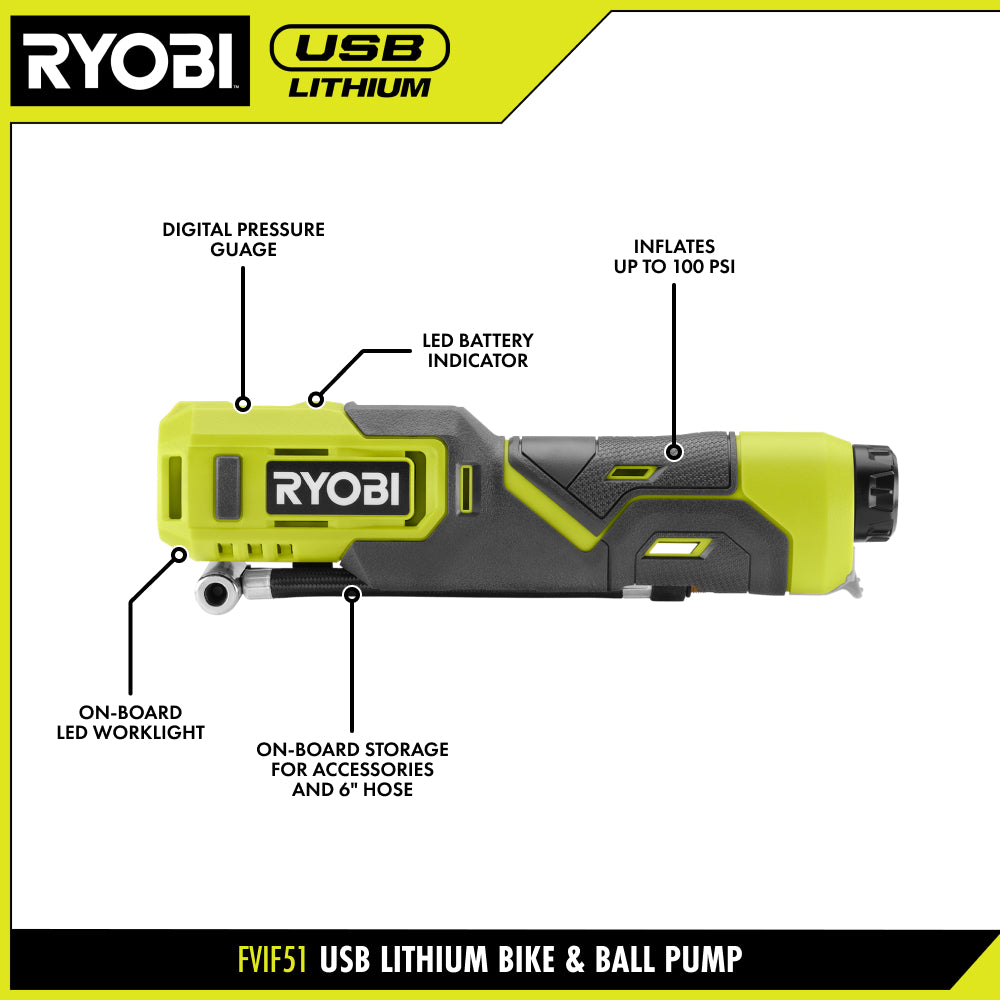
The pump's main use case remains modest: RYOBI identifies bicycle tires and sports balls, an onboard digital PSI display, an LED worklight, storage for its hose and accessories, and a maximum pressure of 100 PSI. The base pump manual does not describe a preset-pressure cutoff. Its operating steps tell the user to release the power button when the chosen pressure is reached; it also warns that the pressure reading fluctuates while air is flowing. Stop the pump, allow the reading to settle, and remain present. An illuminated digital gauge is useful, but it is not interchangeable with the selected-pressure shutoff RYOBI advertises for the different FVIF52K kit.
Choose by the object, not by the maximum number
The manual lists small tires, bicycle tires and sports balls as applications, and the retail page specifically highlights bicycle and ball use. Its 100 PSI maximum is an equipment limit, not a recommended bicycle or ball pressure and not a promise about fill time. RYOBI publishes no tire-size envelope, pressure accuracy tolerance, per-charge tire count or timed fill scenario for this product. For a bicycle, follow the tire and rim maker's permitted pressure. For a ball, use the ball maker's stated range and a pressure-measuring device that can read it reliably. The manufacturer documentation reviewed here does not establish a passenger-car or motorcycle inflation profile, so a buyer needing that use should look for a model whose exact page names it rather than extrapolating from “small tires.”
Included attachments help with two distinct valve jobs
The six-inch high-pressure hose stores on the pump body. For the base tire head, the FVIF51 instructions show the air chuck pushed over a valve stem and secured by pressing the clamp lever parallel to the hose. That supports a press-on connection. The manual names a supplied Presta adapter for the narrower Presta bicycle valve and gives a separate inflation procedure, including loosening and retightening the valve's locking nut. It also identifies a sport-ball needle. These parts make the two use cases legible, but the manual never calls the base valve head “Schrader”; this assessment does not turn the illustration into a separate Schrader claim.
Ball inflation is a supervised, low-pressure task
There is an especially important caveat for balls. The manual says most sports-ball pressures are too low for accurate readings on the inflator's gauge. At 10 PSI or below it instructs the operator to inflate in short bursts and use another measuring device to determine pressure. That advice still applies to the K kit even though a battery is supplied: the package changes what arrives in the box, not the gauge scale, pressure-control method or evidence about low-pressure accuracy. Do not leave the pump attached or running while you look up a target.
Account for the run/cool limit
RYOBI's manual allows five minutes of continuous use, then calls for a five-minute cooling period. It also says not to leave the inflator unattended with a nozzle attached and to keep its outlets clear. Those restrictions are more relevant than the maximum pressure for a person intending to inflate multiple items in sequence. The 2Ah kit option removes one initial battery-shopping step, but the documents do not state the number of bike tires or balls that a charge will handle, how long recharge takes, or whether the pump may be left attached while idle. No comparative test or independent timing was performed for this review.
When the K package is a sensible fit
For someone entering RYOBI's compact USB Lithium system and seeking a dedicated bicycle-and-ball pump, the FVIF51K is the package to compare if the seller's offer includes its 2Ah battery and charging cable. Existing USB Lithium owners may prefer the tool-only FVIF51B if they have the right pack already. In either case the operating pump is the FVIF51 family: manually controlled, limited to five-minute use intervals, and dependent on the operator's own pressure monitoring. Verify the exact model, package selection, battery and cable before ordering; do not expect a digital screen to provide automatic shutoff or trustworthy low-pressure ball readings. This is a source-based assessment of the product pages and FVIF51 manual, not a hands-on test or ownership account.
Key specifications
Key details at a glance
| Product-page maximum-pressure claim | 100 PSI |
|---|---|
| Automatic stop at target | No |
| Documented accessories | FVIF51 high-pressure inflator body / one 2Ah USB Lithium battery (package selection) / USB charging cable (package selection) / 6-inch high-pressure hose / Presta valve adapter / sports-ball needle / hook-and-loop mounting straps / operator's manual |
| Operating power arrangement | Removable usb lithium battery pack |
| Tire-chuck connection style | Press-on tire chuck |
| Pressure gauge scale | 100 PSI |
Use the exact model’s instructions for operating limits, supplied equipment and version differences.
Sources for this review
Sources for this assessment
- RYOBI US Inflators collection
- RYOBI USB Lithium Bike Tire and Ball Pump Inflator Kit / FVIF51K
- RYOBI USB Lithium High-Pressure Inflator FVIF51 operator's manual (manufacturer document mirrored by Manuals+)
- RYOBI USB Lithium 2Ah Lithium Rechargeable Battery / FVB02
- RYOBI product-feature image linked on the FVIF51K manufacturer page
- RYOBI USB Lithium Bike Tire and Ball Pump Inflator / FVIF51B

Match the inflator to your power and tire
Use the finder to check whether a reviewed model's documented power source, mode and accessories fit your requirements. It cannot prove an unlisted fit or predict actual fill time.