
Your needs, this model
Does it fit your priorities?
Does PCL031K1 include its battery and charger, and is the battery internal?
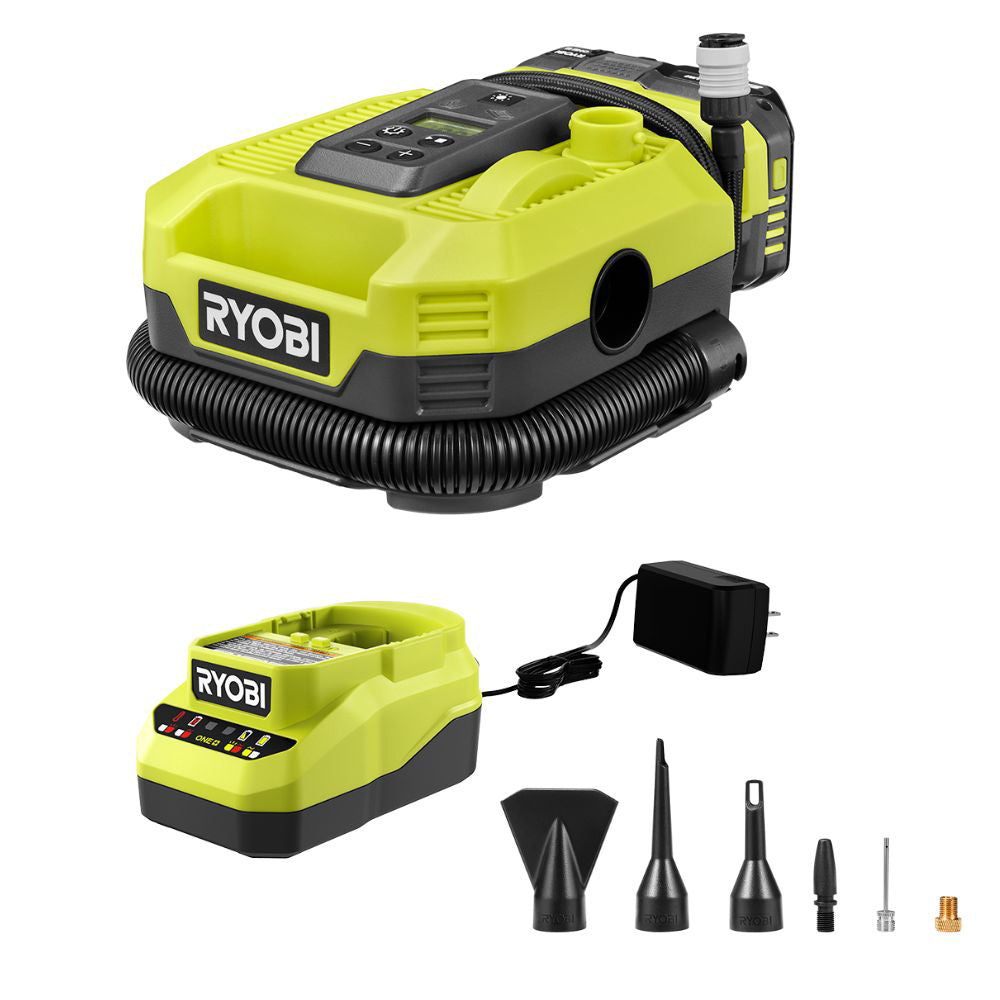
The exact RYOBI PCL031K1 page lists one removable PBP006 2Ah 18V ONE+ lithium-ion battery and a PCG002 charger with the PCL031 pump. This is a tool-platform pack that docks into the pump, not an internal battery. The tool-only PCL031B is a distinct package that excludes both; check the exact suffix before ordering.
Explore this need in the finder →Can PCL031K1 inflate a bicycle tire using Presta?
The exact K1 page lists a Presta adapter, and the PCL031 manual describes threading it into the air chuck, loosening the Presta stem nut, attaching without cross-threading, then tightening the locknut after inflation. No bicycle pressure range or gauge tolerance is provided; use the bicycle maker’s pressure target and check it with a suitable independent gauge.
Explore this need in the finder →Does PCL031K1 reliably stop the pump at a selected tire pressure?
RYOBI’s exact K1 page advertises automatic shutoff at the desired PSI, but the PCL031 manual’s automatic-shutoff heading is about the digital gauge turning off after up to five minutes. The manual describes manual start/stop operation and says never to leave the inflator unattended with its nozzle attached; it does not confirm a pressure-triggered pump stop. Treat the feature as unverified.
Explore this need in the finder →What pressure and cooling limits apply to PCL031K1?
The page and some manual passages state 160 PSI, but the same manual’s specific safety rule says not to use above 150 PSI; honor the lower written ceiling unless RYOBI clarifies. Neither number is a tire target. The manual gives 5 PSI setting increments, a five-minute continuous-use interval followed by five minutes of cooling, and a short-burst plus calibrated-check procedure at 10 PSI or less. Gauge tolerance, tire-size envelope and fill time are not published.
Explore this need in the finder →The RYOBI PCL031K1 is the battery-and-charger kit version of the 18V ONE+ Dual Function Digital Inflator/Deflator. The package includes the PCL031 pump, a removable 2Ah 18V ONE+ battery and PCG002 charger, as well as the high-pressure and high-volume arrangement and listed attachments. The exact PCL031B is a separate tool-only package. The two versions share the PCL031 pump and its manual, but not their included power equipment. This evaluation uses RYOBI's exact US-facing kit page and the PCL031 operator manual; it does not claim product use or independent testing.
The kit's useful distinction is two separate hoses
The PCL031 is more than a tire-only pump. RYOBI identifies a high-pressure route for tires and sports balls and a separate high-volume route for larger, low-pressure inflatables. In the manual, the high-pressure hose is 24 inches and the high-volume hose is 14 inches. Tire work belongs on the high-pressure hose; the volume hose is for items such as air mattresses, rafts and floats, and it can inflate or deflate. The product page's up-to-16-SCFM high-volume figure is a manufacturer claim without a disclosed test method, so it does not establish a comparative fill time.
The exact K1 page lists a Presta adapter, sports-ball needle and pinch-valve adapter. The PCL031 manual also lists a spreader nozzle, standard pinch-valve nozzle, narrower pinch-valve nozzle and accessory bag. Its figures show how those accessories attach to the appropriate hose. The manual says the gauge and preset features apply only when using the high-pressure hose. Keeping the two routes distinct matters: a bulky inflatable nozzle is not a tire chuck, and the high-volume mode is not a route to precise tire-pressure control.
A removable battery is included, but not built in
For someone who lacks the ONE+ platform, K1's package advantage is concrete: the exact RYOBI product description identifies one PBP006 2Ah lithium battery and one PCG002 charger with the pump. They are removable tool-platform equipment, not a sealed internal battery, and the listing is not a vehicle-socket or direct-clamp arrangement. The battery's inclusion does not establish a runtime, number of tires per charge or permission to operate while charging; the manufacturer sources reviewed here do not give those details.
The B package may be more economical for an owner who already has a compatible battery and charger, but its exact page says those are sold separately. The K1 therefore reduces the number of components a new buyer must source while adding no documented change to the pump itself. Check the K1 suffix on the offer and match the delivered pack, charger, pump and small accessories against the manufacturer's current package information. Do not infer that another RYOBI kit with a similar title includes the same parts.
Read the pressure and gauge limits conservatively
RYOBI's page advertises up to 160 PSI, and that figure appears in the manual's specification table. But the manual's specific safety rule says not to use the inflator above 150 PSI. No explanation resolves the two limits. Until clarified by the manufacturer, honor the lower written safety ceiling; in either case, a maximum is not a recommended tire setting. Use the vehicle or tire maker's cold-pressure guidance.
The pressure setting changes in 5 PSI steps. That may be a coarse adjustment for low-pressure tasks, and the manual does not state a gauge tolerance. It treats the built-in gauge as a guide and advises checking vehicle pressure with a reliable measuring device before driving. At 10 PSI or less it calls for short bursts and a calibrated check after each burst. The manual also warns that most sports-ball pressure is too low for an accurate reading on the pump's gauge. The ball needle is a connection accessory, not a claim of low-pressure precision.
Target stopping and supervision remain caveats
The K1 page advertises automatic shutoff at a selected PSI, but the PCL031 manual does not make that feature clear. Its “Automatic Shutoff” heading refers to the digital gauge remaining on for up to five minutes, while its pressure-operation instructions describe the user starting the pump and manually stopping it at the target. The manual does not clearly say that the pump itself stops when a preset is reached. For an essential auto-stop requirement, do not count this as verified. The manual also says never to leave the pump unattended with the nozzle attached and tells the operator to monitor the item.
Cooling is another real operating constraint. The manual instructs five minutes of cooling after each five minutes of continuous use and separately gives a ten-minutes-cooling-per-ten-minutes-use notice. A five-minute run followed by a five-minute rest is the conservative reading. It also says the product is not designed for commercial applications. Those instructions matter more than unreported runtime or fill-time expectations.
Package contents do not answer every fit question
A Presta adapter makes a documented bicycle-valve connection possible, but the sources do not give a bicycle pressure range or prove fit for every tire stem. The product page calls the tire head a quick-connect air chuck; the manual does not name a press-on or twist-on chuck style or explicitly call it Schrader. If one exact connection style is essential, inspect the included head and its instructions rather than translating “quick connect” into an unsupported category. RYOBI's manual lists more high-volume nozzles than the embedded product-page package description, so check the delivered items.
Bottom line: PCL031K1 is the more complete purchase package for a shopper starting without ONE+ power equipment. Its two modes broaden the jobs it can address, but do not erase the pressure warning conflict, gauge limitations, unverified pressure-stop behavior or cooling schedule. A buyer should check the exact kit contents, select the proper hose, remain present, follow the tire maker's pressure and verify the result independently. It is a source-documented utility tool, not a tested shortcut to a specified tire fill time.
Key specifications
Key details at a glance
| Product-page maximum-pressure claim | 160 PSI |
|---|---|
| Documented accessories | PCL031 18V ONE+ dual-function inflator/deflator / one PBP006 18V ONE+ 2Ah lithium-ion battery / one PCG002 charger / high-pressure hose (24 in.) / high-volume hose (14 in.) / Presta valve adapter / sports-ball needle / pinch-valve adapter / spreader nozzle / standard pinch-valve nozzle / narrow pinch-valve nozzle / accessory bag / operator's manual |
| Operating power arrangement | Removable 18v one plus battery |
| Published duty-cycle condition | The manual says to allow five minutes of cooling after each five minutes of continuous operation; a separate notice says ten minutes of cooling for every ten minutes of use. The five-on/five-off schedule is retained as the conservative operating interpretation. |
| Pressure gauge scale | 160 PSI |
Use the exact model’s instructions for operating limits, supplied equipment and version differences.
Sources for this review
Sources for this assessment

Match the inflator to your power and tire
Use the finder to check whether a reviewed model's documented power source, mode and accessories fit your requirements. It cannot prove an unlisted fit or predict actual fill time.