
Your needs, this model
Does it fit your priorities?
What vehicle outlet does the 40088 need?
The manual requires a 12V vehicle outlet rated at least 15A and recommends running the engine while using the pump; it specifically warns against older 8A cigarette-lighter receptacles. It lists a 10-foot cord and 12-foot total reach. The 15A fuse in the plug is not a separate current-draw measurement.
Explore this need in the finder →Does the 40088 stop by itself at my chosen pressure?
Slime documents its Inflate-Right feature: hold a target control until the display flashes, set the needed pressure, then start; the manual says it switches off when the gauge reaches the selected value and the on/off switch can override that preset. Its 0–99 PSI display is not a gauge-accuracy or maximum-working-pressure statement.
Explore this need in the finder →Which green-lever direction locks the 40088 hose?
Slime's product page says the green lever lifts to lock after the head is pressed onto the valve; the linked manual says to attach the head and push the lever down to lock. Because the instructions conflict, inspect the lever on the exact inflator and follow the directions supplied for that version.
Explore this need in the finder →Is Slime's six-minute car claim a general result?
No. The 40088 manual specifies the six-minute example for a P205/55R16 tire from 0 to 35 PSI. It also limits continuous use to 10 minutes with about 25 minutes of cooling between uses. Tire size, starting pressure, temperature, outlet condition and other settings can change results; the maker's example is not an independent test.
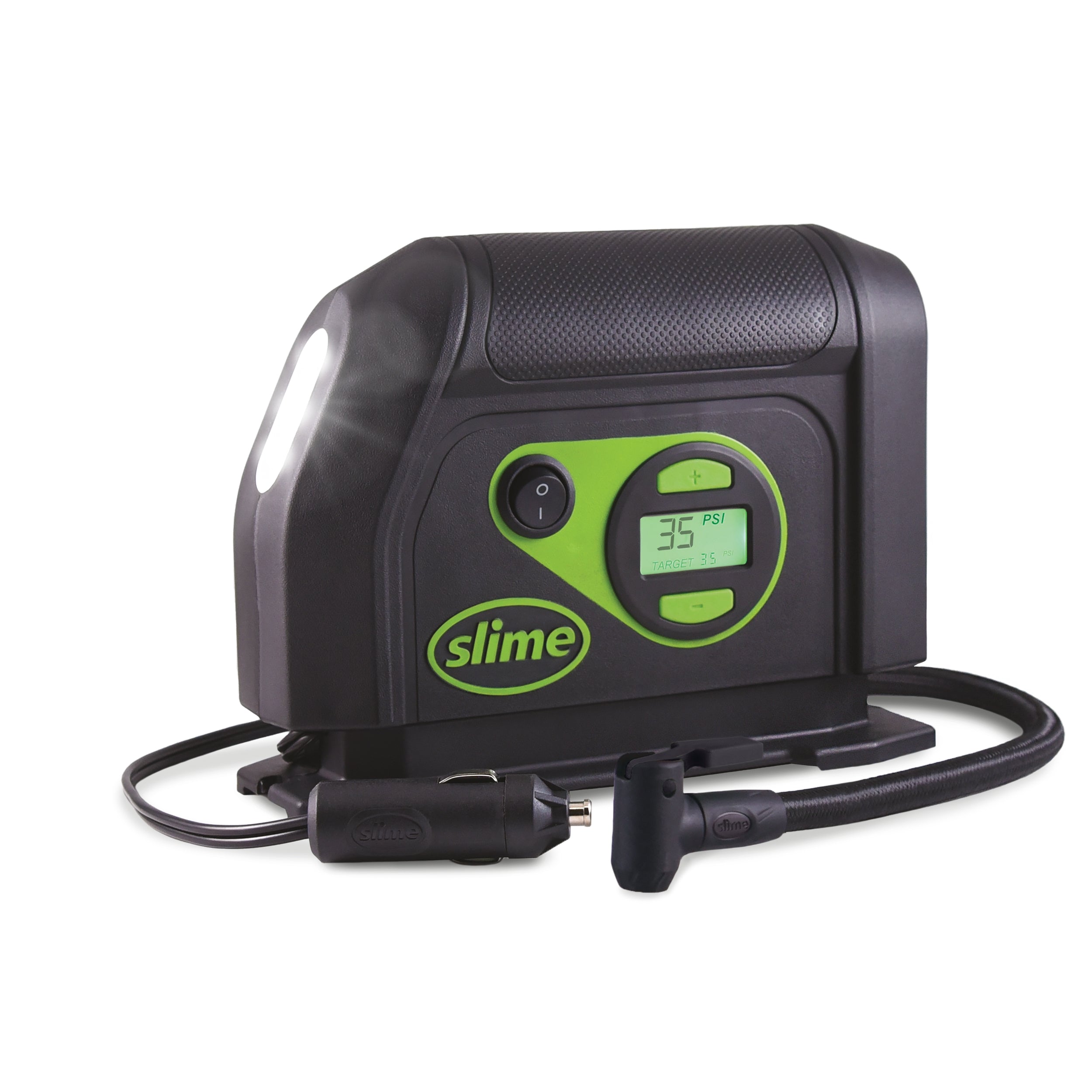
Explore this need in the finder →The Slime 12V Digital Tire Inflator (part 40088) is a vehicle-socket model with a digital pressure display and Inflate-Right target stopping. It is materially different from the internal-battery 40084 and Slime's analog, manual-control 40050, 40059 and 40060. Its most important fit check is electrical: the 40088 manual requires a 12V outlet rated for at least 15 amps, recommends running the engine during use and warns against older 8-amp cigarette-lighter receptacles. The label “12V” by itself is not enough to establish that a particular vehicle outlet can power it.
Socket rating, cord and reach
The manual lists a 10-foot power cord and 12-foot total reach. That distinction matters when planning where the compressor can sit relative to the outlet and tire valve. It also identifies a 15A fuse in the plug, but a fuse rating is not a measured or stated maximum current draw. The manual separately says the vehicle outlet should be at least 15 amps. If the vehicle's owner's information does not confirm that rating, do not infer it from the plug shape; a different source such as battery clamps is not a documented alternate operating plan for this SKU.
Slime's manual recommends that the engine be running for best inflator performance. It also calls for a well-ventilated area, parking brake set and transmission in Park (or neutral for a manual). Those instructions affect where and how this pump can be used: it is not simply a cordless inflator that can be carried away from the car. The instructions limit continuous running to 10 minutes and call for about 25 minutes of cooling between uses. The manual says not to leave the inflator unattended even though the product page uses walk-away phrasing around preset stopping; I would follow the manual and remain present.
Digital display and preset stop
The manual marks the digital display from 0 to 99 PSI (0 to 7 bar) and gives 0.75 CFM at zero pressure. That display range is not a maximum working-pressure specification, and the reviewed sources give no gauge-accuracy tolerance. Inflate-Right is a genuine difference from Slime's manual analog models: the instructions describe selecting a target, starting the pump and letting it stop when the indicated pressure reaches that setting. The on/off switch can override the preset. The stop does not choose the correct pressure or establish display accuracy.
The maker's six-minute figure is tied to a specific example, not every car tire. The 40088 manual states six minutes for a P205/55R16 standard tire from 0 to 35 PSI, matching the page's standard mid-size tire description. Treat that as Slime's scenario only. It does not predict time for a larger tire, a small top-off, a weak outlet, a different starting pressure or a partially charged vehicle battery. The instructions still say to check the vehicle's recommended cold pressure and not overinflate.
One unresolved hose-head difference
Slime's exact product page describes a press-on head with a green lever that is raised to lock after the head is placed on the valve. The linked 40088 manual's tire-inflation step instead says to attach the hose and push the lever down to lock. Both are manufacturer instructions for the same SKU, so this review does not silently choose one or treat the difference as a new model. Inspect the lever on the exact unit and follow the matching manual for that production version. If you are buying from an offer that does not show the hose head clearly, ask the seller to confirm the package/version before relying on a particular connection sequence.
The manual also shows use of included accessory adapters. Slime's page and the exact package graphic identify ball/inflatable use; the package also marks bicycle use. A ball needle is part of the shown accessory route, but the sources do not provide a pressure range or gauge-accuracy statement for a ball. Follow the ball maker's pressure instruction and remain in attendance. For bicycles, a separate Presta adapter is not documented; the package icon does not tell you whether the head fits your particular bicycle valve.
What the specification does not settle
The 0.75 CFM rating is at zero PSI, not a flow curve across tire pressures. The 0–99 digital display does not say the unit can safely or accurately operate to 99 PSI. The sources do not state a maximum working pressure, current draw, sensor tolerance or a tire-size range beyond the named manufacturer example. Nor is the six-minute scenario an independent test. These gaps matter more than a large number on the display if your task depends on a specific high-pressure tire, repeated inflations or a known vehicle-outlet limit.
The package graphic marks passenger cars, off-road use, bicycles and balls/inflatables, but not trucks/SUVs or rafts/mattresses. This is a useful signal about the manufacturer's intended categories, not proof that every tire in those categories is compatible. The product page mentions adapters for rafts, while the package graphic does not mark rafts; this assessment does not recommend raft use on that conflicting evidence. The model is also not an internal-battery choice: its documented operating power is the 12V vehicle accessory outlet.
Who may want it
The 40088 is a candidate for someone who confirms a 15A-capable vehicle outlet, can follow the running-engine and cooldown directions, and wants a selected-pressure stop for a car tire. Its 12-foot stated reach and digital preset feature set it apart from Slime's manual 12V analog pumps. A buyer who needs internal battery power, clamp power, a known high-pressure limit, a Presta adapter or verified fill performance for a different tire should compare another documented configuration instead.
This is a research-based review, not a hands-on test. The exact Slime 40088 product page and its linked instruction manual support the operating plan and are also where the unresolved lever directions can be checked. Before purchase, verify that the offered unit is part 40088, that the vehicle outlet meets the manual's rating, and that the hose head and supplied adapters match the exact package.
Key specifications
Key details at a glance
| Automatic stop at target | Yes |
|---|---|
| Documented accessories | digital pressure display / Inflate-Right preset-stop control / manual on/off switch / 12V accessory-socket power cord / quick-connect tire hose and press-on head / multipurpose air adapters including a ball needle / LED work light |
| Operating power arrangement | 12V vehicle accessory port |
| Minimum documented vehicle-port rating | 15 A |
| Tire-chuck connection style | Press-on tire chuck |
| Power cord length | 10 ft |
| Pressure gauge scale | 99 PSI |
Use the exact model’s instructions for operating limits, supplied equipment and version differences.
Sources for this review
Sources for this assessment
- Slime Every Day Tire Inflators collection
- Slime 12V Digital Tire Inflator 40088 product page
- Slime 12V Digital Tire Inflator 40088 product record
- Slime 12V Digital Tire Inflator 40088 instruction manual
- Slime 12V Digital Tire Inflator 40088 manufacturer package image
- Slime 12V Digital Tire Inflator 40088 official body image
- CPSC Recalls & Product Safety Warnings portal


Match the inflator to your power and tire
Use the finder to check whether a reviewed model's documented power source, mode and accessories fit your requirements. It cannot prove an unlisted fit or predict actual fill time.