
Your needs, this model
Does it fit your priorities?
Is the 40060 cordless or powered from a vehicle outlet?
Slime identifies 12V accessory power and the manual gives a 9.7-foot power cord. The unit does not have a documented internal battery or direct-clamp power plan, so check the location and vehicle guidance for the accessory socket.
Explore this need in the finder →Does the 40060 stop automatically at a pressure I choose?
The reviewed 40060 page and manual document a dial and manual operation, not a preset target stop. Treat it as a pump that needs operator monitoring; the 0–60 PSI dial scale is not an automatic cut-off setting.
Explore this need in the finder →Which lever direction does the Compact Tire Inflator use?
Slime says 40060 units may have the older green lever that lifts to lock or a newer black lever that presses down to lock. The product page does not give a date or serial cutoff, so inspect the exact unit and follow its matching instructions.
Explore this need in the finder →Is 60 PSI the 40060's safe maximum tire pressure?
The manufacturer's source gives 0–60 PSI as the dial range but does not state a maximum working pressure or accuracy tolerance in the reviewed materials. Use the vehicle-recommended cold pressure and do not equate the end of the dial with a safe operating limit.
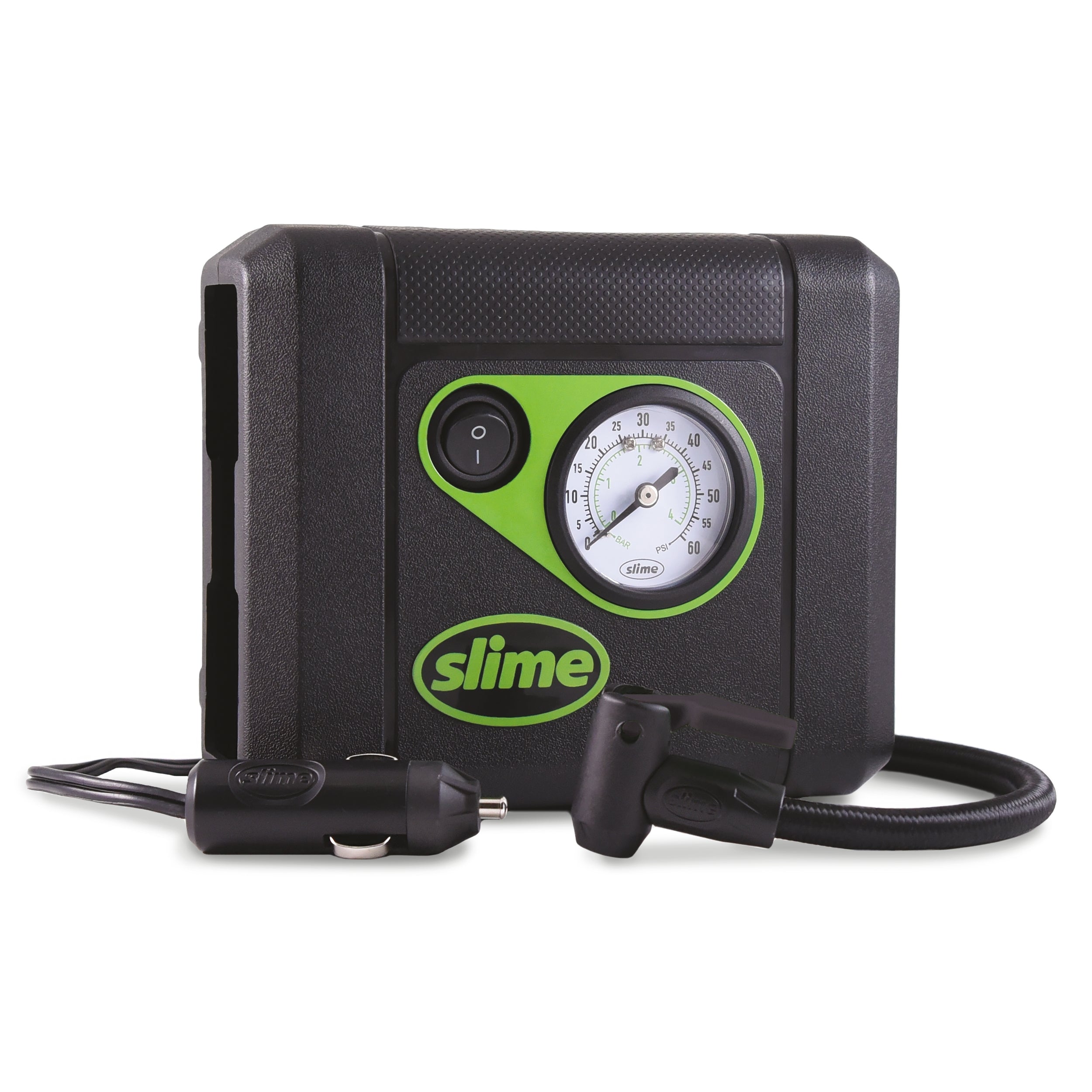
Explore this need in the finder →Slime's Compact Tire Inflator is the 40060, a 12-volt accessory-powered model with an analog dial, light and quick-connect air hose. It is separate from the Tire Inflator Jr. 40059 despite the similar compact-car positioning. Slime's page gives the 40060 a 10-minute flat-to-full mid-size-car scenario; that is a manufacturer claim, not a test or a promise for every tire. The source does not publish the scenario's starting pressure, ending pressure, tire dimensions or environmental conditions.
Reach and connection details are more useful than the name
This model needs a 12V vehicle accessory outlet. It does not have a documented built-in rechargeable battery, direct battery clamps or a 120V home-power arrangement. The instruction sheet gives a 9.7-foot power cord and 11.3 feet of total reach. That total is the manufacturer-listed source-to-tire path; it is more useful when planning around a low or rear-mounted outlet than looking at the word “Compact.” Measure or estimate the outlet-to-valve distance on the vehicle you intend to use, and check the vehicle's guidance for accessory outlets. Slime does not state a required amperage or current draw in the reviewed page or manual, so this review does not guess one from the 12V label.
The air hose uses a quick-connect lever head. Slime says 40060 production may have the earlier green lift-to-lock lever or a newer black down-to-lock lever; the page provides different instructions for the two. Both sequences start by pressing the hose head onto the tire valve stem, but the locking motion changes. Because the manufacturer does not give a production-date cutoff, a current product photo cannot guarantee which version a used or seller-held unit has. Check the lever on the unit and use the matching Slime instructions instead of applying the green-lever steps to a black lever.
Pressure control remains a manual task
The 0–60 PSI dial scale is not a published maximum working pressure and does not state how accurate the reading is. Slime lists an on/off control rather than a preset-pressure automatic stop. A pressure gauge scale, pressure limit and gauge-accuracy tolerance are separate facts; the reviewed documentation confirms the first and leaves the latter two unknown. Plan to monitor inflation yourself and use a separate reliable tire gauge for the final check if needed. NHTSA says to use the vehicle label or owner's manual for the correct tire pressure and to check pressure when the tires are cold. The correct vehicle target is not the number printed as a tire's sidewall maximum.
The manual lists 0.44 CFM (12.5 L/min) at zero pressure. Slime also describes car and bicycle tire use, plus balls and small inflatables, but no pressure-dependent flow curve, independent fill time, tire-size boundary, gauge tolerance or repeated-use duty cycle appears in the reviewed sources. A zero-pressure flow rate can help distinguish published specifications; it cannot be turned into a reliable minute estimate for a loaded tire. Likewise, the advertised 10-minute example should not be used as a guarantee that any tire from flat will be full in that interval.
Choosing it over the Tire Inflator Jr.
The manufacturer specification sheets make one practical contrast visible: the Compact is listed at 11.3 feet of total reach, versus 9.6 feet for the Jr. The Compact's cord is 9.7 feet, slightly longer than the Jr.'s 9.2 feet. Its zero-pressure flow figure is lower, 0.44 CFM against 0.60 CFM for the Jr., while Slime's separate fill-time scenarios say 10 minutes for the Compact and 12 for the Jr. Those statements do not form a controlled comparison and should not be combined into a speed ranking. The Compact page explicitly mentions both car and bike tires; its page also illustrates balls and other small inflatables. The Jr. page lists ball and raft adapters, so adapter names and package details should be checked per SKU rather than transferred between them.
Neither model has a documented preset auto-stop in the reviewed materials. Their hose-lever details also differ: the Jr. product page describes green lift-to-lock operation, whereas the Compact page warns that 40060 may use either green lift-to-lock or black down-to-lock hardware. If an automatic stop or a single predictable connector version is a hard requirement, this is not a good shortcut around that requirement. If the Compact's extra published reach is useful and the buyer is comfortable with a manual pressure-check routine, the 40060 is the more relevant of the two; the Jr. has the higher published zero-pressure flow figure and a specifically listed ball-and-raft adapter set.
Bottom line
Consider the 40060 for modest, occasional tire maintenance where a vehicle socket is available, its longer stated reach fits the vehicle and the operator will stay with the pump and check pressure independently. Avoid treating its dial's 60-PSI top marking as a working limit or its 10-minute maker scenario as a tested result. Confirm the exact SKU, package, outlet rules and installed lever version before purchase, and use the model-specific instructions for that connection.
Slime Compact Tire Inflator 40060 product information · Slime Compact Tire Inflator instruction manual · NHTSA TireWise maintenance guidance
Key specifications
Key details at a glance
| Documented accessories | LED work light / quick-connect air hose |
|---|---|
| Operating power arrangement | 12V vehicle accessory port |
| Tire-chuck connection style | Press-on tire chuck |
| Power cord length | 9.7 ft |
| Pressure gauge scale | 60 PSI |
Use the exact model’s instructions for operating limits, supplied equipment and version differences.
Sources for this review
Sources for this assessment
Match the inflator to your power and tire
Use the finder to check whether a reviewed model's documented power source, mode and accessories fit your requirements. It cannot prove an unlisted fit or predict actual fill time.