
Your needs, this model
Does it fit your priorities?
Can the 50154 pump be powered from jumper-cable clamps?
No. The exact manual’s pump plugs into a 12V vehicle accessory outlet that must be rated for at least 15 amps. The separate 8-gauge booster cables are included for jump-starting, not as an inflator power lead.
Explore this need in the finder →What outlet and run/cool limits apply to the 50154 inflator?
The manual requires a 15A-or-higher 12V outlet, recommends a running engine in a ventilated place, limits continuous operation to 12 minutes, calls for about 25 minutes cooling and says not to leave it unattended. Use a separate gauge to confirm the vehicle’s recommended pressure.
Explore this need in the finder →Does the 50154 kit include a ball inflation route?
Slime lists multi-purpose adapters for balls and other inflatables. Its manual warns not to overinflate soft items but gives no ball-pressure range or low-pressure accuracy. Follow the ball maker’s target and stay with the unit.
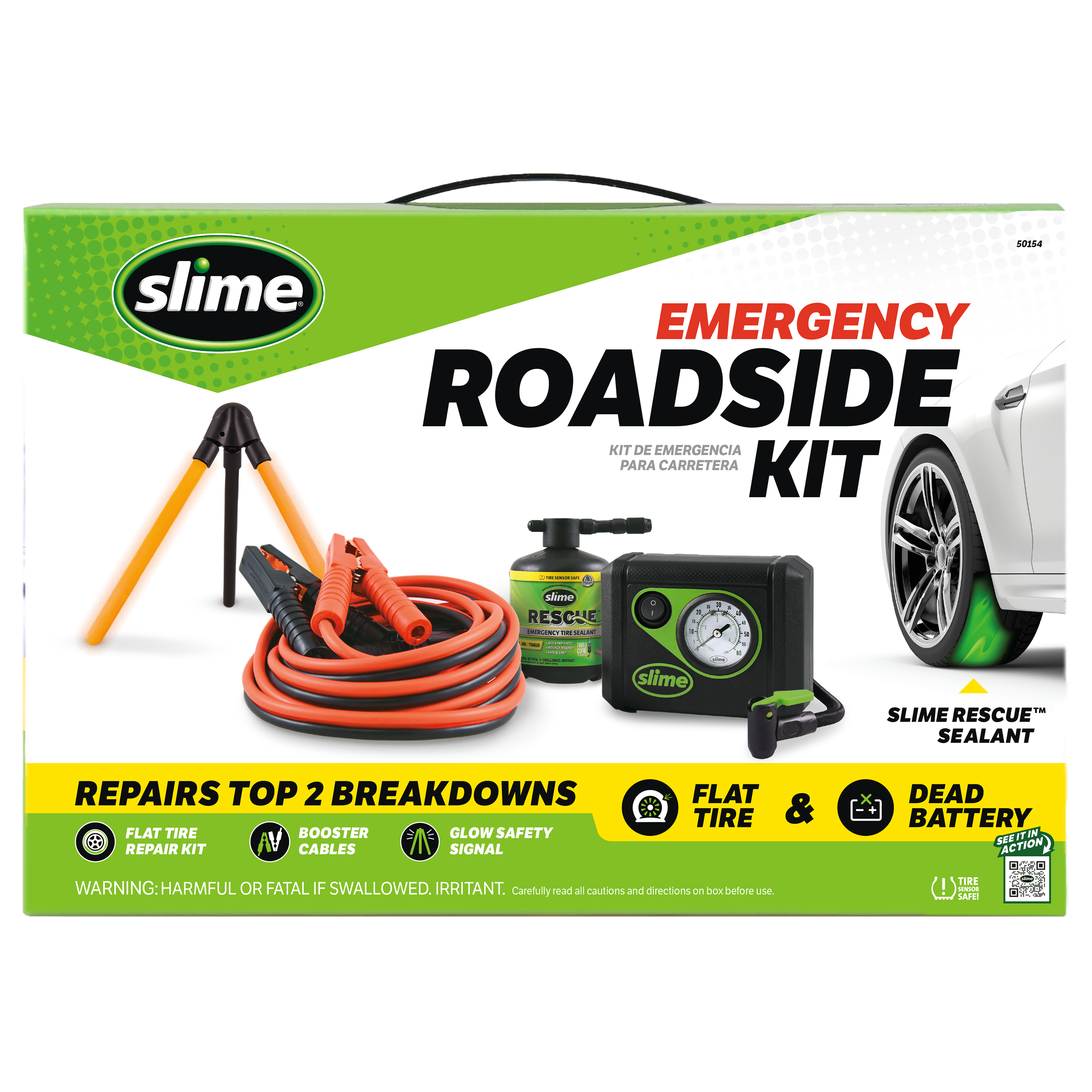
Explore this need in the finder →The Slime Emergency Roadside Kit 50154 is a bundle rather than a lone compressor. Its tire-inflation part is a compact 12-volt accessory-socket inflator, paired with 14 ounces of emergency sealant; the case also includes jumper cables and a glow safety signal. That combination is the reason to consider it, and also a reason to read the whole package carefully: the booster-cable clamps are for starting a vehicle, not a clamp-power input for the tire inflator.
What the 50154 documents
Slime identifies the inflator as a 12-volt model with a 0–60 PSI dial, on/off switch and quick-connect air hose. The kit page names compact and standard cars, crossovers and small SUVs. It lists 14 ounces of Rescue sealant, multi-purpose air adapters, 8-gauge booster cables measuring 10 feet, and a glow signal assembled from two light sticks and a stand. This is a more complete roadside bundle than a bare 12-volt pump, but it is also bulkier and more specialized than a top-off inflator.
The manual gives a 15-amp minimum for the vehicle outlet, says to run the engine while inflating and warns against using the unit in a closed garage or other confined area because of exhaust. It calls for a hard, clean surface, a pressure check with a separate gauge, no more than 12 minutes of continuous operation, roughly 25 minutes of cooling and attended use. The 0–60 PSI scale is a dial range, not an accuracy statement or a maximum working-pressure rating. The manual does not give a current draw, hose reach or a gauge tolerance.
A repair kit and an inflator are different tasks
For a puncture emergency, the included sealant is the main differentiator. Slime describes the formula as a temporary repair for passenger-vehicle tires, says it can address tread punctures up to one-quarter inch, and directs that it be removed within three days or 100 miles, whichever comes first. The manual limits repair to the tread area of radial passenger-car tires and says it is not for major damage or the bead, sidewall or shoulder. After application, its procedure calls for inflating to the vehicle maker’s recommended pressure, driving two miles, stopping to inspect the repair and checking pressure again. A leaking or damaged tire still needs professional attention; the kit is not a permanent repair or a way to ignore a spare or roadside assistance when conditions are unsafe.
Slime’s product page describes a 12-minute full-inflation claim, but the exact manual does not identify a matching tire size or pressure interval for that figure. Treat it as a maker claim, not a timed comparison or promise for a different tire. The manual also includes a straightforward air-only tire-inflation procedure, so the pump can serve a maintenance role without applying sealant. In either case, use the vehicle’s cold-pressure specification, not the gauge’s outer scale as a target.
Power, attachments and package checks
The compressor plugs into a 12-volt accessory outlet; the manual requires a circuit rated for at least 15 amps and recommends the engine running. The same kit’s 10-foot booster cables do not change this power route. They have separate clamps and instructions for jump-starting another vehicle. If the purchase requirement is an inflator that connects directly to a battery, this package does not document that arrangement.
The exact 50154 instructions show a quick-connect tire head pressed onto the valve and locked by lifting its lever. The product page describes the included adapters as suitable for balls, rafts and other inflatables, but no ball-pressure range or low-pressure accuracy is stated. A separate air-adapter plan is not the same thing as the sealant-on-tire procedure. Check that the offered box is the exact 50154 bundle and inspect its small attachments rather than assuming a retail listing includes every pictured component.
Where it sits among Slime’s kits
Compared with the Smart Spair 50107, the 50154 adds jump-start cables and a glow signal and uses Slime Rescue sealant with Thru-Core instructions; the 50107’s manual instead describes removing and replacing the valve core. The Smart Spair Ultra 50158 is a more integrated case with a reusable sealant bottle and a shorter fill-time claim for a named passenger-car scenario, but it does not add the 50154’s booster cables or roadside signal. Those are meaningful package differences, not proof that one inflator is faster in the same conditions.
The 50154 is most defensible for a driver who wants one emergency kit with a 12-volt pump, temporary sealant, separate jump leads and a warning signal, and whose outlet and operating space meet the manual. It is a poor match for someone seeking an internal battery, direct-clamp pump power, a preset pressure stop, a verified long hose reach or routine sealant-free inflation as the only use. Slime’s manual and listing were reviewed; no hands-on test, fill measurement or recall clearance is implied.
Key specifications
Key details at a glance
| Automatic stop at target | No |
|---|---|
| Documented accessories | 12V accessory-socket inflator with quick-connect hose and 0–60 PSI dial / 14 oz Slime Rescue emergency tire sealant / 8-gauge booster cables, 10 ft (separate jump-start function) / two glow sticks and signal stand / multi-purpose air adapters |
| Operating power arrangement | 12v vehicle accessory outlet |
| Minimum documented vehicle-port rating | 15 A |
| Inline fuse rating | 15 A |
| Tire-chuck connection style | Press-on tire chuck |
| Pressure gauge scale | 60 PSI |
Use the exact model’s instructions for operating limits, supplied equipment and version differences.
Sources for this review
Sources for this assessment

Match the inflator to your power and tire
Use the finder to check whether a reviewed model's documented power source, mode and accessories fit your requirements. It cannot prove an unlisted fit or predict actual fill time.