
Your needs, this model
Does it fit your priorities?
Is the 38034 ready to connect to a tire out of the box?
No. VIAIR says to pair it with a tire-inflation kit, and the 38034 package list does not include a tire gun or valve chuck. Verify the separate kit and its hose, gauge and attachment before relying on it for tire inflation.
Explore this need in the finder →Does its 200-PSI automatic switch stop a tire at my target?
No. The switch fills the 1.5-gallon reservoir between its 165-PSI cut-on and 200-PSI cut-off; tire pressure is handled with the separately selected inflator and operator control.
Explore this need in the finder →What electrical setup does 38034 need?
The manual lists 12V, 23A maximum draw, a recommended 30A fuse, and says to run the vehicle engine. It is the battery-clamp version, not a 12V accessory-socket model.
Explore this need in the finder →The VIAIR 200 PSI Plug-N-Play On-Demand Portable, part 38034, is best understood as a compact tank-and-compressor system that can supply air to tires after a separate inflation kit is connected. The manufacturer identifies tire inflation as an intended job, but its page says to pair the system with a tire-inflation kit; the 38034 package itself is not a ready-to-use tire gun. That distinction matters more here than the headline 200 PSI.
What the 38034 package actually does
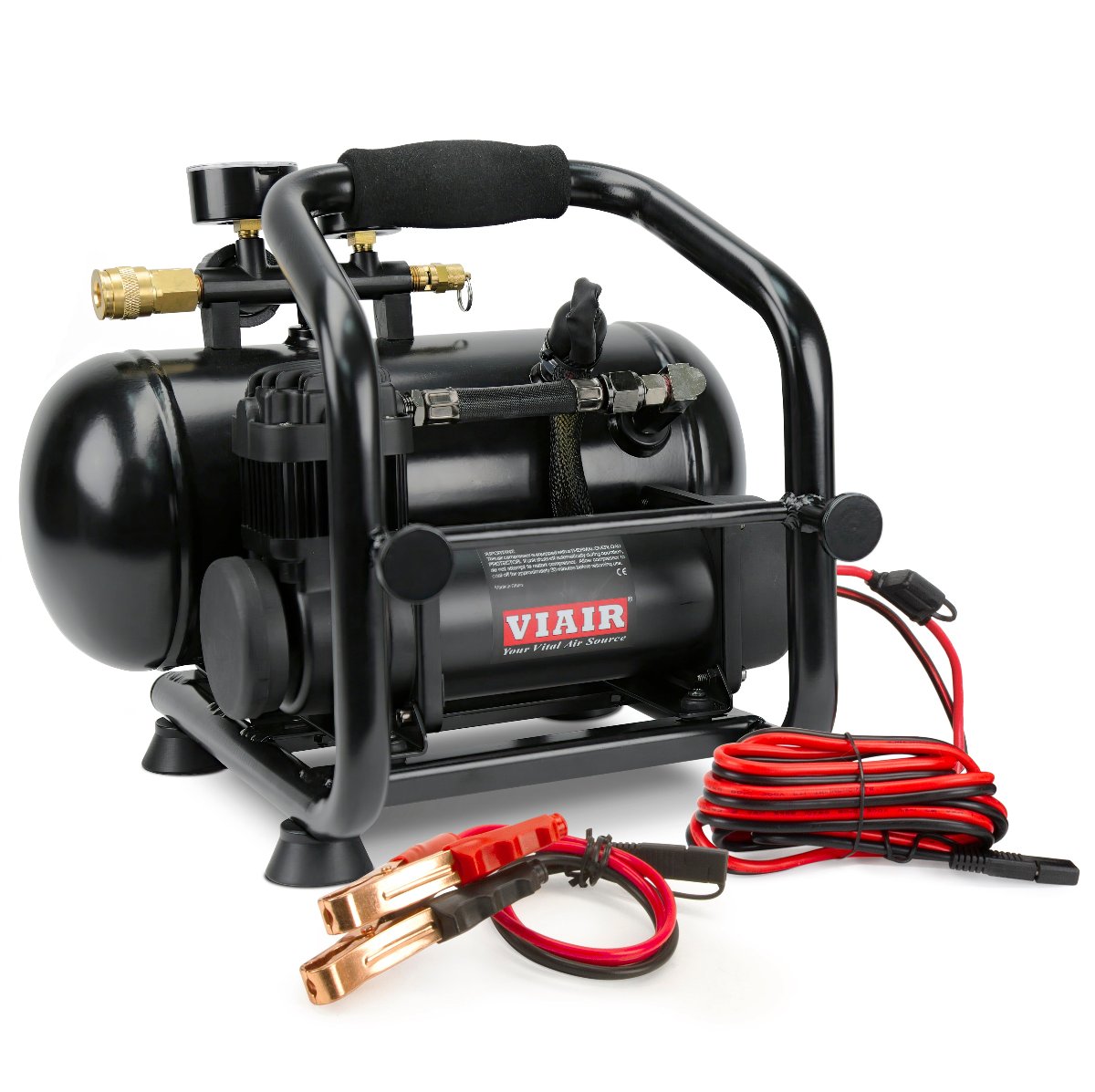
The 38034 configuration is the battery-clamp version. Its current VIAIR product page describes a 380C compressor, a 1.5-gallon tank, a pressure regulator and gauge, a tank gauge, a safety valve, a drain cock and a quarter-inch quick-connect outlet. A product-page image shows the compressor and clamps. The page and the part-specific manual identify the related 38035 as the separate 7-way-plug version; that is a different power configuration and has its own assessment on this site.
For tire work, VIAIR directs the owner to attach an appropriately rated hose/tool and specifically recommends tire-inflation kits 00043 and 00044 in its manual. Neither a tire chuck nor a tire gun is listed in the 38034 product package. So a buyer should cost and verify the full air path, pressure gauge, hose length and tire-valve connection before treating the 38034 as an emergency inflator. This is a more involved setup than a one-piece socket compressor or a boxed handheld pump.
Battery power, tank behavior and pressure
The manual calls for 12-volt power, a maximum draw of 23 amps and a recommended 30-amp fuse. It instructs the user to connect the supplied red and black clamps to the battery and says the engine must be running during use. This is not an accessory-socket appliance. The extra tank and portable frame also mean its roughly 23-pound net weight and 14-by-14-by-12-inch product-page dimensions are relevant storage constraints, not merely technical details.
The automatic pressure switch fills the reservoir: the manual gives a 165 PSI cut-on and 200 PSI cut-off. That is not a sensor stopping a tire at the driver’s chosen target. The operator sets the outlet regulator and must use a compatible tire-inflation attachment and its pressure controls. For tire inflation, VIAIR says to set the regulator to 200 PSI for maximum airflow, but that is a source instruction for compressor output—not a tire-pressure target. Use the vehicle or tire maker’s pressure guidance and the separate inflator’s instructions.
Pressure and rest limits are conditional
The manufacturer rates the tank and compressor for 200 PSI maximum working pressure. The current product page describes continuous duty at 100 PSI and 55% at 200 PSI; the manual’s specification table also states 55% at 200 PSI, while its precautions say to observe a maximum duty cycle of 30 minutes at 200 PSI. These statements do not line up exactly, so the conservative reading is to follow the manual’s stated 30-minute limit at 200 PSI and let the unit cool as directed. The manual says excessive heat can trip the automatic-reset thermal protector and instructs a cooling pause before restart.
Those figures are compressor operating limits, not a fill-time test for any particular tire. The sources reviewed for this assessment do not establish a tire-size rating or a measured 38034-to-tire fill rate. The reservoir is useful for storing compressed air, but it does not turn unspecified flow, an unknown hose or a missing inflation gun into a verified vehicle fit.
Who should compare it—and what to check
Part 38034 is a plausible match for someone who specifically wants a clamp-powered portable air source, is comfortable managing a tank and can select a compatible tire gun or inflation kit separately. It is a poor shortcut for a driver who expects a box to contain a hose, Schrader chuck and target-pressure shutoff. For a contained tire-only kit, compare a VIAIR portable model that includes its exact hose and valve attachment; for an onboard multi-use air source, compare the kit components and installation needs rather than comparing only maximum PSI.
Before relying on this configuration, verify that the offer is part 38034 with clamps, the vehicle battery can support the required circuit, the recommended fuse is installed, the engine can run during use, and the separately chosen inflation kit fits the quarter-inch outlet and intended tire. The manual also calls for draining moisture from the tank after each use and releasing stored pressure after operation. Those maintenance steps are part of ownership of a small air tank, not optional polish.
Sources: VIAIR 38034/38035 product page and 38034/38035 user manual.
Key specifications
Key details at a glance
| Automatic stop at target | No |
|---|---|
| Documented accessories | 380C compressor / 1.5-gallon air tank / battery-clamp power connection / 2-pin SAE power connection / 0-200 PSI outlet regulator/gauge / 200 PSI tank-pressure gauge / pressure switch / quarter-inch quick-connect outlet / drain cock / air filter / safety valve |
| Operating power arrangement | Vehicle battery clamps |
| Maximum working pressure | 200 PSI |
| Maximum current draw | 23 A |
| Published duty-cycle condition | Product page: continuous at 100 PSI and 55% at 200 PSI; manual table: continuous at 100 PSI and 55% at 200 PSI, while its precaution says maximum 30 minutes at 200 PSI. Preserve the 200-PSI wording difference and follow the manual's 30-minute precaution. |
Use the exact model’s instructions for operating limits, supplied equipment and version differences.
Sources for this review
Sources for this assessment
Match the inflator to your power and tire
Use the finder to check whether a reviewed model's documented power source, mode and accessories fit your requirements. It cannot prove an unlisted fit or predict actual fill time.