
Your needs, this model
Does it fit your priorities?
Will any seven-way trailer socket power this 38035?
No. The manual says to confirm the tow-charge/auxiliary circuit can supply the 23-amp draw, check the fuse, and notes that some vehicles may require the brake pedal before power reaches the seven-way socket.
Explore this need in the finder →Does the package include the tire hose and chuck?
The product page says to pair the system with a separate tire-inflation kit; it lists a quick-connect outlet but not a tire gun or valve chuck. Confirm the full separate air path before relying on it for tires.
Explore this need in the finder →Does the tank shut off at the tire's desired pressure?
No. The 165/200-PSI pressure switch cycles the reservoir. The manual says the user sets the regulator and connects a compatible hose/tool; a separate tire gun controls the tire pressure.
Explore this need in the finder →The VIAIR 200 PSI Plug-N-Play On-Demand Portable, part 38035, is the 7-way trailer-socket configuration of VIAIR’s portable tank-and-compressor system. It can supply air for tires, but it is not a complete tire-inflation kit by itself: VIAIR tells buyers to pair the compressor with a separate tire-inflation kit. The distinction between an available air source and the actual hose, gauge and chuck that attach to a tire is the first thing to resolve before purchase.
38035 is not the clamp version
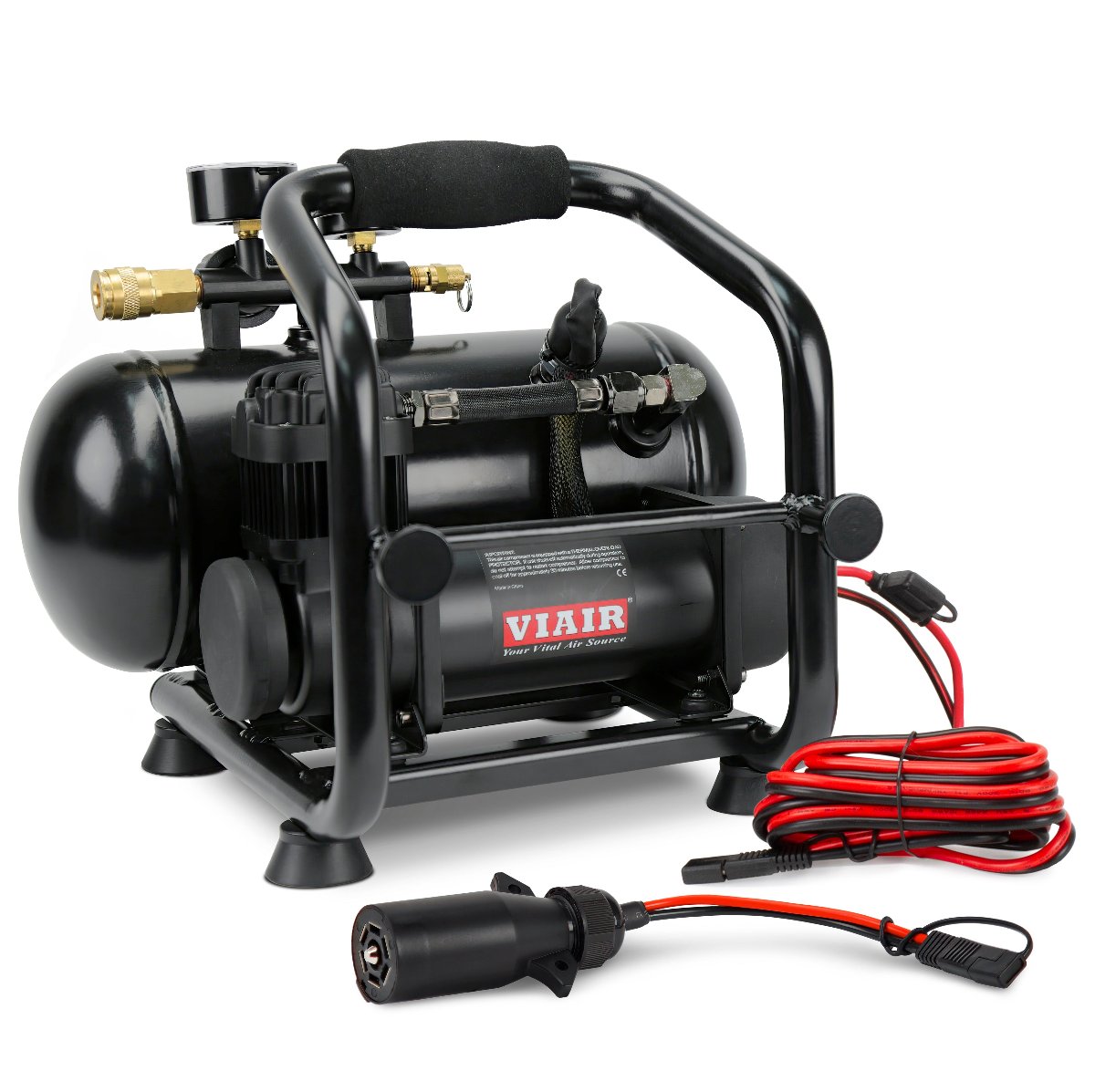
The manufacturer product page has a power-source selector and identifies part 38035 as the 7-way trailer plug; part 38034 is the battery-clamp version. The product manual covers both parts, but their supplied connection ends differ. The exact 38035 image shows the trailer plug and its lead with the tank-and-compressor body. This review therefore does not treat it as interchangeable with the clamps-only 38034, even though both use the same documented 380C compressor platform.
VIAIR’s manual says the tow-vehicle auxiliary circuit must be rated for the compressor’s 23-amp maximum draw and must be properly fused. It notes that some vehicles need a fuse installed and that some may require the brake pedal to be pressed before the seven-way socket supplies power. The manual recommends running the engine during operation. A seven-way connector’s shape alone is not proof that its auxiliary pin is powered or able to deliver this load; check the specific tow vehicle’s manual and fuse layout first.
Plan for the missing tire hardware
The 38035 package page lists the compressor, 1.5-gallon air tank, regulator and gauges, quarter-inch quick-connect coupler, drain cock, filter and safety valve. It does not list a tire gun or valve chuck. The manual says to attach an appropriately rated hose and air tool and recommends separate tire-inflation kits, including a mechanical-gauge tire gun kit and a digital-gauge tire gun kit. A prospective buyer should confirm which separately purchased kit is appropriate for the intended tire and outlet pressure, rather than assume that every 7-way package contains the same tire accessories.
This system’s pressure switch fills its air tank, cycling on at 165 PSI and off at 200 PSI. The manual’s 200-PSI regulator instruction for tire inflation is about maximizing airflow from the compressor. Neither the reservoir switch nor its 200-PSI setting stops a tire at the vehicle’s specified cold pressure. Tire pressure remains an operator-controlled task through the selected tire gun or attachment.
Read the operating limits as conditions, not a ranking
The 38034/38035 manual lists 12 volts, 23 amps, a recommended 30-amp fuse and a 200-PSI maximum working pressure. It rates the compressor at 55% duty at 200 PSI and continuous operation at 100 PSI in its specification table. In its precautions, the same manual says to observe a maximum duty cycle of 30 minutes at 200 PSI. The current product page describes 100% at 100 PSI and 55% at 200 PSI. Because the manual’s simpler 30-minute precaution is more restrictive than a literal 55% hourly interpretation, use the manual’s stated 30-minute limit at 200 PSI and allow cooling as directed.
These source figures do not establish how quickly it will inflate a specific tire. The source set reviewed here does not publish a confirmed tire-size fit boundary or a 38035-specific vehicle-tire fill time. Its 1.5-gallon tank, portability, 23.25-pound listed weight and 14-by-14-by-12-inch product-page dimensions may suit a mobile utility setup, but they do not replace checking available cargo space or the complete air-line arrangement. The dimension drawing lists a different footprint from the product page; verify the current item’s actual storage dimensions if a tight enclosure is involved.
Who should compare it
The 38035 makes sense to investigate when a tow vehicle has a confirmed, suitably rated auxiliary circuit and a user wants a portable tank/compressor for more than one pneumatic job. It is not the easy choice for someone whose only requirement is a ready-to-connect tire inflator, or for a vehicle with an unverified seven-way circuit. If the tow-circuit question is unresolved, the clamp version is a different product configuration—not a reason to assume the 38035 will work from the clamps in its box.
Check the exact part number, circuit and fuse in the vehicle manual, whether the engine must remain running for your setup, and the separate inflation kit’s compatibility, gauge scale and chuck. After use, the compressor manual calls for releasing tank/hose pressure and draining tank moisture. Those steps, plus the need to cool after demanding operation, make the 38035 a small air system to manage rather than a set-and-forget preset inflator.
Sources: VIAIR 38034/38035 product page, 38034/38035 user manual and 38034/38035 dimensional drawing.
Key specifications
Key details at a glance
| Automatic stop at target | No |
|---|---|
| Documented accessories | 380C compressor / 1.5-gallon air tank / 7-way trailer-plug power connection / 2-pin SAE power connection / 0-200 PSI outlet regulator/gauge / 200 PSI tank-pressure gauge / pressure switch / quarter-inch quick-connect outlet / drain cock / air filter / safety valve |
| Operating power arrangement | 7-way trailer auxiliary circuit |
| Maximum working pressure | 200 PSI |
| Maximum current draw | 23 A |
| Published duty-cycle condition | Product page: continuous at 100 PSI and 55% at 200 PSI; manual table: continuous at 100 PSI and 55% at 200 PSI, while its precaution says maximum 30 minutes at 200 PSI. Preserve the 200-PSI wording difference and follow the manual's 30-minute precaution. |
Use the exact model’s instructions for operating limits, supplied equipment and version differences.
Sources for this review
Sources for this assessment
Match the inflator to your power and tire
Use the finder to check whether a reviewed model's documented power source, mode and accessories fit your requirements. It cannot prove an unlisted fit or predict actual fill time.