
Your needs, this model
Does it fit your priorities?
Does part 30034 have automatic tire-pressure stop?
No selected-pressure stop is documented for the 300P-RVS. Its manual says to turn the compressor off at the desired pressure, and the inline gauge can be inaccurate while air is moving. Stay present, use the RV tire’s recommended target and pause to verify pressure.
Explore this need in the finder →Is the 300P-RVS suitable for a cigarette-lighter outlet?
No accessory-socket plan is documented. VIAIR specifies 12V direct battery clamps, up to 30A draw, a 40A fuse and an engine-running procedure. Check the exact vehicle and manual setup rather than assuming a 12V dash socket can power it.
Explore this need in the finder →Can I use the included hose for a Presta bicycle valve?
VIAIR lists a Presta adapter and says that a Presta bicycle valve requires it. The 30034 manual’s tire pressure and duty specifications do not establish a bicycle tire size or fill time; check the adapter is in the exact package and follow the bicycle tire maker’s pressure guidance.
Explore this need in the finder →The VIAIR 300P-RVS / part 30034 is a compact-looking but clamp-powered 12-volt compressor package intended for towable and smaller RV tires. Its exact RVS page lists a 30-foot hose, a 5-in-1 inflator/deflator assembly and an application reference up to 245/70R19.5. This is not the same version as the 300P / 30033 or 300P SXS / 30032. The part number and dedicated 30034 manual matter because the hose length, gauge and package are not interchangeable by family name alone.
What the published speed statement does not establish
The 30034 page advertises a fill from 80 to 90 PSI in 44 seconds for “most” towable-size tires, but it does not name the tire dimensions or give a complete test method on the page. It should not be used as a predicted fill time for a different tire or workload. VIAIR’s product page and comparison table list 2.30 CFM at zero PSI, 150 PSI maximum working pressure, and 33% duty at 100 PSI. The manual adds a condition of 30 minutes at 30 PSI and 72°F. These are separate specifications, not evidence that the product can run continuously at high pressure or fill every RV tire in the advertised time.
The included 150-PSI inline gauge is a scale, not a target stop. The 30034 manual describes switching the compressor off when the desired pressure is reached; it warns that the gauge is affected while air is moving and advises a pause to check pressure. It also describes a thermal protector and calls for roughly 30 minutes of cooling after a thermal shutdown. Use the tire maker’s recommended pressure, keep the pump attended and observe the duty limit.
Battery connection and heat are part of the decision
VIAIR specifies battery clamps and a 30-amp maximum draw. The exact page lists a 40-amp inline fuse holder; the manual names a 40-amp fuse and 12-volt DC operation. It says the engine must run, the switch should be off while attaching the clamps, and the compressor should be kept upright and ventilated. It is not an accessory-socket unit. Do not infer that a 12V outlet is suitable merely from the supply-voltage label.
The page’s application is RV towables and smaller RVs, while the chart’s tire-size reference is 245/70R19.5. Those are manufacturer bounds, not a fit guarantee for a specific wheel, tire or valve. The exact 30034 product page links a dimensional drawing named for 30033, so that drawing is not used here as proof of 30034 dimensions. The product-page figures remain the exact-model source for the 30034 body dimensions.
Hose, gauge and included connections
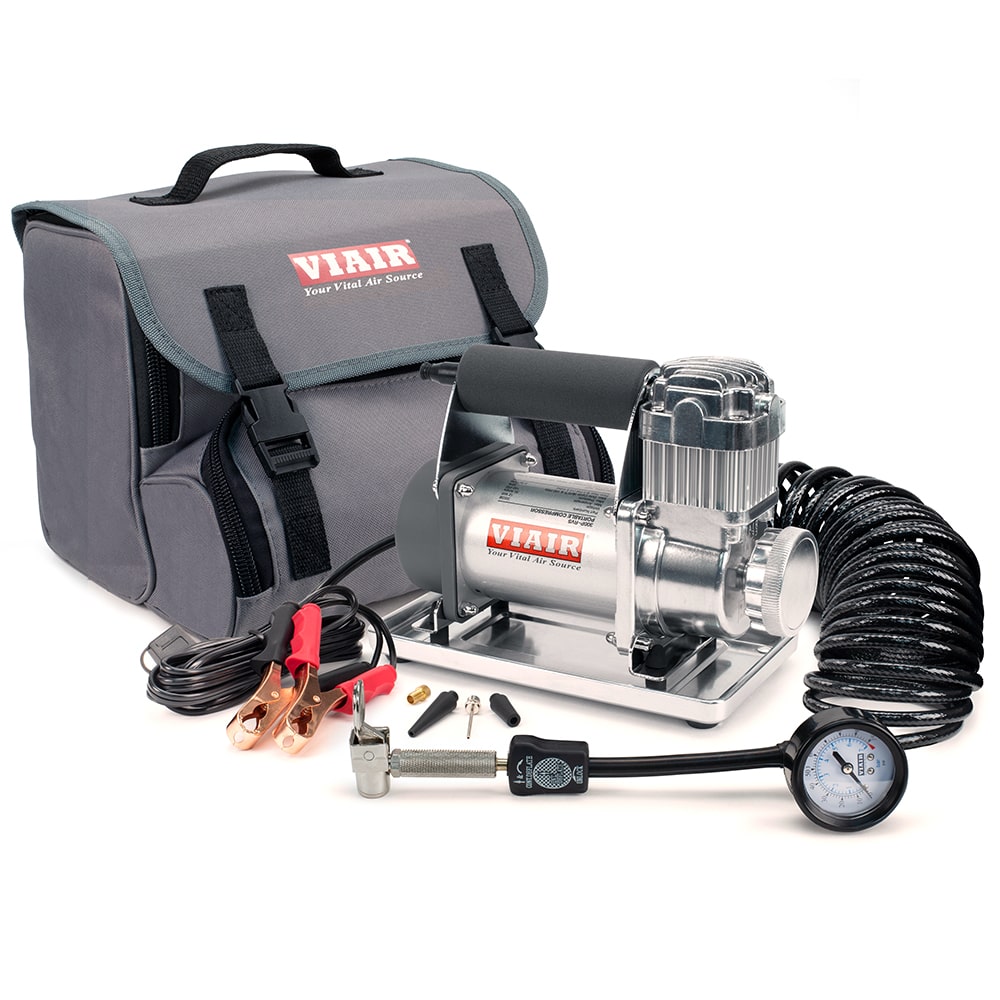
The product page lists a 30-foot 5-in-1 inflator/deflator hose and an inline 150-PSI gauge. The manual describes an inflation chuck that locks onto the tire valve and a separate deflation control, allowing the operator to add or release pressure without changing the whole tool. VIAIR also lists a three-piece tip kit and Presta adapter. Its exact page cautions that a Presta bicycle valve requires the adapter, so a bicycle arrangement depends on that included piece and the correct attachment procedure. No reviewed source establishes a bicycle-tire size or fill-rate limit.
VIAIR warns that the hose can become brittle with extended UV exposure, should be kept from the hot compressor head, and is not recommended for sub-zero or freezing conditions. The compressor and fittings also become hot in use. Store the hose out of the sun, allow hot parts to cool, and check the current manual before using replacement hoses or accessories. The product photo shows the package components but does not guarantee what a third-party seller will ship.
How the RVS model differs from 300P / 30033
The ordinary 300P / 30033 is a separate standard 12V clamp package. Its page describes a 25-foot hose and a 100-PSI gauge, while the exact 30034 RVS page lists a 30-foot hose, 150-PSI gauge and RV-oriented application. Both have a 30-amp maximum-draw claim and a 33%-at-100-PSI duty statement, but the product editions have different accessories and tire references. The “300P” family name is not a substitute for checking the part number on a used or marketplace offer.
Who should shortlist the 30034?
The 300P-RVS is a reasonable document-based candidate for someone who can use direct battery clamps with the engine running, wants a long hose and manual inflate/deflate control, and is evaluating a towable or smaller-RV tire against VIAIR’s stated application reference. It is not a fit for a required accessory-socket connection, cordless use, or preset auto-stop. Before relying on it, verify that the offer is part 30034, contains the 5-in-1 hose, tips and Presta adapter, and matches the current manual. Confirm the tire’s actual pressure requirement, valve access and the vehicle’s electrical arrangement; neither the gauge maximum nor an incomplete time claim resolves those questions.
Sources checked 2026-10-29: VIAIR’s 300P-RVS / 30034 product page, the 30034 manual, and the VIAIR compressor comparison chart. The product page links a dimensional drawing for part 30033; it was not used to assign 30034 dimensions.
Key specifications
Key details at a glance
| Automatic stop at target | No |
|---|---|
| Documented accessories | dual battery clamps / 40A inline fuse holder / 8-foot power lead / 30-foot 5-in-1 inflator/deflator hose with 150-PSI inline gauge / three-piece tip kit / Presta adapter / carry bag |
| Operating power arrangement | Vehicle battery clamps |
| Maximum working pressure | 150 PSI |
| Maximum current draw | 30 A |
| Inline fuse rating | 40 A |
| Tire-chuck connection style | Press-on tire chuck |
| Published duty-cycle condition | 33% at 100 PSI; manual also specifies 30 minutes at 30 PSI at 72F |
| Manufacturer-listed tire-size reference | 245/70R19.5 (manufacturer application reference, not a fit guarantee) |
| Power cord length | 8 ft |
| Air hose length | 30 ft |
| Pressure gauge scale | 150 PSI |
Use the exact model’s instructions for operating limits, supplied equipment and version differences.
Sources for this review
Sources for this assessment
Match the inflator to your power and tire
Use the finder to check whether a reviewed model's documented power source, mode and accessories fit your requirements. It cannot prove an unlisted fit or predict actual fill time.