
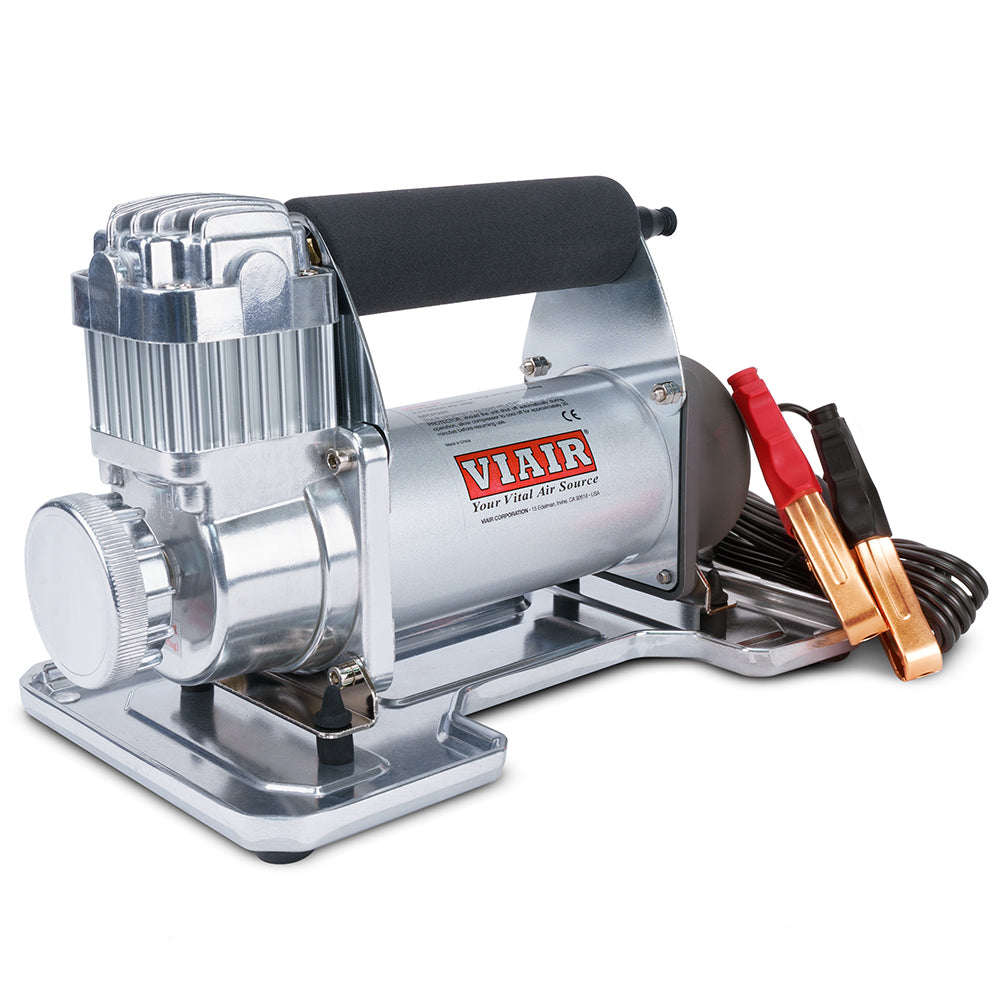
Your needs, this model
Does it fit your priorities?
Can the 400P / 40043 plug into a cigarette-lighter outlet?
The exact 40043 manual specifies 12V battery-clamp use, a 30A maximum draw and a 40A fuse; it does not document an accessory-socket setup. Use the direct-battery connection and follow the engine-running instructions.
Explore this need in the finder →Does the 40043 stop automatically at the tire target?
No preset target stop is documented. The manual says to switch the compressor off at the desired pressure and pause airflow to read the inline gauge accurately.
Explore this need in the finder →Can this 400P inflate a Presta bicycle valve?
VIAIR lists a Presta adapter and says it is needed for that valve type. Verify that the exact 40043 package includes the adapter; the sources do not establish a bicycle-tire capacity or fill time.
Explore this need in the finder →The VIAIR 400P / part 40043 is the 12-volt version of a portable direct-battery compressor. It is not a dash-socket pump, and its rating should not be separated from its electrical hookup, manual controls and duty limits. The manufacturer offers a separate 24-volt 40050 under the same 400P family page, so check the part number before comparing specifications or connecting the clamps. This is a source-based assessment of the documented 40043 package, not a hands-on test.
Begin with the 12V connection
The 40043 manual identifies a 12V DC system, a 30-amp maximum draw and a 40-amp fuse. VIAIR’s product page lists dual battery clamps and an eight-foot power lead; the manual says the vehicle engine must be running and the compressor should not be left unattended. Those details make the setup a poor match for a driver who needs a simple accessory-socket plug. Confirm that the intended vehicle and connection point are suitable for the stated current, install the supplied protection as instructed, and do not improvise a smaller fuse or substitute an outlet that is not rated for the load.
At the tire end, VIAIR lists a 25-foot coil hose. The manual directs the operator to keep the compressor upright, move it to the same side of the vehicle as the tire rather than dragging it, and fully uncoil the power lead. It also warns that the compressor and connected fittings become hot, that the unit is moisture- and dust-resistant rather than waterproof, and that soft sand can let the vibrating base settle into debris. A suitable work area and a plan for handling hot parts are part of the ownership tradeoff.
Pressure control stays with the operator
The listed maximum working pressure is 150 PSI, but the inline gauge is marked to 100 PSI. Those numbers describe different limits: the higher compressor rating is not a useful tire target, and the gauge scale does not display the full compressor rating. The 40043 hose can inflate and deflate; its instructions call for manually switching the compressor off at the desired tire pressure. They also warn that air moving through the hose affects the gauge reading, so pause the flow to check pressure. Use the vehicle’s recommended cold pressure, remain present, and verify the result with an appropriate gauge when needed.
VIAIR publishes 2.30 CFM at zero PSI and a 33% duty cycle at 100 PSI. The manual separately specifies a minimum 20-minutes-on/40-minutes-off cycle at 72°F and 100 PSI, and approximately 40 minutes of continuous use at 30 PSI and 72°F. These are condition-specific limits, not a fill-time estimate for a particular tire. The product page’s broad “up to 35-inch” reference is also an application claim, not proof that every tire of that size, pressure change or repeated workload is suitable.
The hose kit can do more than top off a tire
The 400P page describes a 5-in-1 inflator/deflator hose with a 100-PSI inline gauge, three inflation tips and a Presta adapter. VIAIR says a Presta bicycle valve requires that adapter; the included tire chuck is intended for ordinary vehicle-valve use. That gives the package a documented route for a bicycle valve connection, but the reviewed sources do not establish a bicycle-tire capacity or fill time. Check that the adapter and other small parts are present in the precise offer rather than assuming a used or incomplete kit matches the manufacturer’s box list.
Hose care matters too. VIAIR warns that prolonged sunlight can make the included hose brittle, says to stow it when it is not in use, cautions against contact with the hot compressor head, and does not recommend the hose in sub-zero or freezing conditions. The manual additionally calls for a heat-resistant, minimum 200-PSI working-pressure extension hose if an extension is used. The kit’s published reach is helpful only when the hose and electrical lead can be routed safely.
Keep the neighboring 400P versions separate
The 400P / 40050 is a different 24V configuration with a 15-amp maximum draw and 20-amp fuse; its manual says to use it only on a 24V system. It is not an interchangeable substitute for this 12V 40043. The 400P-AUTO / 40045 adds a trigger-style tire gun and a fixed pressure switch, while the 400P-RV / 40047 is packaged with longer hose components and RV-oriented fittings. Those are separate configurations, not alternate names for the 40043. If you want to compare ordinary tire top-offs, the 400P’s manually operated multifunction hose may be simpler than the larger automatic/RV packages; it still demands direct battery access and operator attention.
Who should consider this exact part?
On paper, the 40043 suits a buyer with a compatible 12V battery connection who values a long coil hose, manual inflate/deflate control and the listed Presta adapter. It is a poor choice if the essential requirement is cordless operation, preset tire-pressure shutoff, a low-current outlet or unattended use. Before buying, verify the 40043 label, the included clamps and fuse holder, the 5-in-1 hose and adapters, and the current manual. Match the task to the vehicle’s electrical system and the published duty conditions rather than treating CFM, maximum pressure or a tire-size headline as a universal performance guarantee.
Sources checked 2026-10-28: VIAIR’s 400P product page and voltage variants, the 40043 manual, the portable tire-inflator table and the compressor comparison chart.
Key specifications
Key details at a glance
| Automatic stop at target | No |
|---|---|
| Documented accessories | dual battery clamps / 40A inline fuse holder / 8-foot power lead / 25-foot 5-in-1 inflator/deflator hose with inline gauge / I-beam sand tray / dual-compartment carry bag / three-piece inflation-tips kit / Presta adapter |
| Operating power arrangement | Vehicle battery clamps |
| Maximum working pressure | 150 PSI |
| Maximum current draw | 30 A |
| Inline fuse rating | 40 A |
| Tire-chuck connection style | Press-on tire chuck |
| Published duty-cycle condition | 33% at 100 PSI; manual specifies 20 minutes on / 40 minutes off at 72°F and 100 PSI; approx. 40 minutes continuous at 30 PSI and 72°F |
| Manufacturer-listed tire-size reference | Up to 35 inches (manufacturer application reference only; not a fit guarantee) |
| Power cord length | 8 ft |
| Air hose length | 25 ft |
| Pressure gauge scale | 100 PSI |
Use the exact model’s instructions for operating limits, supplied equipment and version differences.
Sources for this review
Sources for this assessment
Match the inflator to your power and tire
Use the finder to check whether a reviewed model's documented power source, mode and accessories fit your requirements. It cannot prove an unlisted fit or predict actual fill time.