
Your needs, this model
Does it fit your priorities?
Will part 40050 work with a typical 12V passenger car?
No. Its own manual says to use the 40050 only with a 24V DC system; it is electrically distinct from the 12V 40043. Confirm the vehicle voltage before ordering.
Explore this need in the finder →Is the 40050’s published flow value settled?
No. The shared product page lists 2.30 CFM at zero PSI, while the current comparison table lists 2.54 CFM for part 40050. This review does not select one or estimate fill time from either.
Explore this need in the finder →Does the 40050 have preset tire-pressure stopping?
No preset target stop is documented. The manual instructs the user to switch off at the desired tire pressure and pause airflow for a reading.
Explore this need in the finder →The VIAIR 400P / part 40050 is the 24-volt member of the 400P family, not a higher-voltage setting on the 12-volt 40043. Its model-specific manual says to use the compressor only with 24V DC systems and documents different current and fuse requirements from the 12V variant. The same product page presents both choices together, which makes the printed part number and manual unusually important checks. This assessment uses VIAIR’s source material; it does not claim installation or testing.
Its defining difference is the supply system
The exact 40050 manual lists a 24-volt motor, a 15-amp maximum current draw and a 20-amp fuse. VIAIR’s product page also identifies a 24-volt variant, while its supply note gives 28 volts for the 24V compressor. The instructions require the vehicle engine to be running and call for direct battery clamps. That combination can suit a properly equipped 24V vehicle, but it is not compatible with an ordinary 12V car battery or a cigarette-lighter outlet. Confirm that the vehicle’s electrical system, connection points and supplied fuse match the manual before purchase or use.
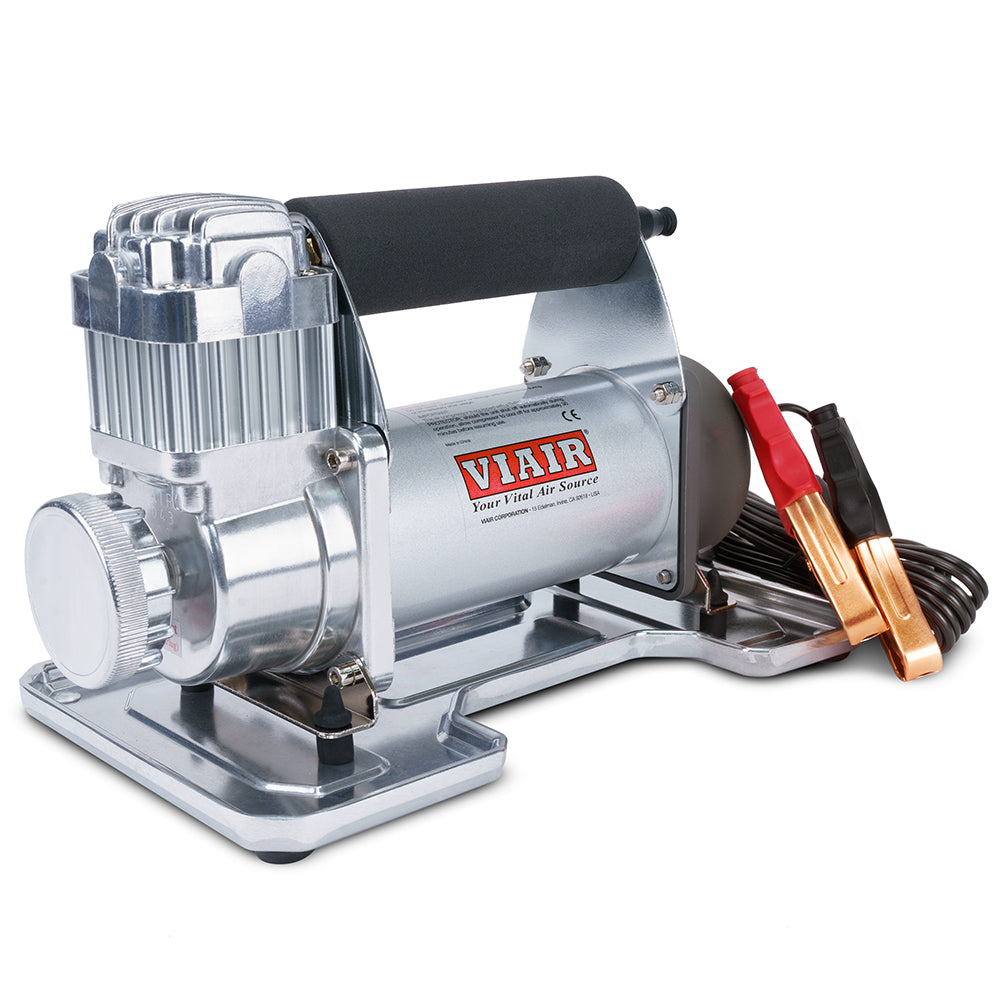
The shared product page lists an eight-foot lead and a 25-foot hose for the 400P family. Its kit description includes a 5-in-1 inflator/deflator hose, a 100-PSI inline gauge, three inflation tips and a Presta adapter. The 40050 manual independently establishes the voltage-specific operating instructions; it should not be replaced by the 40043 manual just because both products use the 400P name. The published manufacturer image is shared on that family page and does not visually distinguish the 24V wiring version, so treat the page photo only as a general 400P body reference and verify the SKU label in any offer.
Do not resolve the flow discrepancy by guesswork
The product page gives a family-level 2.30 CFM figure at zero PSI, while VIAIR’s compressor comparison chart lists 2.54 CFM for part 40050. Because those are conflicting manufacturer figures for the 24V part, this review does not choose one as a settled 40050 rate or derive a fill-time estimate from either. The chart also lists 35-inch tire size, a 150-PSI working-pressure maximum and 33% duty at 100 PSI. The manual specifies a minimum 20-minutes-on/40-minutes-off cycle at 72°F and 100 PSI, plus approximately 40 minutes of continuous use at 30 PSI and 72°F. Those operating conditions matter more than a zero-pressure flow number when planning a real job.
The manual gives the inline gauge a 100-PSI scale even though the compressor maximum is 150 PSI. It tells the operator to switch the motor off at the desired tire pressure, and warns that airflow affects the inline reading. In practical terms, this is a manually controlled machine, not a preset-stop inflator. Pause to read pressure, follow the tire or vehicle’s recommended target, and stay with the running compressor.
Long reach comes with handling constraints
The hose length gives room to position the compressor near a vehicle rather than placing it beside every tire, but the manual still says to keep the machine upright, avoid tugging it by the lead or hose, and fully uncoil the power cord. VIAIR cautions that the hose can become brittle after prolonged exposure to sunlight, should be stored out of the sun when not in use, must not touch the hot compressor head and is not recommended for freezing conditions. It describes the unit as moisture- and dust-resistant, not waterproof, and warns against running it in soft sand. The package is substantial enough that these details should shape where it is stored and operated.
Choose 40050 only when 24V is intentional
For a 12V passenger car, the 40043 is the more relevant 400P configuration; changing to part 40050 because it appears on the same page would create an electrical mismatch. For a fleet truck, RV or other 24V platform, the 40050’s lower published current draw than the 12V sibling is a meaningful distinction, but it does not prove that a particular vehicle’s wiring, battery state or application is suitable. The 400P-AUTO and 400P-RV are separate 12V part numbers with gun-and-switch or RV-reach packages, not 24V alternatives.
Fit boundaries to verify
On paper, part 40050 is for someone who has a confirmed 24V direct-battery setup and wants VIAIR’s long-hose, manual-control 400P format. It is a poor choice for 12V passenger vehicles, accessory sockets, cordless use or anyone expecting preset shutoff. Check the 40050 model marking, 24V manual, 20-amp fuse, clamps, hose and adapter contents before ordering. The manufacturer’s flow figures conflict, the gauge scale is below the compressor’s working-pressure limit, and neither a tire-size reference nor a maximum-pressure rating guarantees fit or speed for an individual task.
Sources checked 2026-11-01 for the current page variant/image association and 2026-10-28 for the other records: VIAIR’s 400P product page and voltage variants, the 40050 manual, the portable tire-inflator table and the compressor comparison chart. The current page maps 40050 to the same official image asset used for 40043; the photo itself does not show a voltage label.
Key specifications
Key details at a glance
| Automatic stop at target | No |
|---|---|
| Documented accessories | dual battery clamps / 20A inline fuse holder / 8-foot power lead / 25-foot 5-in-1 inflator/deflator hose with inline gauge / I-beam sand tray / dual-compartment carry bag / three-piece inflation-tips kit / Presta adapter |
| Operating power arrangement | Vehicle battery clamps |
| Maximum working pressure | 150 PSI |
| Maximum current draw | 15 A |
| Inline fuse rating | 20 A |
| Tire-chuck connection style | Press-on tire chuck |
| Published duty-cycle condition | 33% at 100 PSI; manual specifies 20 minutes on / 40 minutes off at 72°F and 100 PSI; approx. 40 minutes continuous at 30 PSI and 72°F |
| Manufacturer-listed tire-size reference | 35 inches (manufacturer table application reference only; not a fit guarantee) |
| Power cord length | 8 ft |
| Air hose length | 25 ft |
| Pressure gauge scale | 100 PSI |
Use the exact model’s instructions for operating limits, supplied equipment and version differences.
Sources for this review
Sources for this assessment
Match the inflator to your power and tire
Use the finder to check whether a reviewed model's documented power source, mode and accessories fit your requirements. It cannot prove an unlisted fit or predict actual fill time.