
Your needs, this model
Does it fit your priorities?
Does the 450P-RVS stop automatically at my tire’s selected PSI?
No user-selected tire target stop is established for part 45057. Its manual says to hold the inflation-gun trigger and release it at the desired pressure; the fixed internal pressure switch protects the compressor rather than sensing your chosen tire target. Stay present and pause the flow before checking the gun gauge.
Explore this need in the finder →Can I run the 450P-RVS from a dashboard 12V socket?
The exact product page and manual document battery clamps, a maximum draw of 23A and engine-running use, not an accessory-socket plan. The manual specifies a 30A fuse, while the exact-part drawing labels 40A battery clamps; confirm the wiring and fuse with VIAIR rather than treating the clamp rating as a fuse or using an assumed socket.
Explore this need in the finder →What is the practical difference between the 450P-RVS hose and chuck pieces?
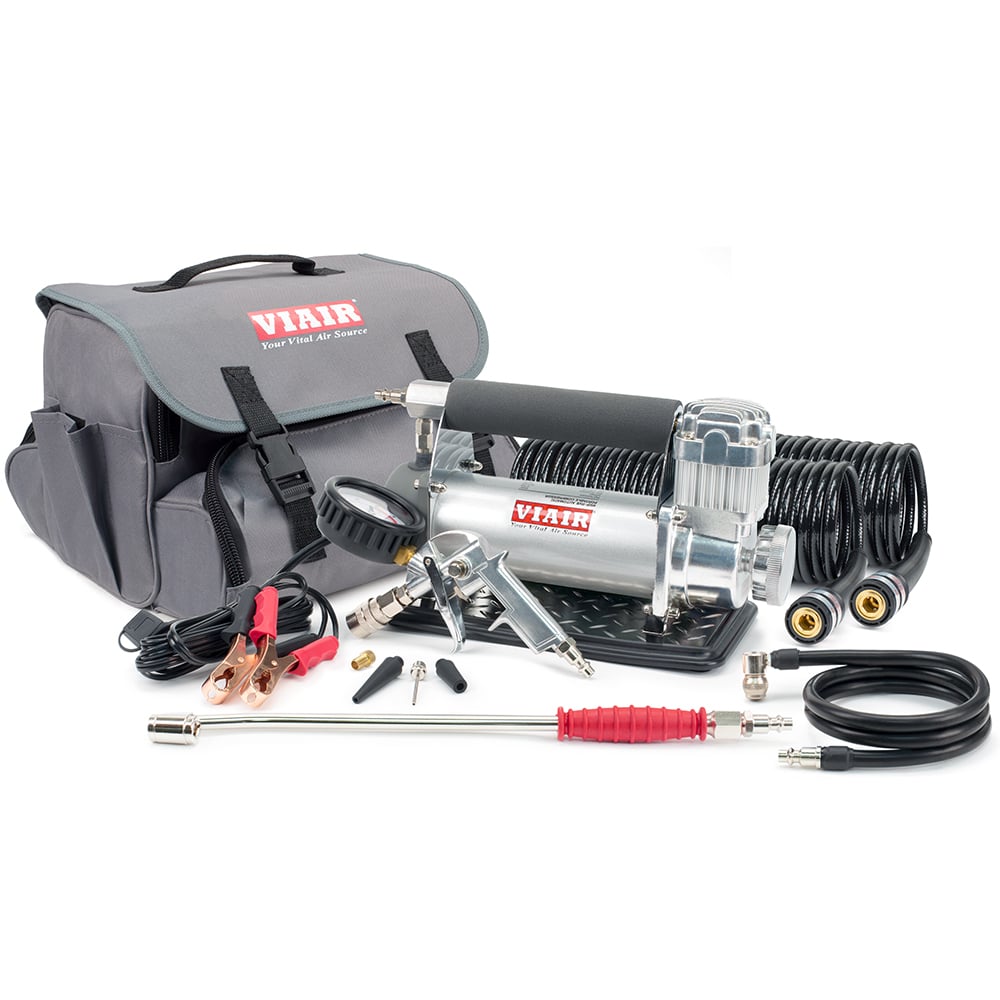
The exact 45057 page lists a 30-foot primary hose, a separate 30-foot extension, a standard trigger gun, a 45-degree extended-reach chuck and a 90-degree twist-on attachment. These solve different access problems; the twist-on setup does not include the Presta route assigned to the standard press-on gun plan. Check which pieces are in the exact offer.
Explore this need in the finder →The VIAIR 450P-RVS / part 45057 is a 12-volt clamp-powered compressor package aimed at Class A and smaller RVs. Its distinguishing idea is not a different power source from every other RVS unit; it is the combination of a published continuous-duty rating at a stated pressure, a long primary-and-extension hose arrangement, and alternate chucks for access around larger or paired wheels. This is a document-based assessment of the exact VIAIR listing and manual, not a hands-on test.
“Automatic” does not mean target-pressure autopilot
The listing calls the model automatic and advertises an automatic shut-off function. The manual’s tire procedure, however, tells the operator to hold the inflation-gun trigger and release it when the desired tire pressure is reached. It describes a built-in pressure switch that turns the compressor off at its factory-set internal pressure and back on at a lower threshold; that is not the same as entering a tire target and having the pump stop at that number. For this assessment, preset tire-pressure stopping is not established. Stay with the compressor, use the vehicle or tire maker’s pressure guidance, and pause the flow before relying on the gun gauge reading.
The manual also says that the vehicle engine must run while the compressor is used. Attach the red and black clamps with the switch off, keep the unit upright and ventilated, and fully uncoil the power lead. The exact page lists a maximum draw of 23 amps. Its manual specifies a 30-amp fuse, while the exact-part drawing labels 40-amp battery clamps; the page says an inline fuse is included but does not give its amperage. Those labels describe different components, and the documents do not explain their relationship. Do not treat the clamp label as a fuse rating or substitute a different fuse; confirm the exact wiring and included hardware with VIAIR.
Continuous-duty figures still have conditions
VIAIR publishes 100% duty at 100 PSI, and the manual specifies that rating at 72°F; it also reports continuous use at 30 PSI at that temperature. The product page separately says the unit can operate for up to an hour before rest at up to 100 PSI. These statements make the 45057 the high-duty RVS option in this VIAIR group, but they do not establish an unlimited workload in hotter weather, at every pressure or with every tire. The listed 1.80 CFM is at zero PSI, not a fill rate at a real tire pressure. The page lists a 275/80R22.5 tire-size reference and a 150-PSI maximum working pressure; neither number certifies a specific RV’s tire or predicts how quickly it will inflate.
Use the manual’s cooling and pressure limits rather than extrapolating from the duty headline. It warns that the compressor and fittings become very hot, calls for ventilation, and says not to leave the unit unattended. Its gauge is convenient for monitoring but not accurate while air is moving; briefly release the gun trigger to check pressure. The gun also includes a bleeder, so this package supports deliberate manual air-down as well as inflation.
Why the RVS package is about reach
The reviewed 45057 page lists a 30-foot primary hose and a separate 30-foot extension, along with a 40-inch hose on the 90-degree twist-on chuck. The box also lists the gas-station-style trigger gun, a 45-degree extended-reach chuck, dual clamps, bag, tips and a Presta adapter. VIAIR’s note says the Presta bicycle valve needs that adapter. Those are alternate attachments, not one universal valve connection: the standard gun’s press-on chuck, the open-ended 45-degree reach piece and the 90-degree twist-on piece should be treated as different setups. The matcher therefore only counts a Presta adapter with the standard gun arrangement, not the alternate twist-on route.
Hose length is useful only if it fits the route around the actual vehicle. The manual advises moving the compressor to the same side as the wheels being serviced rather than pulling it by its cord or hose. It also warns that the hose and fittings can be hot and calls for heat-resistant, pressure-rated replacement hose if one is ever needed. VIAIR’s product page warns about prolonged sun exposure and freezing conditions for the supplied hose; stow it when not in use and check the current instructions for the expected environment.
450P-RVS versus 450P-RV
The 450P-RVS / 45057 and 450P-RV / 45053 are separate exact listings, not suffixes to ignore. Both are clamp-powered 450P packages with extended hose and alternate RV chucks; the RVS product page specifically positions 45057 for Class A and smaller RVs and publishes its own tire-size reference. The 45053 page has a different package presentation and manual record. Check the actual part label, hose set, manual, fuse information and target application rather than assuming a seller’s generic “450P RV” wording identifies 45057. The 400P-RVS / 40044 also has dual hoses and reach attachments, but its 33%-at-100-PSI duty claim is not interchangeable with the 45057’s rating.
Who should investigate it further?
The 45057 is a paper-based candidate for an RV owner who can use a direct battery connection with the engine running, needs a long hose route or alternate reach chuck, and is prepared to control tire pressure manually. It is a poor match for a buyer who requires a vehicle accessory plug, cordless use or an automatic stop at a selected tire pressure. Before choosing a specific offer, verify part 45057, the included primary and extension hoses, the 45- and 90-degree attachments, the exact fuse-and-clamp arrangement, the vehicle’s electrical setup and the tire maker’s pressure instructions. VIAIR’s numerical references are bounded manufacturer specifications, not a compatibility guarantee or an independent performance result.
Sources checked 2026-10-29: VIAIR’s 450P-RVS / 45057 product page, the 45057 manual, the 45057 dimensional drawing, and the VIAIR compressor comparison chart.
Key specifications
Key details at a glance
| Automatic stop at target | No |
|---|---|
| Documented accessories | dual battery clamps / inline fuse of unresolved page amperage / 30-foot primary hose / 30-foot extension hose / trigger inflation gun with 160-PSI gauge and bleeder / 45-degree extended-reach chuck / 90-degree twist-on chuck with separate 40-inch hose / three-piece tip kit / Presta adapter / carry bag |
| Operating power arrangement | Vehicle battery clamps |
| Maximum working pressure | 150 PSI |
| Maximum current draw | 23 A |
| Published duty-cycle condition | 100% at 100 PSI at 72F per manual; continuous at 30 PSI at 72F; product page separately says up to one hour at up to 100 PSI |
| Manufacturer-listed tire-size reference | 275/80R22.5 (manufacturer application reference, not a fit guarantee) |
| Power cord length | 8 ft |
| Air hose length | 30 ft |
| Pressure gauge scale | 160 PSI |
Use the exact model’s instructions for operating limits, supplied equipment and version differences.
Sources for this review
Sources for this assessment
Match the inflator to your power and tire
Use the finder to check whether a reviewed model's documented power source, mode and accessories fit your requirements. It cannot prove an unlisted fit or predict actual fill time.