
Your needs, this model
Does it fit your priorities?
Will the VIAIR 75P work from a passenger car’s 12V outlet?
Only if that specific outlet is rated for at least 10 amps or 120 watts. VIAIR says the engine must be running and warns that some vehicle outlets have a lower rating. Check the owner manual before purchase; do not replace the original fuse with a higher-rated fuse.
Explore this need in the finder →Can the 75P inflate a bicycle with a Presta valve?
VIAIR lists a Presta adapter among the 75P accessories and the manual says a Presta bicycle valve needs that adapter. The included primary chuck is a press-on tire chuck; confirm the exact kit still includes the small adapter before ordering.
Explore this need in the finder →Does the 75P stop when a preset pressure is reached?
No preset auto-stop is documented for the 00075. The manual describes switching the unit off when the gauge reaches the desired target, and cautions that the gauge is not accurate while air is moving. Turn the compressor off to verify pressure, and do not leave it running unattended.
Explore this need in the finder →The VIAIR 75P (part number 00075) is a small, 12-volt compressor for motorists who can power it from an accessory socket rated for at least 10 amps or 120 watts. It is a different proposition from a rechargeable inflator: the 75P depends on a vehicle power cord, a running engine, and a manual switch-off. This assessment uses VIAIR’s product listing and the exact 00075 manual; it is not a hands-on test.
A useful fit depends on the socket, not just the plug
VIAIR describes the 75P as suited to sedans and hatchbacks. Its manual makes the electrical condition explicit: the socket must support 10 A or 120 W, and some vehicles provide less. Check the rating in the vehicle manual before buying; the existence of a 12-volt outlet does not establish that it can safely supply the compressor’s full draw. VIAIR also says to leave the original circuit fuse in place rather than substituting a higher-rated fuse. During use the engine must be running. That is a real trade: it avoids carrying a battery-powered pump that must be recharged, but it is not an engine-off emergency option.
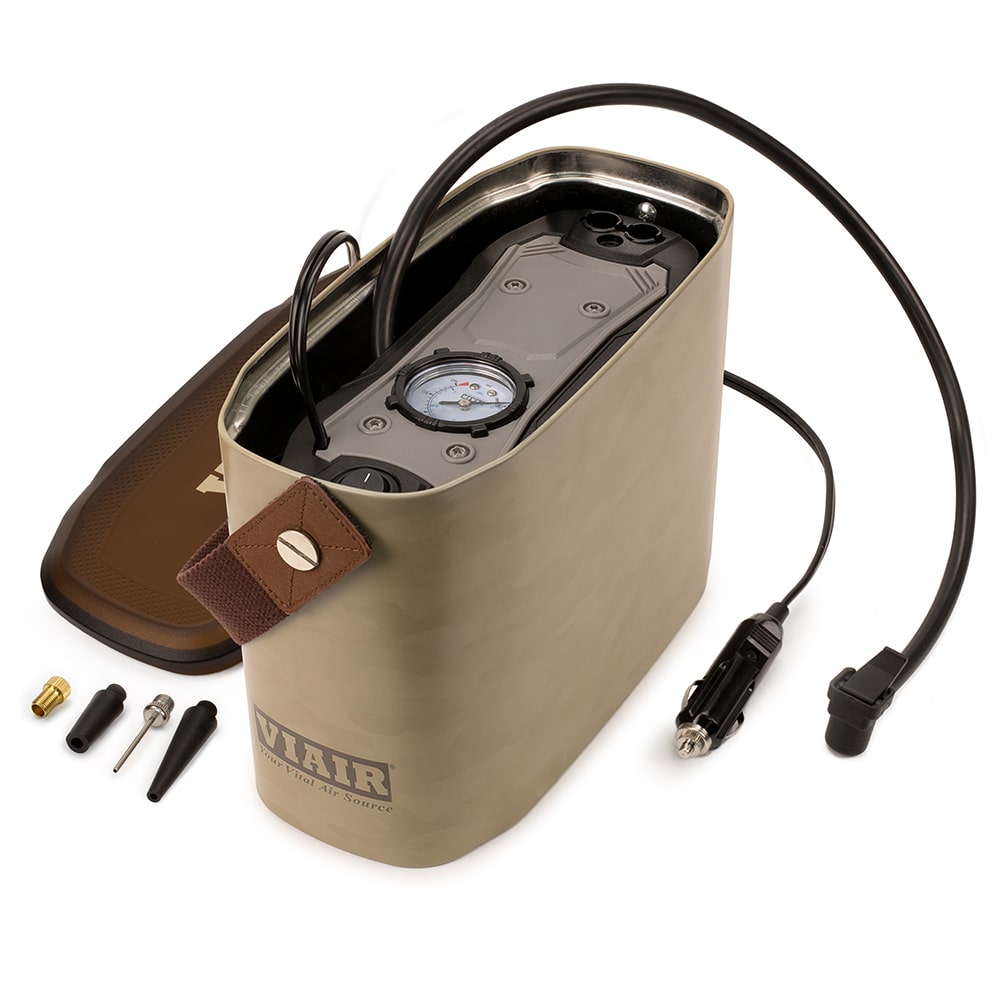
The published setup is plain. Uncoil and fully extend the 10-foot power cord, put the switch in OFF before connecting power, attach the press-on chuck to the valve, start the engine, then switch the compressor on. The air hose is only 2 feet long, so access from the vehicle socket to the tire valve deserves a check on vehicles with an inconvenient outlet position. A metal storage case, strap, top-mounted gauge, accessory plug, three-piece inflation-tip kit and Presta adapter are listed. Confirm the exact contents in the seller’s package rather than assuming every offer is identical.
Keep the pressure ceiling and gauge use separate
The product page and manual give a maximum working pressure of 50 PSI. The manufacturer’s portable-inflator table lists a largest tire size of 225/60/18, while the product page describes the model more generally for smaller passenger vehicles. Treat those as VIAIR’s stated fit boundaries, not as a promise that the unit is suitable for every tire at that size or every inflation task. Set the target from the vehicle placard or owner’s manual, not from the tire’s sidewall maximum, consistent with NHTSA tire guidance.
The included gauge is marked to 60 PSI, but a gauge scale is not the same as the compressor’s 50-PSI working-pressure limit. More importantly, VIAIR says the gauge cannot provide an accurate reading while air is moving; its manual instructs the user to turn the compressor off to verify tire pressure. There is no preset-pressure controller or automatic shutoff listed for this model, so the operator has to monitor pressure and switch it off. That makes a separate final check sensible, particularly if a vehicle’s required cold pressure is near the unit’s ceiling.
Do not convert a flow claim into a fill-time promise
VIAIR rates the 75P for continuous duty at 50 PSI and lists a 1.13-CFM flow figure at zero pressure on both the product page and current manual. However, the manufacturer’s portable-tire-inflator comparison table lists 1.43 CFM at zero pressure for the same 00075 part number. The same table and product page also disagree on the zero-pressure noise value (74 dB versus 70 dB). Those official-source conflicts are unresolved, so this review does not pick one figure or translate it into minutes per tire. The sources do not provide a standardized tire, start pressure, final pressure or test procedure that would support a fill-time comparison. The duty-cycle figure is a stated rating at a particular pressure, not proof of unlimited operation in all temperatures or conditions.
VIAIR warns that the compressor becomes hot during and immediately after use. The manual says to use it in a well-ventilated, dry area, not to leave it running unattended, and to inflate only to the item maker’s recommended pressure. Its moisture-and-dust-resistant statement is not a claim that the operating unit is waterproof; avoid running it in rain, snow or wet ground. Give the unit time to cool before packing it away.
Where it differs from a rechargeable inflator
Compared with the VIAIR EVC25, the 75P trades the internal battery, digital preset and automatic stop for direct 12-volt socket operation and a simple analog gauge. The EVC25 manual describes battery-powered preset stopping; it also must not be operated while charging. Choose by the job, not by a headline PSI number: a charged self-contained unit may be easier away from the car, while the 75P avoids charge-state dependence if a suitable, engine-running vehicle socket is available. The 75P’s 50-PSI working limit and the outlet’s amperage rating are decisive constraints, not minor details.
Bottom line
The 75P is worth shortlisting when a compact case, a standard vehicle socket, a 10-amp circuit and manual pressure control suit the intended top-off routine. It is a poor match if the vehicle port is unrated or below spec, if the engine cannot run during inflation, if automatic stopping is essential, or if the tire task exceeds the stated pressure/size boundary. Before ordering, verify the exact model number 00075, the listed accessories and the seller’s return terms; then use the vehicle’s specified cold pressure and the 75P manual’s operating precautions.
VIAIR 75P product information · VIAIR 00075 user manual · VIAIR portable tire-inflator comparison table
Key specifications
Key details at a glance
| Automatic stop at target | No |
|---|---|
| Documented accessories | integrated steel storage case / durable strap / 10A accessory power plug / three-piece inflation tips kit / Presta valve adapter |
| Operating power arrangement | 12V vehicle accessory port |
| Maximum working pressure | 50 PSI |
| Maximum current draw | 10 A |
| Minimum documented vehicle-port rating | 10 A |
| Tire-chuck connection style | Press-on tire chuck |
| Published duty-cycle condition | 100% at 50 PSI (manual specifies at 72°F) |
| Manufacturer-listed tire-size reference | 225/60/18 (manufacturer comparison-table notation) |
| Power cord length | 10 ft |
| Air hose length | 2 ft |
| Pressure gauge scale | 60 PSI |
Use the exact model’s instructions for operating limits, supplied equipment and version differences.
Sources for this review
Sources for this assessment
Match the inflator to your power and tire
Use the finder to check whether a reviewed model's documented power source, mode and accessories fit your requirements. It cannot prove an unlisted fit or predict actual fill time.