
Your needs, this model
Does it fit your priorities?
Will the 84P run from any 12V car socket?
No. The exact 00084 manual requires a vehicle power port rated for 15 amps and says to run the engine. Check the rating for that particular outlet in the vehicle manual; do not fit a larger fuse to compensate for an undersized circuit.
Explore this need in the finder →Does the analog 84P stop at a selected pressure?
No preset shutoff is documented. The manual describes watching the gauge and switching the pump off yourself. Its gauge is not accurate while air is moving, so verify the reading with the compressor off; do not leave the unit running unattended.
Explore this need in the finder →Is 84P/00084 the same as 85P/00085 or EVC84P Digital?
No. VIAIR identifies analog SKU 00084 as a press-on-chuck accessory-socket configuration; 00085 is the analog twist-on version, and EVC84P is a separate digital model with preset shutoff. The shared 85P product-page heading can obscure the variant names, so compare exact SKU and manual.
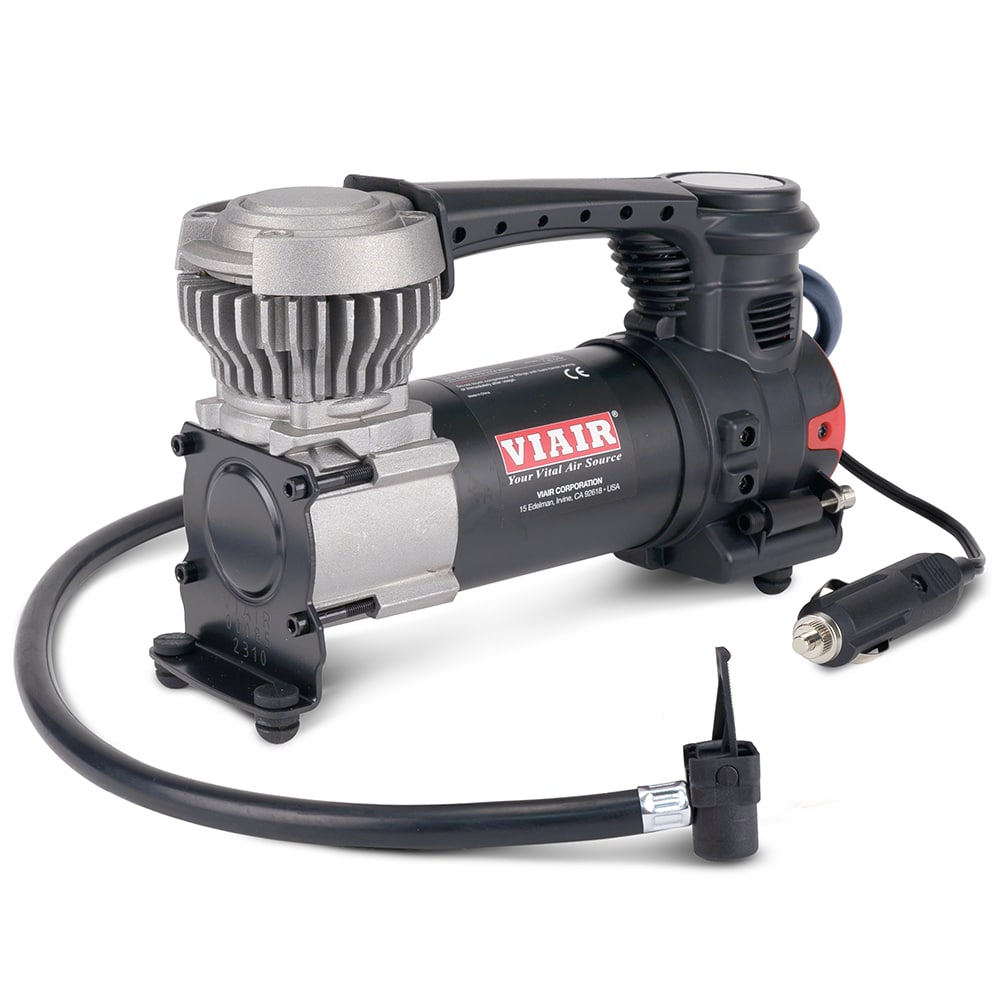
Explore this need in the finder →This assessment is for the analog VIAIR 84P, part 00084: the accessory-socket version with a press-on tire chuck. It is not the similarly named 85P/00085 twist-on model, the clamp-powered 87P/00087, or the later EVC84P Digital. VIAIR's shared product page uses “85P” as its family title while its live variant and manual identify 00084 as the 84P. Check the part number and connection style in an offer rather than relying on the family heading. This is a documentary assessment, not a hands-on test.
The accessory outlet has to be rated for the compressor
The 84P is a 12-volt compressor that draws up to 15 amps. VIAIR says the vehicle's power port must itself be rated for 15 amps, and the manual calls for the engine to be running while the pump operates. That makes this a poor fit for a lower-rated cabin socket, a battery-only roadside setup, or someone who needs engine-off use. The manual specifically warns not to substitute a larger fuse for the vehicle's original rating. Confirm the correct port in the vehicle's owner information before considering this model; a plug that physically fits does not prove the circuit can supply the load.
The manufacturer lists a ten-foot power cord but only a three-foot air hose. At 4.3 pounds and about 9.1 by 3.1 by 5.6 inches, it is compact on paper; those figures do not establish storage fit in a particular vehicle.
Press-on is the defining connection
The 00084 uses a press-on tire chuck, rather than the twist-on chuck shown for the neighboring 00085 and 00087 variants. A press-on fitting is a different routine at the valve; it is not a substitute for the latter models' thread-on connection. VIAIR's current variant page labels the 00084 as “Aux-Port (15A) / Press-on chuck,” and the 00084 manual names the press-on chuck. An older dimensional drawing groups 00084 with 00085 under a twist-on label, which conflicts with the current variant page and exact manual. I would trust neither an ambiguous family photo nor that old drawing over the exact part number and its current manual; check the nozzle shown in the offer.
The page lists a built-in 100-PSI gauge, LED work light/power indicator, carrying bag, three-piece inflation-tip kit and Presta adapter. The manual also documents the Presta adapter and explains that the tips attach to the hose chuck for other inflatables. Confirm small accessories in the exact package, especially if a bicycle valve is part of the plan. VIAIR lists car-tire, bicycle-tire and sports-ball uses, but a broad use label does not establish fit for every valve or guarantee how quickly a particular tire will inflate.
Stay with the pump and verify with it off
This is an analog, manually switched unit. The reviewed instructions do not document a preset pressure selector or automatic shutoff: the operator watches pressure, switches the compressor off, and then checks the reading with the unit off. VIAIR warns that the gauge cannot give an accurate reading while air is moving. A 100-PSI gauge scale is not the compressor's working-pressure rating; the 00084 manual sets its maximum working pressure at 60 PSI. Nor is either number a recommendation for the tire. Use the vehicle's placard or owner information for the intended cold pressure and do not exceed the compressor's stated operating limit.
The manual gives a 20-minute duty-cycle figure at 30 PSI and 72°F. That is a bounded operating instruction, not a promise that a given number of tires can be topped up or that the device can recover a flat. Stop for the required cooling interval and follow the current manual rather than inferring a rest interval from a product listing. VIAIR also warns that the compressor and connected parts become hot, calls for dry, ventilated use, and says not to leave it running unattended.
Published flow numbers do not tell you a fill time
The exact manual and shared product page state 1.77 CFM at zero pressure, while VIAIR's portable-inflator comparison table lists 1.26 CFM for the 84P. The current table lists a 31-inch tire-size reference and a 60-PSI working pressure; the family page also claims use for midsize tires up to 31 inches. Those are manufacturer-published references, not independent fit or speed tests. Since the zero-pressure flow values conflict and neither reviewed source gives a standardized result for a named tire and starting pressure, this assessment does not predict fill time or rank the 84P by speed. The manual's duty cycle and the exact tire target are more relevant constraints for the owner's decision.
Where it sits beside the 87P and Digital models
The 87P/00087 changes the power route to battery clamps, the tire fitting to twist-on, and the listed air hose to eight feet; it is a distinct compressor configuration, not simply the 84P with another cable. The standard analog 85P/00085 keeps an accessory plug but uses a twist-on chuck. EVC84P Digital also uses an accessory plug and press-on chuck, but adds a digital preset shutoff and is a separate SKU with its own evidence and unresolved pressure-rating discrepancy. If any of those differences is essential, compare the exact manual for that model instead of treating “84/85P” as one interchangeable package.
Bottom line
The 84P/00084 is a plausible choice only when the vehicle has a verified 15-amp accessory port, the engine can run, a press-on fitting is acceptable, and manual monitoring fits the task. Its short hose, 60-PSI maximum working pressure, limited duty-cycle condition, and conflicting flow data rule out confident claims about universal tire fit or inflation speed. It is not the option for a shopper who needs direct battery clamps or preset shutoff. Before ordering, verify the 00084 part number, press-on chuck, included adapters, socket rating and operating instructions; then set pressure from the vehicle's cold-tire recommendation and recheck with a separate gauge as appropriate.
Key specifications
Key details at a glance
| Automatic stop at target | No |
|---|---|
| Documented accessories | press-on tire chuck / three-piece inflation-tip kit / Presta valve adapter / 10-foot accessory power cord / carry bag / LED work light/power indicator / built-in 100-PSI gauge |
| Operating power arrangement | 12V vehicle accessory port |
| Maximum working pressure | 60 PSI |
| Maximum current draw | 15 A |
| Minimum documented vehicle-port rating | 15 A |
| Tire-chuck connection style | Press-on tire chuck |
| Published duty-cycle condition | 20 minutes at 30 PSI at 72°F (exact 84P manual) |
| Manufacturer-listed tire-size reference | 31-inch tire-size reference in VIAIR comparison table and 85P-family page |
| Power cord length | 10 ft |
| Air hose length | 3 ft |
| Pressure gauge scale | 100 PSI |
Use the exact model’s instructions for operating limits, supplied equipment and version differences.
Sources for this review
Sources for this assessment
Match the inflator to your power and tire
Use the finder to check whether a reviewed model's documented power source, mode and accessories fit your requirements. It cannot prove an unlisted fit or predict actual fill time.