
Your needs, this model
Does it fit your priorities?
Can the 87P be powered from a regular cabin accessory socket?
The exact 00087 configuration uses red and black battery clamps, not an accessory plug. The manual requires the engine to run and shows the clamp connection sequence. Do not assume a socket-compatible alternative or improvise a lower-rated circuit.
Explore this need in the finder →What does the 87P 20-amp fuse mean when its listed maximum draw is 15 amps?
The manual specifies a 20-amp inline fuse holder, while the model specifications list 15 amps maximum draw. These are different ratings; the fuse does not mean the compressor draws 20 amps. Keep the supplied protection in place and follow the manual rather than changing wiring.
Explore this need in the finder →Does the 87P shut off at a preset tire pressure?
No automatic pressure stop is documented for the analog 00087. Stay with the pump, switch it off at the target, and check the pressure only with the compressor stopped because the manual warns that the running gauge is inaccurate. The stated 60-PSI working limit is not a substitute for the vehicle tire-pressure recommendation.
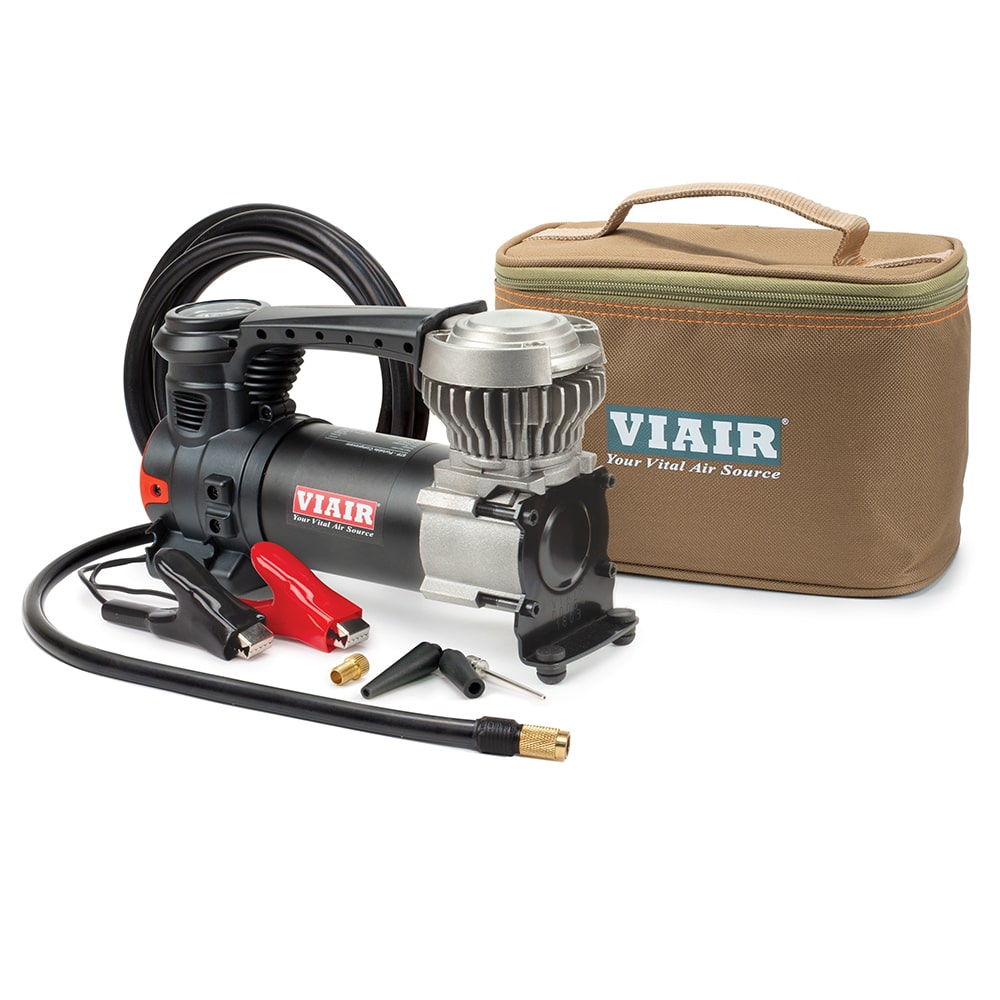
Explore this need in the finder →This review covers the VIAIR 87P portable compressor, part 00087: the analog 12-volt version with battery clamps, a twist-on tire chuck and an eight-foot air hose. It is distinct from the accessory-plug 84P/00084 and 85P/00085, as well as the EVC85P Digital model. VIAIR's shared product page carries an 85P family title, but its selected variant and linked manual identify the 87P and part 00087. The electrical connection and hose length are material configuration differences, so check the SKU and included lead in the specific offer. This is a source-based assessment, not a hands-on test.
Choose it only if battery-clamp power fits your routine
The 87P is not designed around a cabin accessory socket. Its 12-volt lead ends in red and black battery clamps, with an inline 20-amp fuse holder; the model-specific manual describes connecting those clamps to the corresponding battery terminals. VIAIR's specifications list a maximum draw of 15 amps. The fuse rating is a protection component, not a reason to assume a 20-amp draw or to connect it to an undersized circuit. The manual also requires the vehicle engine to be running during operation. Check the vehicle and compressor instructions for the exact connection procedure and do not improvise power from an outlet or wiring harness.
Direct clamps can be useful when a suitable accessory port is unavailable, but they ask more of the operator: the battery needs to be accessible, the clamps must be placed correctly, and the car must be positioned so the power lead can reach. VIAIR lists a ten-foot power cord and an eight-foot air hose. The longer air hose gives more room to position the compressor than the three-foot hose listed for the 84P and 85P, but the two leads do different jobs. The listed unit weighs 4.3 pounds and measures about 9.1 by 3.1 by 5.6 inches; these figures do not establish storage fit in an individual vehicle.
Twist-on chuck and manual pressure control
The 00087 variant uses a solid brass twist-on tire chuck. VIAIR lists this alongside the 00085, while the 00084 is the press-on accessory-plug variant. The product page lists a 100-PSI gauge, work light/power indicator, carrying bag, three-piece inflation-tip kit and Presta adapter. The manual says the Presta adapter and inflation tips attach at the hose connection for bicycle tires and other inflatables; confirm that the seller package includes the small attachments if you need them.
No preset shutoff is documented for the analog 87P. The operator must watch the gauge and switch the compressor off at the target; VIAIR cautions that the pressure reading is inaccurate while air is flowing, so the tire pressure must be checked with the compressor off. The gauge's 100-PSI scale does not raise the compressor's separate maximum working pressure of 60 PSI. It also does not define the correct pressure for a vehicle tire. Use the vehicle's placard or owner's manual for the recommended cold pressure and avoid inflating beyond the model's operating ceiling.
Duty-cycle and flow claims need context
The exact 87P manual specifies a 20-minute duty cycle at 30 PSI and 72°F. Treat that as an operating limit, not as a promise of repeated full-tire fills. The manufacturer comparison table gives the same duty condition, a 31-inch maximum-tire-size reference and a 60-PSI working-pressure figure. The 31-inch figure is VIAIR's application claim; it is not proof that every tire with that diameter is a suitable match or that a specific starting pressure will be reached in a particular time.
There is a notable flow discrepancy: the exact 87P manual and the 85P-family product page list 1.77 CFM at zero pressure, while VIAIR's portable-tire-inflator table lists 1.26 CFM. Their noise figures also differ slightly: the page states 77 dB at zero pressure and the table 76 dB. I preserve those conflicts rather than choosing the more flattering figure. The reviewed primary evidence does not provide a standardized inflation time for a specified tire, so a zero-pressure flow rating should not be converted into an everyday fill-time estimate.
What matters in setup and storage
VIAIR's manual describes the pump as oil-less and warns that its body, hose and fittings can become hot. It calls for dry, ventilated use, fully uncoiling the power lead, no unattended operation and sufficient cooling before storage. The device is moisture- and dust-resistant, not waterproof or dustproof, so the manual cautions against running it in wet conditions or soft sand.
Before a passenger-vehicle top-off, locate the vehicle's recommended cold pressure and confirm that the clamp route is practical. Stay present while the compressor runs, switch it off before reading pressure, and verify the result with the pump stopped.
How it differs from nearby VIAIR configurations
The 84P/00084 uses an accessory outlet and press-on chuck; the 87P uses clamps and a twist-on chuck. The standard 85P/00085 is socket-powered but twist-on, while EVC85P Digital adds preset stopping. These distinct configurations are easy to confuse under the shared page heading, so compare exact part numbers and manuals rather than family names.
Bottom line
Consider the 87P/00087 when direct battery clamps, a twist-on tire chuck and the longer listed hose fit the intended setup—and when you can keep the engine running and manually supervise inflation. Its 60-PSI working ceiling, 20-minute-at-30-PSI duty condition, 15-amp maximum draw and lack of an automatic stop are meaningful constraints. It is not a socket-powered convenience pump or a set-and-walk-away device. Before ordering, confirm the exact 00087 configuration, fuse and accessory package, and compare the manual's use limits with the tire and vehicle instructions. Do not treat the table's tire-size reference or either zero-pressure flow number as a guarantee of compatibility or speed.
Key specifications
Key details at a glance
| Automatic stop at target | No |
|---|---|
| Documented accessories | dual battery clamps with 20-amp inline fuse holder / eight-foot air hose / twist-on tire chuck / three-piece inflation-tip kit / Presta valve adapter / 10-foot power cord / carry bag / LED work light/power indicator / built-in 100-PSI gauge |
| Operating power arrangement | Vehicle battery clamps |
| Maximum working pressure | 60 PSI |
| Maximum current draw | 15 A |
| Inline fuse rating | 20 A |
| Tire-chuck connection style | Twist-on tire chuck |
| Published duty-cycle condition | 20 minutes at 30 PSI at 72°F (exact 87P manual) |
| Manufacturer-listed tire-size reference | 31-inch tire-size reference in VIAIR comparison table and 85P-family page |
| Power cord length | 10 ft |
| Air hose length | 8 ft |
| Pressure gauge scale | 100 PSI |
Use the exact model’s instructions for operating limits, supplied equipment and version differences.
Sources for this review
Sources for this assessment
Match the inflator to your power and tire
Use the finder to check whether a reviewed model's documented power source, mode and accessories fit your requirements. It cannot prove an unlisted fit or predict actual fill time.