
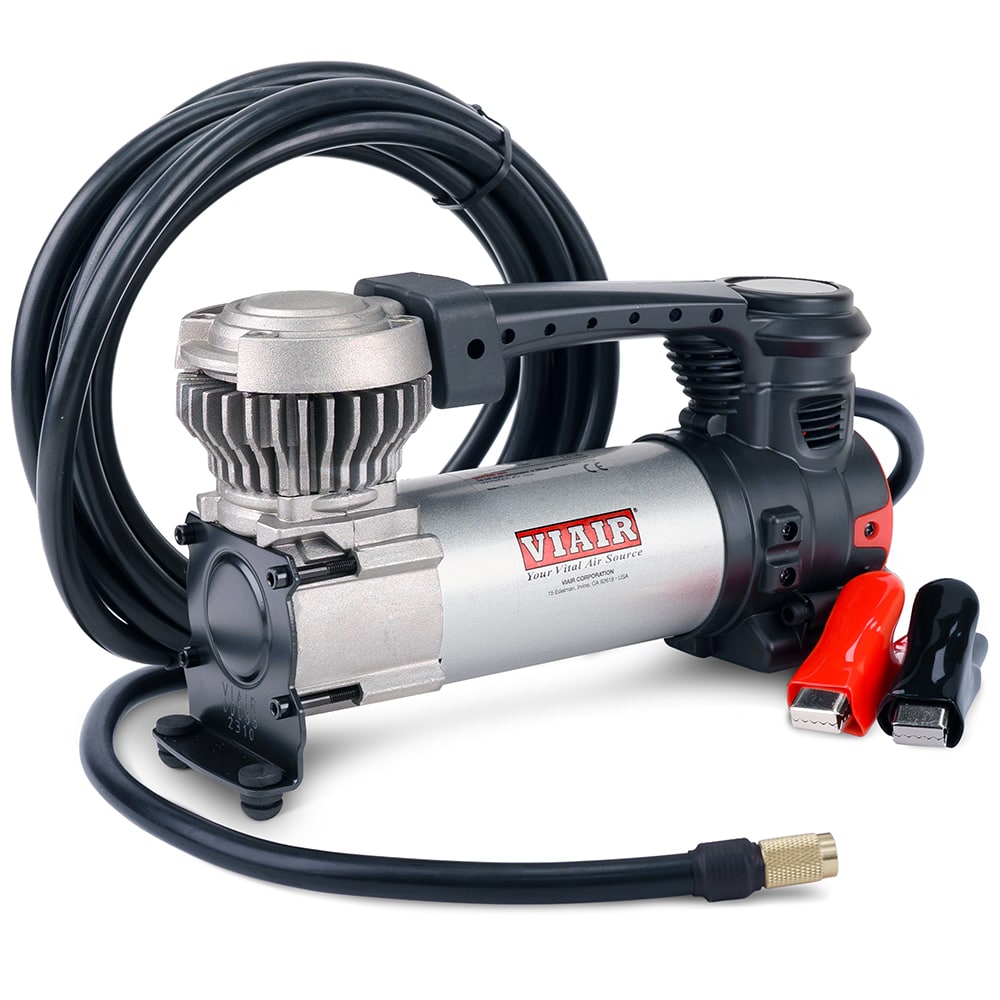
Your needs, this model
Does it fit your priorities?
How does the VIAIR 88P/00088 get its power?
The standard 00088 uses direct battery clamps, not a 12V accessory plug, and the manual says the engine must be running. The product page lists a 20-amp maximum draw and a 25-amp inline fuse holder. Check that you can access the battery and follow the exact clamp sequence in the manual.
Explore this need in the finder →Does the analog 88P have the preset shutoff shown on the digital 88P page?
No. Part 00088 is the manual analog model: its instructions say to watch the gauge, switch the pump off at the target and verify pressure with the compressor off. EVC88P Digital is a different model with a separate manual and additional power-cord variants.
Explore this need in the finder →Does the 88P's 16-foot hose make it a socket-powered inflator?
No. The 16-foot air hose reaches from the pump to the valve; a separate 10-foot power lead connects the pump to the battery clamps. The longer hose may help position the compressor, but the 00088 still needs direct battery access and a running vehicle.
Explore this need in the finder →The VIAIR 88P reviewed here is the analog compressor identified as part 00088. It is not the digital EVC88P, the EVC88P7 trailer-plug edition, or the 88P SXS / part 00082. Those neighboring names refer to separate configurations. The standard 00088 combines a manual gauge and switch with a direct battery-clamp power lead, a twist-on tire chuck and a notably long air hose. This is an analysis of the official product page and the exact 00088 manual, not a report of personal use or testing.
Battery clamps replace the convenience of a socket
The 88P is designed to attach to a vehicle battery, and the manual says the engine must be running while it operates. That direct connection is different from the 85P/00085's accessory-port plug; the 88P draws up to 20 amps, so it should not be treated as a low-current socket inflator. If opening the hood and connecting clamps is inconvenient, or if the vehicle cannot be run during inflation, this is the wrong power arrangement. The product page specifies dual clamps with an inline 25-amp fuse holder, and its manual says to start the engine before using the pump.
Reach is one of the more concrete reasons to choose this setup. VIAIR lists a ten-foot power cord and a sixteen-foot air hose. Those are separate lengths: the hose reaches from the pump to the valve; the power lead connects the pump to the battery. The longer hose can make it easier to place the compressor while attending to a wheel, but it does not make the 88P cordless or remove the need for battery access.
Manual gauge, manual stopping
The 00088 has a built-in gauge with a 120-PSI scale and an on/off switch. Its instructions tell the operator to stop the pump at the desired reading, then check pressure with the compressor switched off because the moving air can make the gauge reading inaccurate. There is no preset auto-stop documented for this analog model. It is not a “set a number and leave” design, and the manual says not to leave the compressor running unattended.
That 120-PSI working-pressure maximum is not a tire-pressure recommendation. VIAIR says the 88P can handle tires up to 33 inches, but that product claim is not a measured fill-time result or a universal fit guarantee. The manual rates the duty cycle at 25 minutes at 30 PSI at 72°F. That rating helps define an operating boundary; it does not show how many tires a single session can cover because no comparable named-tire test is provided in the manual.
Do not turn inconsistent flow figures into a speed ranking
The exact product page and 00088 manual list 1.97 CFM at zero pressure, but VIAIR's comparison table lists 1.47 CFM. That discrepancy remains unresolved here. The manufacturer page also includes a short fill-rate section, but it does not provide a fully specified, reproducible starting pressure, ending pressure, tire/load protocol and conditions for the generic “one minute” graphic. This assessment therefore avoids translating a zero-pressure flow figure into a promised time or repeating the graphic as a general performance result. A buyer comparing compressors should ask for a test with the intended tire size, pressure change, power setup and ambient conditions.
Valve attachments and care
The product page lists a solid-brass twist-on tire chuck, three-piece inflation tips, a Presta adapter, a carry bag and an LED work light/power indicator. VIAIR says a Presta bicycle valve needs the separate adapter; the ordinary tire chuck is not itself a Presta fitting. The manual also lists sports balls and bicycle tires among other inflatable objects, but users still need the correct tip and must follow the item's own pressure limit. Check the exact package rather than assuming a seller's kit matches the manufacturer's list.
The manual says the compressor becomes hot during and immediately after use, needs cooling before storage, should be used in a dry environment and must not be exposed to water while running. It describes the pump as moisture- and dust-resistant, but explicitly says it is not waterproof or dustproof. VIAIR also lists the 88P as incompatible with its winterization kit, part 90145. These conditions make placement and post-use handling part of the decision, not minor footnotes.
Bottom line
The 88P/00088 is best considered by someone who can run the vehicle, is comfortable connecting battery clamps, wants a long hose and accepts manual pressure checks. Its 20-amp draw, clamp-only power path, no preset shutoff and conflicting zero-pressure flow listings are meaningful limitations. A digital 88P-family variant may add automatic stopping or a seven-way trailer connection, but those are different models with separate manuals and package details. Before choosing, verify the exact part number, the vehicle battery access, the desired cold pressure from the vehicle placard, the supplied attachments and the duty-cycle instructions.
Key specifications
Key details at a glance
| Automatic stop at target | No |
|---|---|
| Documented accessories | dual battery clamps with 25-amp inline fuse holder / 10-foot power cord / 16-foot air hose / solid brass twist-on tire chuck / three-piece inflation tips kit / Presta valve adapter / deluxe carry bag / 120-PSI gauge / LED work light/power indicator |
| Operating power arrangement | Vehicle battery clamps |
| Maximum working pressure | 120 PSI |
| Maximum current draw | 20 A |
| Inline fuse rating | 25 A |
| Tire-chuck connection style | Twist-on tire chuck |
| Published duty-cycle condition | 25 minutes at 30 PSI; manual specifies 72°F |
| Manufacturer-listed tire-size reference | up to 33-inch tires (manufacturer claim) |
| Power cord length | 10 ft |
| Air hose length | 16 ft |
| Pressure gauge scale | 120 PSI |
Use the exact model’s instructions for operating limits, supplied equipment and version differences.
Sources for this review
Sources for this assessment
- Every Vehicle Carry 88P Portable Compressor, SKU 00088
- 88P Portable Compressor User Manual, part 00088, revision R6-080625
- VIAIR Portable Tire Inflators comparison table
- VIAIR Portable Tire Inflators / Daily Driver collection
- Tire Safety Ratings and Awareness / TireWise
- CPSC Recalls and Product Safety Warnings search
Match the inflator to your power and tire
Use the finder to check whether a reviewed model's documented power source, mode and accessories fit your requirements. It cannot prove an unlisted fit or predict actual fill time.