
Your needs, this model
Does it fit your priorities?
Can the 89P-RVS run from a 12V dashboard outlet?
No outlet arrangement is documented for part 00089. The manual specifies 12V battery clamps, a 20A maximum draw, a 25A fuse and an engine-running routine. Check the vehicle’s battery access and the exact manual rather than assuming a socket can supply the pump.
Explore this need in the finder →Does the 89P-RVS stop at a target pressure automatically?
No preset target stop is documented. The manual says to run the compressor until the gauge indicates the intended pressure, switch it off, and then check the tire with the compressor off because airflow makes the gauge reading unreliable. Stay present and use the RV’s tire instructions.
Explore this need in the finder →Can part 00089 inflate a sports ball or Presta bicycle tire?
The 00089 manual describes sports balls and bicycle tires and the kit lists a tip set and Presta adapter. VIAIR notes that the adapter is needed for Presta valves. Verify the exact tip package and item pressure instructions; the published RV tire-size and speed claims are not ball or bicycle performance measures.
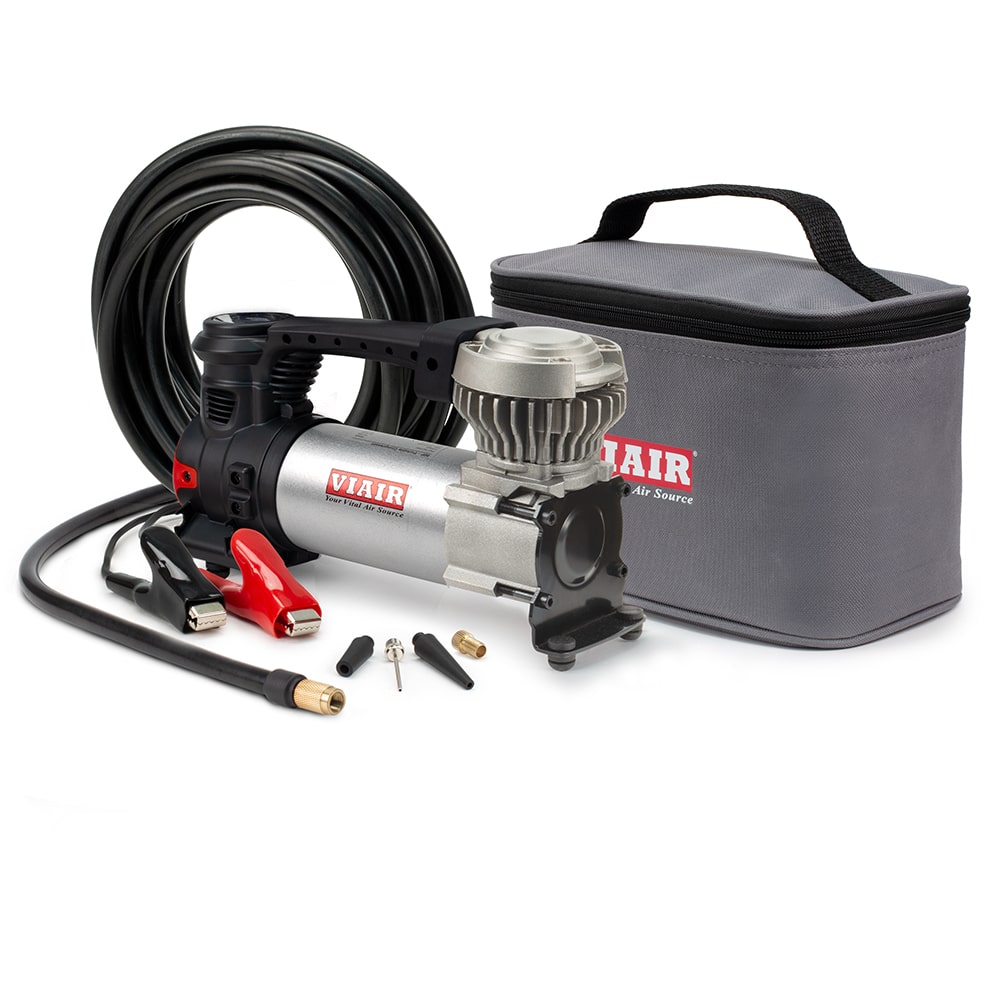
Explore this need in the finder →The VIAIR 89P-RVS / part 00089 is the smallest and lowest-current RVS model in this four-product group, and the exact manufacturer page positions it for Class B RVs. It uses a direct 12V battery-clamp connection, a twist-on tire chuck, a 20-foot air hose and a 10-foot power lead. Its compact package is not cordless or socket-powered, and its instructions still require the operator to run the vehicle engine and control pressure manually. This is a source-based assessment, not a test or ownership report.
A compact RV reference with clear limits
VIAIR lists a 245/70R19.5 tire-size reference, a 120-PSI maximum working pressure and a 25-minute-at-30-PSI duty claim at 72°F. The manual states a maximum 20-amp draw and 25-amp inline fuse; it says the compressor should be used only with the engine running. A 120-PSI gauge scale or maximum pressure is not a recommended target for a tire. The manual says to switch the compressor off to verify pressure because the gauge cannot be relied on while air is moving. Stay with the unit, check the exact RV tire guidance and give the compressor cooling time before storage.
The page advertises a fill from 80 to 90 PSI in under two minutes, but the reviewed page does not identify the tire’s dimensions or a complete test setup for that statement. It should not be treated as a guaranteed fill time for another tire or a row of tires. There is also a specification discrepancy: the manufacturer page lists 1.97 CFM at zero PSI, while the dedicated manual states 1.47 CFM at zero PSI. Because the documents do not reconcile the difference, this review does not select a definitive airflow number or use it to estimate speed.
The exact product page and manual list IP53, while the manufacturer comparison chart labels the model IP54. The sources do not explain that difference, so no single ingress rating is selected here. In either case, follow the model’s dry-use instructions; do not treat a chart rating as permission to expose the compressor to rain, immersion or wet storage.
The connection is the tradeoff
The 00089 manual and product image show a solid-brass twist-on tire chuck. It is a different interaction from a press-on lever-lock chuck: the operator needs to thread the fitting onto a valve and allow enough access to do so. The 20-foot hose gives more reach than some compact units, but the 10-foot power lead still tethers the compressor to the battery. Plan the compressor’s position before attaching the cable, and do not pull the unit by its hose.
The product page lists a three-piece inflation-tip kit and a Presta adapter. The dedicated manual specifically discusses bicycle tires and sports balls, and says to use the appropriate included tip; VIAIR also notes that the Presta valve needs its adapter. Those are separately documented attachments, not proof that every valve, ball or seller package is covered. Check the exact kit and the pressure directions for the item being inflated. The current product page says the model is not recommended for dual rear tires, an important boundary for an RV-oriented name.
Do not confuse it with 88P or other VIAIR RVS models
VIAIR’s drawing includes rows for both 00088 and 00089, with a longer air hose listed for the 00089 row; the exact manual and current 89P-RVS page identify part 00089. The 88P / 00088 is a different model, so a seller using a generic “88/89” title should be checked against the nameplate, hose and manual. Larger RVS models add different compressor and hose arrangements: the 300P-RVS / 30034 is chart-listed for a larger tire reference, while the 400P-RVS and 450P-RVS add paired hoses and alternate reach chucks. Do not infer that the 89P’s Class B application or dual-rear restriction transfers unchanged to another model.
Who should consider it?
The 89P-RVS is worth examining if the exact task is an RV tire or another manufacturer-listed inflatable, the battery-clamp arrangement is acceptable, and a twist-on chuck and manual switch fit the operator’s routine. It is a poor choice when the required power route is a dashboard outlet, internal battery, preset auto-stop or a connection that cannot be threaded onto the valve. Before choosing a listing, verify part 00089, the Presta adapter and tip kit, the 25-amp fuse information, actual hose condition and the model’s dual-rear limitation. For an RV tire, check the vehicle and tire guidance; published maximum pressure and a product-page speed phrase cannot guarantee suitability or fill time.
Sources checked 2026-10-29: VIAIR’s 89P-RVS / 00089 product page, the 00089 manual, the shared 00088/00089 dimensional drawing, and the VIAIR compressor comparison chart.
Key specifications
Key details at a glance
| Automatic stop at target | No |
|---|---|
| Documented accessories | dual battery clamps / 25A inline fuse holder / 10-foot power cord / 20-foot air hose with twist-on tire chuck / 120-PSI gauge / LED work light and power indicator / three-piece inflation-tip kit including ball needle / Presta adapter / carry bag |
| Operating power arrangement | Vehicle battery clamps |
| Maximum working pressure | 120 PSI |
| Maximum current draw | 20 A |
| Inline fuse rating | 25 A |
| Tire-chuck connection style | Twist-on tire chuck |
| Published duty-cycle condition | 25 minutes at 30 PSI at 72F |
| Manufacturer-listed tire-size reference | 245/70R19.5 (manufacturer application reference, not a fit guarantee) |
| Power cord length | 10 ft |
| Air hose length | 20 ft |
| Pressure gauge scale | 120 PSI |
Use the exact model’s instructions for operating limits, supplied equipment and version differences.
Sources for this review
Sources for this assessment
Match the inflator to your power and tire
Use the finder to check whether a reviewed model's documented power source, mode and accessories fit your requirements. It cannot prove an unlisted fit or predict actual fill time.