
Your needs, this model
Does it fit your priorities?
Can the EVC25 top up a passenger-car tire without a vehicle power cable?
The manufacturer lists car-tire use and identifies an internal pair of 2,000mAh lithium-ion cells, rated at 7.4V and 14.8Wh. The manual documents automatic stopping at the selected target. It cannot operate while charging, and the reviewed sources do not specify tire-size capacity or fill rate, so they do not establish how long a particular car tire will take or whether it is a suitable from-flat recovery tool.
Explore this need in the finder →Does the EVC25 include a way to inflate a Presta bicycle tire?
Yes, the linked manual describes a Presta adapter used with the Schrader connection, and the VIAIR product listing names a Presta valve adapter among the included items. The manual explains to attach the adapter to the hose connection and open the Presta valve before inflating. Confirm the exact retail package still contains that adapter.
Explore this need in the finder →Can this model inflate a sports ball, and what must be in the kit?
VIAIR lists ball inflation among the EVC25's five modes, and its manual describes using the supplied ball needle at the Schrader interface. The ball mode is listed as 2–15 PSI with an 8-PSI default; set the target appropriate to the ball rather than assuming the default is right. Check the needle is in the exact package before ordering.
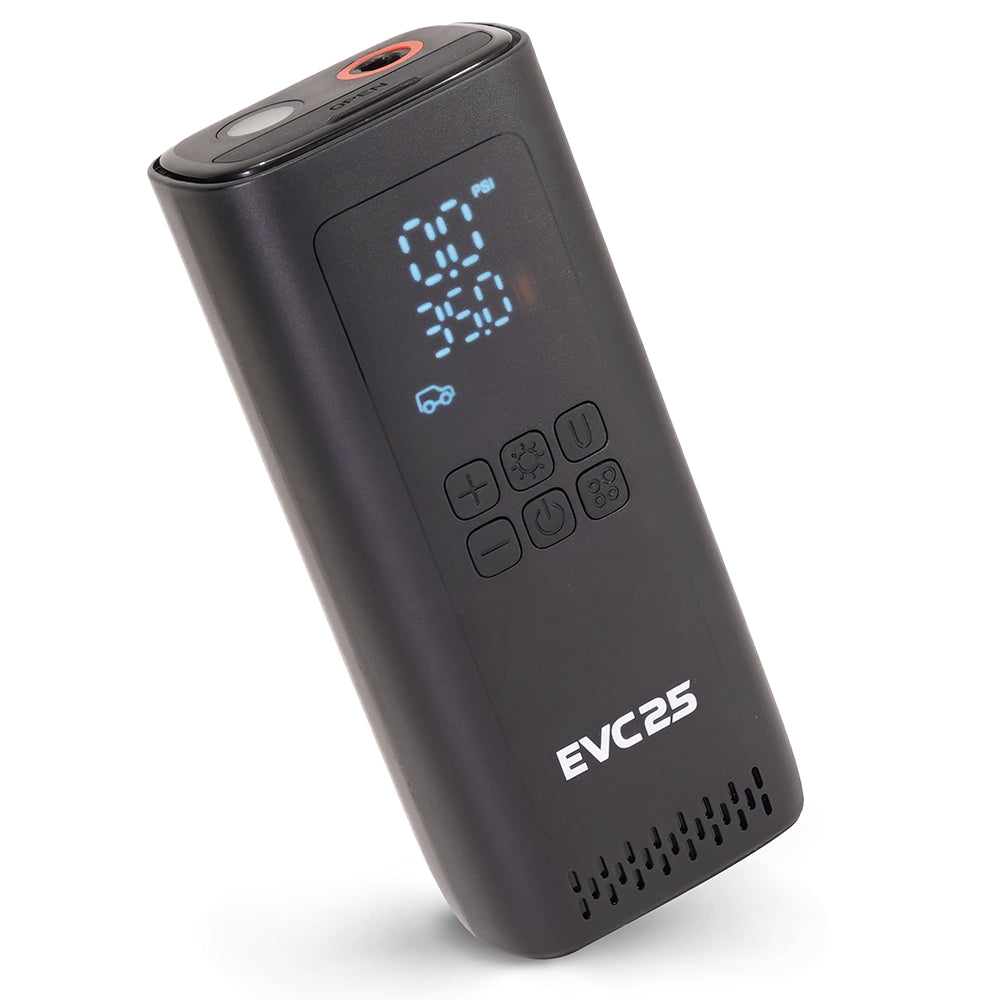
Explore this need in the finder →The VIAIR EVC25 is a self-contained rechargeable inflator for the driver or cyclist who values a small, untethered unit more than a documented high-volume fill rate. The manufacturer’s US product listing calls out car, motorcycle, bicycle and inflatable use, preset pressure with automatic shutoff, a USB power-bank output and a roughly 25-minute runtime claim. This assessment is based on that listing and its linked manual, not on hands-on use or an independent fill test.
A small battery pump, not a vehicle-powered compressor
The EVC25 uses two 2,000mAh lithium-ion cells, rated together as 7.4V and 14.8Wh. It charges through USB-C at 5V/2A; VIAIR estimates two to three hours to charge. The manual says not to operate the compressor while it is charging, so a low battery cannot be solved by plugging the unit into a vehicle accessory socket mid-job. That is the central buying tradeoff: you avoid managing a long 12V power lead or clamps at the tire, but you must keep the internal battery ready.
VIAIR also describes the EVC25 as a power bank with a USB output. That is a useful secondary function, but it shares the same small battery and is not evidence that the inflator will complete a particular tire fill after it has charged a phone. Plan for the pump’s charge state first. The product page’s approximate 25-minute run time does not say what tire, starting pressure, temperature, battery age or duty pattern produced the claim.
Five modes, with different pressure ceilings
The manual lists five selectable modes: car, motorcycle, bicycle, ball and custom. Its pressure table gives a 2–65 psi range for car mode, 2–55 psi for motorcycle, 2–160 psi for bicycle and custom, and 2–15 psi for a ball; the listed default targets are 35, 40, 38, 8 and 100 psi respectively. Those numbers are mode settings, not proof of flow rate, accuracy or suitability for every tire within the broad label. The manual also permits switching the display between PSI, kPa, bar and kg/cm².
There is a source discrepancy worth keeping visible: the official product-page specification says the air-pressure range is 0–150 PSI, while the manual’s bicycle and custom mode ranges extend to 160 PSI. I use the 150-PSI product-page figure as the conservative headline and do not promise that this model is a verified 160-PSI solution. Anyone buying for a specific high-pressure application should confirm the correct current manual and exact package directly with VIAIR before relying on a mode setting.
For a passenger vehicle, do not set pressure from the inflator’s car-mode default or the tire’s sidewall maximum. Use the vehicle maker’s recommended cold pressure from the driver-door placard or owner’s manual. NHTSA says to check tires when cold (after at least three hours parked) and distinguishes the vehicle’s recommended pressure from the tire’s maximum marking. Automatic stop is a convenience, not a substitute for setting that target correctly or checking the result.
Attachments and practical reach
The linked manual describes a Schrader connection, a Presta adapter and a ball needle; the product listing names the ball needle and Presta valve adapter among its supplied items and includes a carry bag and a 13.5-inch USB-C cable. The cable length is for charging, not an air hose. VIAIR’s product page does not state the EVC25 air-hose length, its weight, a tire-size capacity or a model-specific fill-rate benchmark in the material reviewed here. Do not infer reach or speed from the pressure maximum.
For Presta-equipped road or some mountain-bike tires, the manual instructs the user to connect the adapter to the Schrader interface and open the Presta valve before inflating. For a ball, the needle must be fitted to the connection. This is a broader small-inflatable tool than a dedicated car-only pump, but every additional tip is another small part to keep together. Inspect the actual retail package to make sure the intended adapters are present.
Limits and setup cautions
The manual warns that attachments may become very hot when the compressor runs continuously for more than three minutes. It advises avoiding heavy rain and mud because water or debris can enter through the vents, not submerging the unit, and not leaving it unattended while operating. The product page’s run-time statement is not a duty-cycle specification; it does not establish how many flat tires, large tires or repeated jobs the EVC25 can handle. With no published fill-rate or tire-size data in the sources checked, I would not choose it as a verified rapid-recovery or high-volume compressor.
Before buying, decide whether internal-battery convenience outweighs the need for an outlet, clamps, longer sessions or a documented workload. Check your tire’s required pressure, valve type, expected access around the wheel and the kit’s included accessories. If you need a 12V socket or direct-battery power, a separate operating plan is required; the EVC25 is not shown running from either route. If the use depends on an exact high-pressure ceiling, the 150-versus-160-PSI discrepancy should be resolved first.
Verdict
The EVC25 is a plausible choice for occasional pressure maintenance and small-inflatable tasks when a cordless, rechargeable package is the priority and the user is comfortable charging it ahead of time. The preset stop, several named inflation modes, multiple units and included small-item adapters make its intended role clear. Its limitations are equally important: no operation while charging, a manufacturer-only approximate runtime, no published EVC25 fill rate or tire-size capacity in the reviewed listing, and conflicting maximum-pressure statements between product page and manual. Choose it for the supported convenience features, not for an unverified promise of speed, heavy-duty output or emergency recovery. The model name in the seller’s offer should read EVC25; adjacent VIAIR models and package combinations are not interchangeable by name alone.
Key specifications
Key details at a glance
| Product-page maximum-pressure claim | 150 PSI |
|---|---|
| Battery energy | 14.8 Wh |
| Approximate run-time claim | 25 min (approx.) |
| Automatic stop at target | Yes |
| Documented accessories | carry bag / ball needle / Presta valve adapter / 13.5-inch USB-C cable / Schrader connection documented in the linked manual |
| Manual mode ranges (PSI) | Car: 2–65 psi (default 35) / Motorcycle: 2–55 psi (default 40) / Bicycle: 2–160 psi (default 38) / Ball: 2–15 psi (default 8) / Custom: 2–160 psi (default 100) |
| Operating power arrangement | Internal rechargeable battery |
Use the exact model’s instructions for operating limits, supplied equipment and version differences.
Sources for this review
Sources for this assessment
Match the inflator to your power and tire
Use the finder to check whether a reviewed model's documented power source, mode and accessories fit your requirements. It cannot prove an unlisted fit or predict actual fill time.