
Your needs, this model
Does it fit your priorities?
Can the EVC31 PRO top off a car tire without running a power cable to the vehicle?
Yes, its product page and manual describe operation from three internal 2600mAh lithium-ion cells, and the manual says it stops automatically at the selected preset. VIAIR estimates about 25 minutes of runtime but does not define a specific tire size or test workload for that figure; the page's approximately one-minute 25-to-35-PSI example is also a manufacturer claim. Charge the battery in advance, use the vehicle maker's recommended cold tire pressure, and do not run the compressor while it is charging.
Explore this need in the finder →Does the EVC31 PRO include a Presta adapter for a bicycle tire?
The EVC31 PRO listing names a Presta valve adapter, and the manual shows how it connects through the Schrader interface. The manual lists a bicycle mode with a 38-PSI default, but its bicycle/custom setting range reaches 160 PSI while the product page states 150 PSI maximum. Set only a pressure appropriate to the tire and rim maker and confirm the adapter is in the exact package; do not rely on the conflicting upper setting as a verified pressure rating.
Explore this need in the finder →Can the EVC31 PRO inflate a sports ball with its own battery?
The manual documents a ball mode and a ball needle, and the product page lists the needle among included accessories. The manual's ball mode defaults to 8 PSI within a 2–15-PSI setting range; that default is not right for every ball. Verify the ball's pressure instructions, attach the needle, choose a suitable target, and treat the preset stop as a convenience rather than a substitute for monitoring.
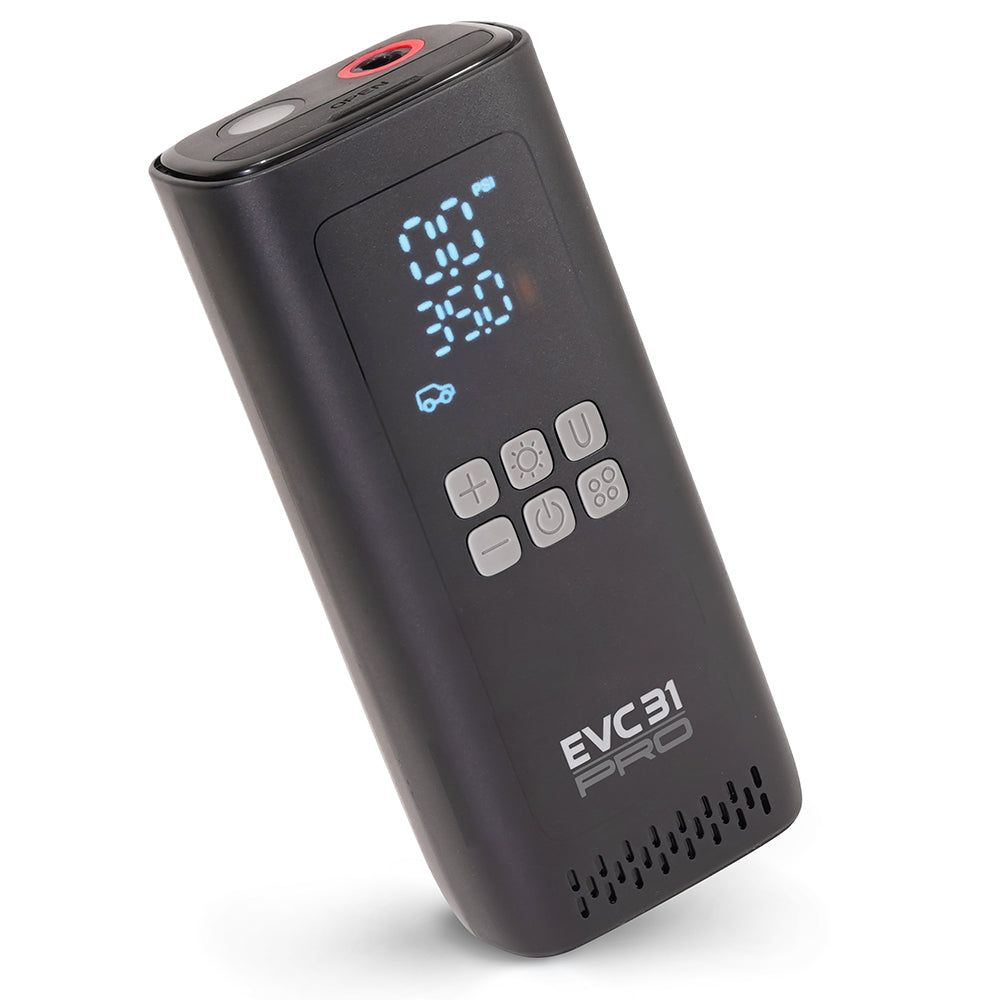
Explore this need in the finder →The VIAIR Every Vehicle Carry EVC31 PRO (part EVC31) is a rechargeable digital inflator with a second power route: a supplied 12V vehicle-accessory lead for backup. It is not the EVC25, nor one of VIAIR's analog socket or battery-clamp compressors. The difference matters because its battery path, auxiliary-port backup, preset controls and supplied attachments all affect setup. This assessment follows the current manufacturer page and its manual; it is not a hands-on test.
Two ways to power one small compressor
VIAIR lists three 2600mAh lithium-ion cells, rated together at 11.1V and 28.86Wh. The battery charges over USB-C at 5V/2A, with a stated two-to-three-hour charging time, and the product page gives an approximate 25-minute runtime. Those figures do not say how many tires a charge will handle: the runtime workload, tire size, starting pressure and conditions are not specified in the reviewed listing. Treat the battery as a convenience to keep charged, not a guaranteed amount of inflation capacity.
If the internal battery is low, the manual describes using the supplied 12V accessory-port lead. The product page lists a 10-amp maximum draw on that path. VIAIR recommends running the vehicle while using the auxiliary supply to avoid draining its battery. That is a backup power arrangement, not a way to charge the EVC31 during a job: the manual says it cannot be charged through that port and must not run while charging over USB-C. Check the vehicle's outlet instructions before relying on a 10-amp load, and do not treat this device as a direct-clamp compressor.
Preset modes and a pressure-rating discrepancy
The manual documents five modes: car, motorcycle, bicycle, ball and custom. The listed ranges and defaults are 2–65 PSI / 35 PSI for car, 2–55 / 40 for motorcycle, 2–160 / 38 for bicycle, 2–15 / 8 for ball, and 2–160 / 100 for custom. It also documents switching among PSI, kPa, bar and kg/cm², and says the compressor stops when the selected preset is reached. The control feature can reduce the need to watch an analog dial, but it does not choose the right pressure for a particular tire or make the process unattended.
VIAIR's current product page states 0–150 PSI, while the manual's bicycle and custom mode tables allow settings to 160 PSI. These are conflicting manufacturer statements. I use the lower product-page number as a conservative headline and would not buy this model specifically for an application that depends on a verified 160-PSI rating without clarification from VIAIR. For vehicle tires, use the vehicle maker's recommended cold pressure rather than the car-mode default or the tire sidewall maximum.
Connections for tires and small inflatables
The manual shows a Schrader connection, a Presta adapter and a ball needle; the product listing names the two small accessories. The 30-inch air hose connects at the body, and the EVC31 package page also shows a 24-inch USB-C cable for charging. The current product image is of the EVC31 PRO body, not a photograph of every accessory in a retail package, so verify the exact contents in the offer you are considering.
For a Presta bicycle valve, the manual directs the user to attach the adapter through the Schrader interface. Ball mode defaults to 8 PSI, but that is not a universal target for sports balls; check the ball's markings or manufacturer guidance first. The product page says the unit can raise most passenger-car tires from 25 to 35 PSI in about a minute. That is VIAIR's own claim, not a measured result from this review, and the page does not define a precise tire, temperature, battery condition or test method for the broad “most” statement.
What the manual changes about everyday use
The manual warns that attachments may become very hot after more than three minutes of continuous use. It advises avoiding heavy rain and mud, not submerging or covering the compressor, and not leaving it unattended. It also calls out a battery indicator and three light modes. The USB output can charge an external device, but using that secondary function consumes energy from the same compact battery that powers inflation; it should not be counted as spare compressor runtime.
VIAIR's mode labels describe broad intended uses, not a compatibility guarantee for every tire, rim, ball or pressure range. The preset feature makes sense only when the operator has first looked up the right target. Inspect the tire valve and hose connection, keep the unit's ports and vents clear, stay nearby during inflation and verify pressure afterward where the tire instructions call for it.
How it differs from other VIAIR choices
The EVC31 PRO's notable distinction is not simply “cordless”: it can run from its own charged cells and has a 12V accessory backup, both with digital presets. VIAIR's EVC25 is a smaller battery-only configuration in the reviewed catalog; the analog 84P/00084 relies on a vehicle accessory socket and manual shutoff, while the 87P/00087 uses battery clamps and also requires manual monitoring. Those are separate machines, not accessory options to assume from a similar brand name.
Bottom line
Consider the EVC31 PRO if a rechargeable inflator with preset stopping, several named modes and a vehicle-port backup suits occasional tire and small-inflatable tasks. The charging arrangement and two power paths give it more flexibility than a battery-only unit, but the advertised runtime and fill-rate language do not establish a particular workload. Its practical limits are important: it cannot operate while charging, the auxiliary path draws up to 10 amps, attachments can heat up, and the product/manual pressure statements conflict by 10 PSI. Before buying, confirm that the listing is part EVC31, the intended adapters are included, the vehicle outlet can support the backup load and the product's conservative pressure ceiling fits the job. Avoid choosing it on an unsupported promise of speed, a specific number of tires per charge or a high-pressure capability the documents do not consistently confirm.
Key specifications
Key details at a glance
| Product-page maximum-pressure claim | 150 PSI |
|---|---|
| Battery energy | 28.86 Wh |
| Approximate run-time claim | 25 min (approx.) |
| Automatic stop at target | Yes |
| Documented accessories | carry bag / 12V auxiliary-port power cord / 24-inch USB-C cable / 30-inch air hose / Schrader connection documented in the manual / Presta valve adapter / ball needle |
| Manual mode ranges (PSI) | Car: 2–65 PSI; default 35 PSI / Motorcycle: 2–55 PSI; default 40 PSI / Bicycle: 2–160 PSI; default 38 PSI / Ball: 2–15 PSI; default 8 PSI / Custom: 2–160 PSI; default 100 PSI |
Use the exact model’s instructions for operating limits, supplied equipment and version differences.
Sources for this review
Sources for this assessment
Match the inflator to your power and tire
Use the finder to check whether a reviewed model's documented power source, mode and accessories fit your requirements. It cannot prove an unlisted fit or predict actual fill time.