
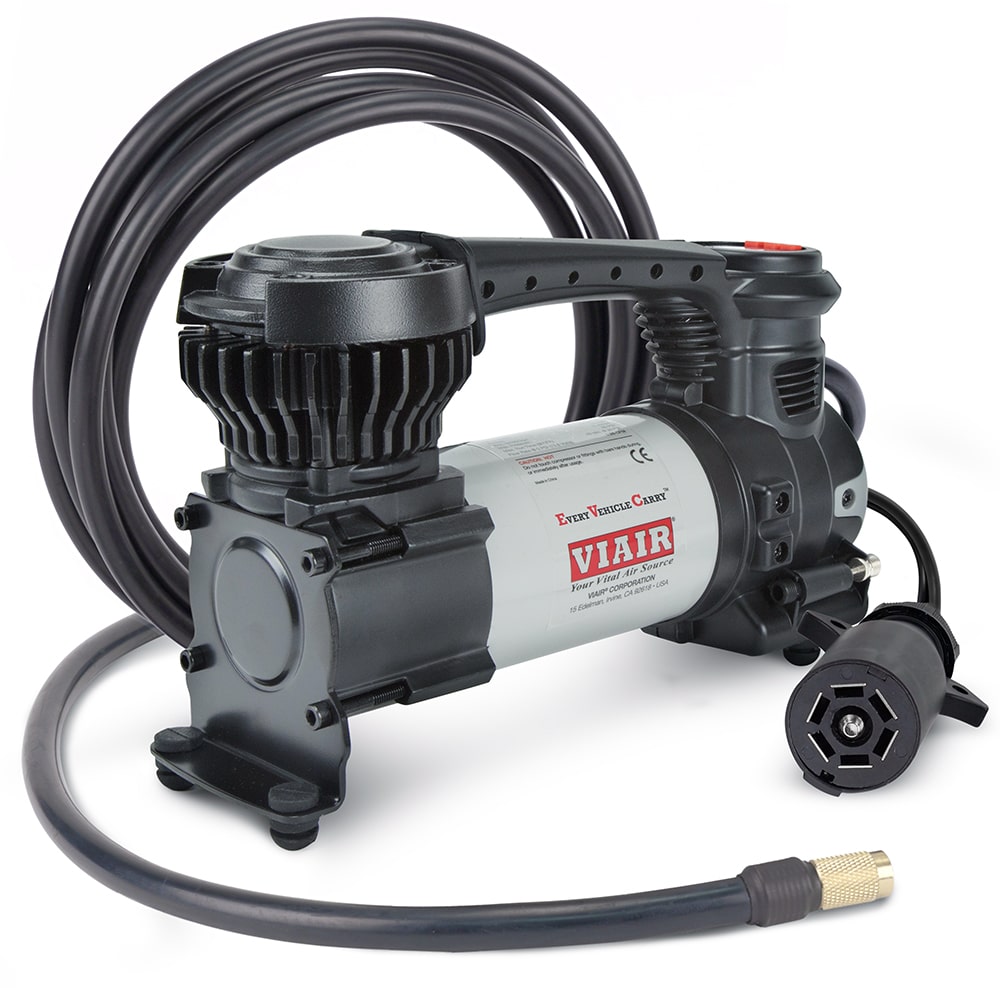
Your needs, this model
Does it fit your priorities?
Will EVC88P7 work with any seven-way trailer connector?
No. VIAIR's manual tells the owner to check that the tow vehicle's auxiliary battery/tow-charge circuit is present, powered and sufficiently fused for the compressor. Some vehicles may need a fuse added at the manufacturer's specified rating, and some may require the brake pedal to be pressed before the circuit is live. The manual also requires the engine to run.
Explore this need in the finder →How is EVC88P7 different from the clamp-powered EVC88P?
EVC88P7 uses a 7-way tow-vehicle auxiliary plug and a 6-foot power lead; EVC88P uses direct battery clamps and a 10-foot lead. Both manuals specify a 20-amp draw and running engine, but the two power systems are not interchangeable without the right vehicle circuit.
Explore this need in the finder →What pressure limit should I assume for EVC88P7?
The exact manual and product page state 120 PSI, but VIAIR's portable-inflator table gives 60 PSI for the EVC88P family. Treat the maximum as unresolved and get exact-SKU confirmation before relying on a value above 60 PSI.
Explore this need in the finder →This assessment covers the manufacturer-listed EVC88P7 version with a seven-way trailer power connector. It is documentary research only; it does not claim hands-on use, vehicle fit testing or measured inflation time.
The trailer connector is the product distinction
EVC88P7 is the Digital Every Vehicle Carry 88P variant that powers through a seven-way trailer receptacle. It is not the clamp-powered EVC88P and not the analog 88P/00088. The compressor body, digital controls and tire hose are closely related to the clamp version, but its supplied power connection changes which vehicles can operate it. Check the model marking and power lead in the exact seller offer before purchase. VIAIR’s manual says to insert the seven-way harness into the tow vehicle’s receptacle and run the engine. It also tells the owner to check the vehicle manual and fuse box to confirm the tow-charge or accessory-battery circuit is protected for the accessory. Some vehicles may not have that circuit fused from the factory; the manual says a fuse may need to be added using the vehicle maker’s specified rating, type and location. It further notes that some vehicles may require the brake pedal to be pressed before the circuit supplies power. These are compatibility checks, not assumptions a 7-way-shaped socket will satisfy. Do not treat this as a universal trailer plug pump or assume the connector is powered with ignition off. The documented use is from a suitable tow-vehicle circuit with the engine running. EVC88P7 does not have the reviewed battery clamps of EVC88P, and the manual does not establish operation from an ordinary cigarette-lighter socket. If the trailer circuit is absent, unfused, disabled or not rated for the draw, this configuration is not an appropriate shortcut.Preset control and safety conditions
The EVC88P7 manual describes a digital gauge with selectable units and automatic stopping at a target pressure for tires. It states gauge accuracy of plus or minus 1 PSI. That is the manufacturer’s stated specification, not an independent calibration test. Select the recommended cold pressure from the vehicle’s placard or owner information. NHTSA advises checking tires when cold and not using the tire sidewall’s maximum as the routine vehicle target. The manual says the engine must be running, the power cord should be fully extended before operation, the compressor becomes hot, and the unit should not be left unattended. It cautions against relying on auto-stop for sports balls, toys and other inflatables; those tasks are manually started and stopped. It also says the compressor is moisture- and dust-resistant but not waterproof or dustproof and warns against operating it in soft sand or dirt. These instructions matter in a roadside or campsite setting where wet ground and loose dust may be present.Pressure figures need manufacturer clarification
VIAIR’s product page and the dedicated EVC88P7 manual list a 120-PSI maximum working pressure. The portable-inflator comparison table’s combined EVC88P family row instead states 60 PSI. The table does not separate the clamp and seven-way variants. Because that lower figure applies to the same named family and has not been reconciled in the reviewed sources, this assessment treats the ceiling as unresolved. Do not rely on 120 PSI for use above 60 PSI unless VIAIR confirms the specification for SKU EVC88P7. The manual lists 20 amps / 240 watts maximum draw, an inline 25-amp fuse, 1.97 CFM at zero pressure, a 25-minute duty condition at 30 PSI and 72°F, and a 16-foot air hose. It lists a 6-foot power cord for EVC88P7, compared with 10 feet for EVC88P clamps. The zero-pressure flow and duty-cycle figures are limited operating data, not a guarantee that any tire size will reach a target in a given interval. The manufacturer page advertises other size and time claims without enough context in the reviewed material for a transferable performance promise.Kit and connection checks
The page lists the Digital 88P with a twist-on tire chuck, three-piece inflation-tip set, Presta adapter and carry bag. A ball needle is not named in the EVC88P7 manual or reviewed product details, so do not presume it is in the kit. If a bicycle valve or accessory is part of the job, confirm the exact adapter and follow the manual. The 16-foot hose gives more reach than the 3-foot hose on VIAIR’s Digital 85P pair, but it does not alter the tow-circuit requirement.Who should shortlist EVC88P7
Consider this model only when the tow vehicle has a verified, appropriately fused and live seven-way auxiliary circuit, the operator can run the engine, and the hose and preset-stop arrangement match the task. It is especially important to distinguish it from EVC88P: one uses trailer-circuit power and a 6-foot lead, while the other uses battery clamps and a 10-foot lead. If your vehicle’s trailer circuit rating or wiring is unknown, resolve that before buying; a connector’s shape alone is not proof of electrical compatibility. The pressure-rating conflict is another reason to obtain exact-model confirmation before a high-pressure application.Key specifications
Key details at a glance
| Automatic stop at target | Yes |
|---|---|
| Documented accessories | carry bag / three-piece inflation-tip set / Presta valve adapter / 7-way trailer auxiliary power connector / LED work light/power indicator |
| Operating power arrangement | 7-way trailer auxiliary circuit |
| Maximum current draw | 20 A |
| Inline fuse rating | 25 A |
| Tire-chuck connection style | Twist-on tire chuck |
| Manufacturer pressure-rating conflict | Yes |
| Conflicting maximum-working-pressure claims | Product page and EVC88P7 manual: 120 PSI; portable-inflator comparison table family row: 60 PSI. Manufacturer sources conflict; confirm exact-SKU limit before use above 60 PSI. |
| Published duty-cycle condition | 25 minutes at 30 PSI at 72°F |
| Power cord length | 6 ft |
| Air hose length | 16 ft |
Use the exact model’s instructions for operating limits, supplied equipment and version differences.
Sources for this review
Sources for this assessment
Match the inflator to your power and tire
Use the finder to check whether a reviewed model's documented power source, mode and accessories fit your requirements. It cannot prove an unlisted fit or predict actual fill time.