
Your needs, this model
Does it fit your priorities?
Does ACAC160YE-US have an internal battery, or does it need the vehicle socket?
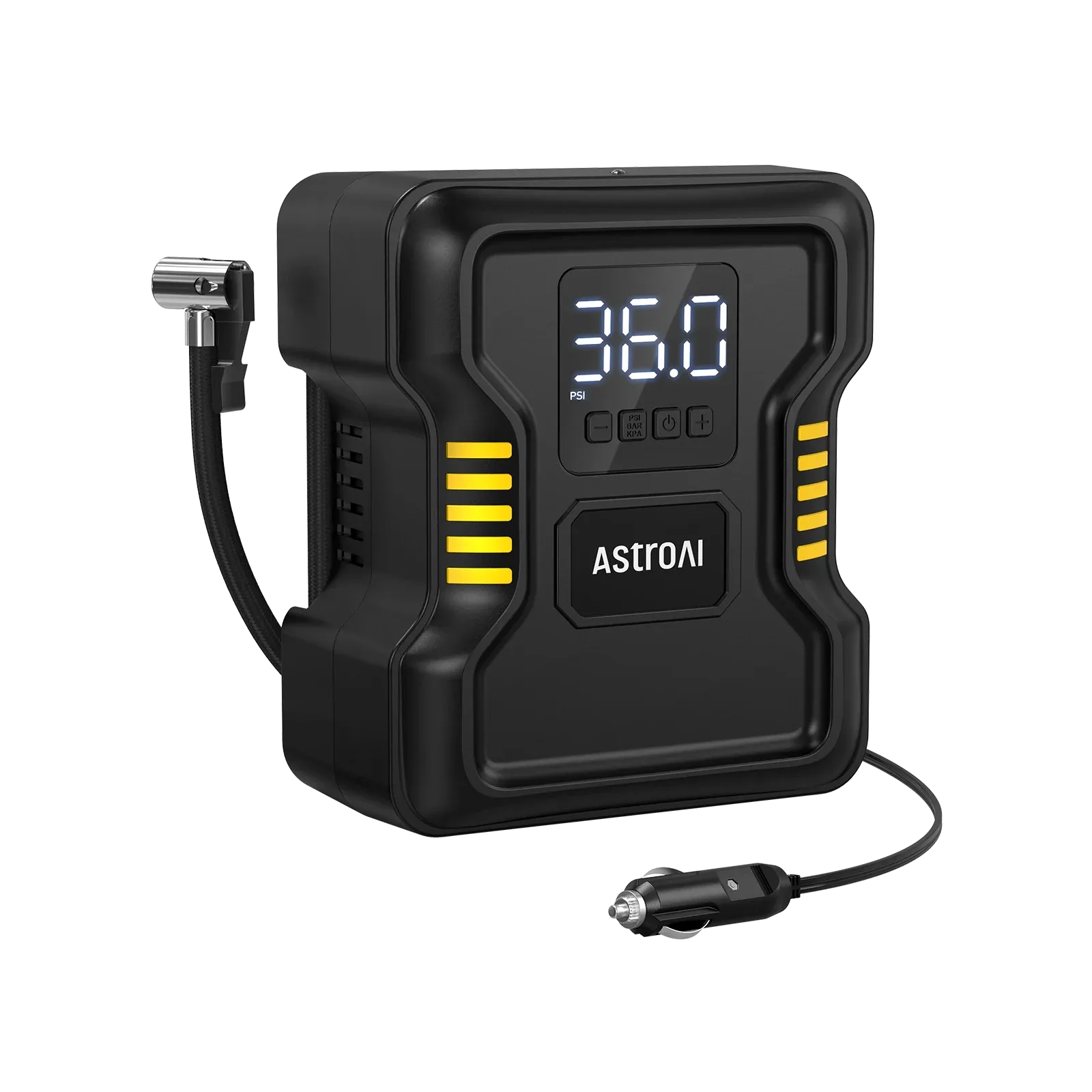
The exact US item record identifies ACAC160YE-US as a 12V DC Portable Car Air Pump. Its linked JY21P160-12 manual instructs you to start the vehicle and connect the compressor to a 12V 15A accessory outlet; it prohibits 24V input. No internal battery, direct clamp lead, household-AC mode or trailer 7-way setup is documented for this SKU. Treat it as a corded vehicle-socket model and verify the exact manual before use.
Explore this need in the finder →Is this the same yellow AstroAI 160 PSI model already reviewed, and what does its speed claim mean?
No. The listing identifies SKU ACAC160YE-US and its description names JY21P160-12; the existing ACACJY21DCYE-US article is linked to a different JY6P160-12 manual and visibly different case. The JY21P160-12 table lists 17 L/min without a pressure point or test method, 15 minutes continuous use and at least 10 minutes cooling. Its table says 160 PSI maximum working pressure while the storefront copy says 150 PSI, so neither number predicts a tire fill time or pressure target.
Explore this need in the finder →Does the exact package include the valve fittings, and does that prove ball use or a particular chuck style?
The exact item page and JY21P160-12 package table list a needle valve adapter and a Presta-to-Schrader adapter; the manual separately says the nozzle is compatible with Schrader valves and that preset-pressure shutoff is available. That documents the attachments, but the manual does not name sports-ball inflation, give a ball-pressure range, or describe the tire head as press-on or twist-on. Check the seller's exact ACAC160YE-US package and supplied manual rather than inferring those capabilities from the product photo.
Explore this need in the finder →This is a document-based assessment of the exact AstroAI US listing ACAC160YE-US and the JY21P160-12 manual linked from its record. I did not use or bench-test the pump. The two most useful things to know before comparing it are that it is a vehicle-powered 12V device, not a cordless battery pump, and that its own page and manual do not agree on every headline specification.
Identify the exact yellow model first
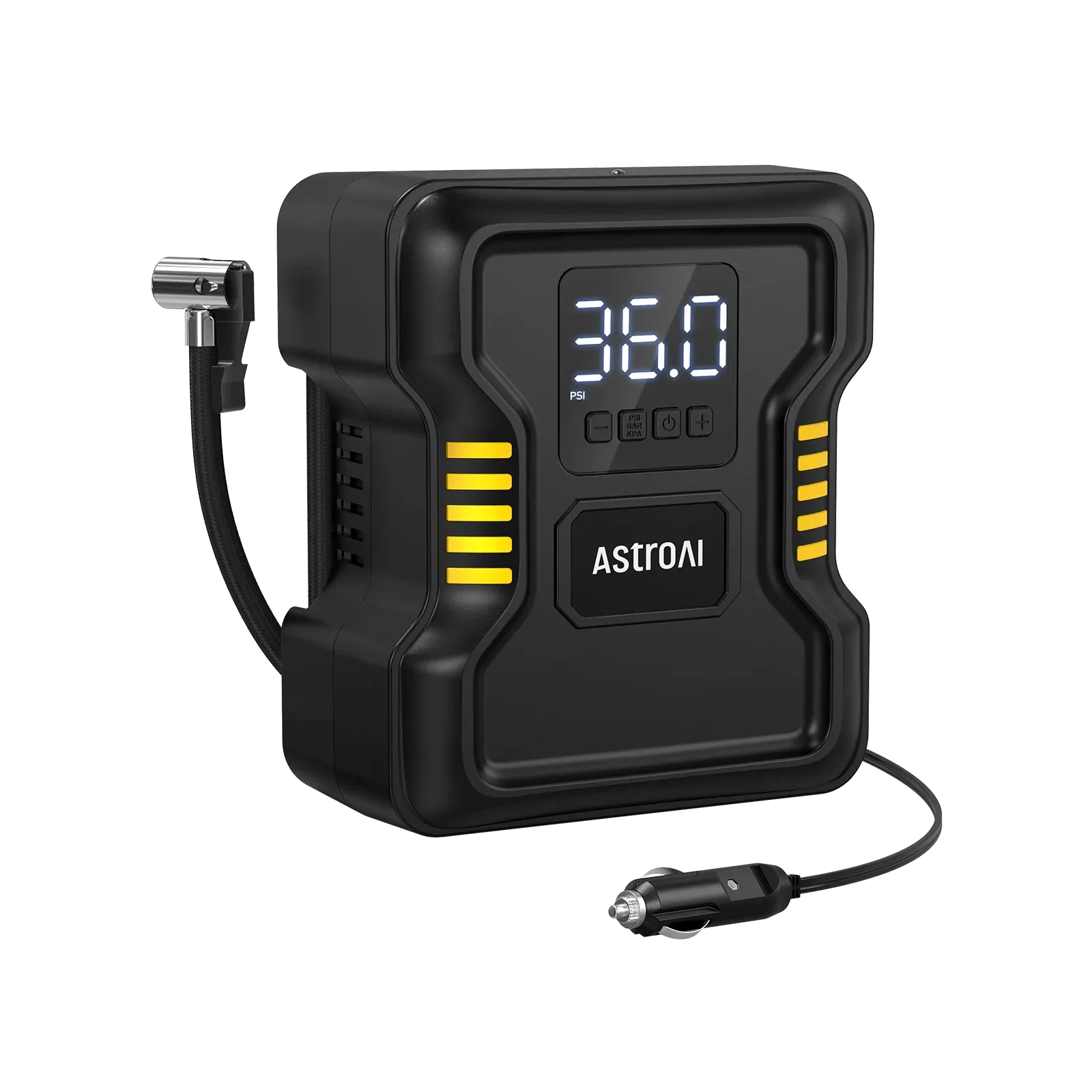
AstroAI's storefront record identifies this item as ACAC160YE-US; the product description and official manual name JY21P160-12. It should not be collapsed into the other yellow AstroAI pump already in this library, ACACJY21DCYE-US / JY6P160-12. Those names and manuals differ, and the official images show different housings: the ACAC160YE has a compact black case with yellow side accents, while the JY6P160-12 listing shows a larger yellow-and-black cross-shaped case. Similar color, a 12V plug and a high maximum-pressure label do not make them one model. The JY21P160-12 manual also lists 120W, 17 L/min and a 15-minute continuous-use limit; the separate JY6P160-12 manual lists different power, speed and run/rest figures. See the JY6P160-12 assessment rather than using its details for this SKU.
Power: an engine-running vehicle outlet
The JY21P160-12 instructions describe a single documented tire-inflation power route: a 12V DC vehicle accessory outlet. The manual says to have the vehicle engine running and calls for a 12V, 15A outlet; it warns against connecting to 24V vehicle power. That 15A figure is the outlet requirement, not a published measurement of the inflator's current draw, and the manual does not state the rating of the replacement fuse listed in the package. The sources do not document an internal rechargeable battery, direct battery clamps, household AC input or a trailer's 7-way auxiliary circuit for this SKU. If the vehicle's outlet cannot supply the specified connection, a battery model or a clamp-powered compressor is a different setup, not an interchangeable mode of this one.
For a model that does have an internal battery, compare its distinct power and package plan rather than interpreting the phrase “battery air compressor” from another AstroAI listing as a family-wide capability. The exact ACAC160YE page calls this one 12V DC, and its matching manual gives vehicle-socket setup instructions.
Preset stopping is useful, but not a pressure guarantee
The product page and manual describe an LCD and automatic stopping when the selected pressure is reached. That can simplify a top-up, but it does not establish gauge accuracy or mean that the compressor chooses the right target for the tire. Use the pressure specified by the vehicle or tire maker, and check it independently when accuracy matters. The JY21P160-12 manual does not publish the selectable target interval, adjustment increment, gauge tolerance, or a pressure-specific fill test.
There is also a real label conflict: the product-page description calls the pump 150 PSI, while the JY21P160-12 specification table says “Maximum Working Pressure 160 PSI.” Keep the discrepancy visible and check the manual supplied with the exact item. Neither figure is a recommended tire setting, and neither says how quickly this pump will raise a particular tire.
What the included fittings establish
The exact page and the manual's package table list two air nozzles, a needle valve adapter, a replacement fuse and a Presta-to-Schrader adapter. The manual says the nozzle is compatible with Schrader valves; the separate Presta adapter is the documented route for a Presta bicycle valve. The included needle is a real package detail, but the model sources do not name sports-ball inflation or give a ball-pressure range. A needle attachment alone is not enough to claim a documented ball-inflation plan. The same manual describes a quick connector but does not say whether the tire head is press-on with a lever or threaded twist-on. If either that connection style or a particular small-valve/ball application is essential, verify the exact hardware and instructions before ordering.
Work limits and untested performance
The manual gives a 17 L/min inflation-speed figure but no pressure point, tire size, test method or comparison condition. AstroAI's product page also uses fast-fill promotional language; that is not a substantiated one-minute fill result for a stated tire. The manual says to stop after at most 15 minutes of continuous operation and let the unit cool for at least 10 minutes after each 15-minute period. It also cautions against high-pressure or large-volume applications. Those limits make the device easier to assess for a short, ordinary tire top-up than for repeated large-tire work, but the source material does not provide a tire-size ceiling or guarantee a result for any one vehicle.
For storage planning, the manual lists a 3 m (9.84 ft) DC power cord and a 65 cm (2.13 ft) air hose. The exact product page separately advertises a “4.3-Meter Cord,” without explaining how that length is measured. Since these statements do not reconcile, I do not add the cable and hose into a claimed working reach. The manual gives dimensions of about 5.78 × 6.69 × 3.11 inches, but not a weight.
Who should compare it—and who should keep looking?
It is a plausible candidate for someone who specifically wants a compact, corded 12V inflator for manufacturer-listed car, motorcycle or bicycle tire tasks, has an outlet rated for the stated 15A connection, can run the engine, and is comfortable with the documented duty limit. The listed adapters are useful to check against the exact valves in the task. It is a poor match for a buyer who needs true cordless operation, a known press-on or twist-on head, documented sports-ball use, a stated low-pressure accuracy range, quantified tire-size capacity, or a long sequence of large-volume fills. The maximum-pressure label does not turn it into a high-volume compressor; the manual expressly cautions against high-pressure and large-volume applications.
Checks to make on the exact offer
Match the package to SKU ACAC160YE-US and model JY21P160-12, not only to the yellow color or “150 PSI” title. Confirm that the supplied manual is the JY21P160-12 version; verify the vehicle outlet requirement, the exact fittings and the replacement-fuse specification from the included instructions. Treat the page's 150 PSI and 4.3 m cord statements as unresolved conflicts with the manual rather than silently choosing the larger or more convenient number. Finally, confirm that the product's power mode, tire, valve connection and continuous-use schedule fit the actual job. The choice-by-choice guide separates those requirements and links each one back to the finder.
Key specifications
Key details at a glance
| Product-page maximum-pressure claim | 150 PSI |
|---|---|
| Automatic stop at target | Yes |
| Documented accessories | Two air nozzles / Needle valve adapter (amperage/shape not further specified) / Replacement fuse (rating not stated) / Presta-to-Schrader adapter / User manual |
| Operating power arrangement | 12V vehicle accessory port |
| Maximum working pressure | 160 PSI |
| Minimum documented vehicle-port rating | 15 A |
| Manufacturer pressure-rating conflict | Yes |
| Conflicting maximum-working-pressure claims | The exact US page's description says 150 PSI; the JY21P160-12 manual specifications table says Maximum Working Pressure 160 PSI. These claims are retained as a conflict; neither is treated as a tire target or a pressure-specific fill result. Verify the exact manual supplied with the offered ACAC160YE-US. |
| Published duty-cycle condition | The exact JY21P160-12 manual limits continuous operation to 15 minutes and directs cooling for at least 10 minutes after every 15 minutes of use. No pressure- or tire-size-specific schedule is given. |
| Power cord length | 9.84 ft |
| Air hose length | 2.13 ft |
Use the exact model’s instructions for operating limits, supplied equipment and version differences.
Sources for this review
Sources for this assessment
Match the inflator to your power and tire
Use the finder to check whether a reviewed model's documented power source, mode and accessories fit your requirements. It cannot prove an unlisted fit or predict actual fill time.