
Your needs, this model
Does it fit your priorities?
Can the L3 top up a passenger-car tire without using a vehicle's 12V outlet?
Yes, if its internal battery is charged: the ACAC19BK-US record and its matching ATJ-8566 manual document a cordless, battery-powered car-tire arrangement with a selected-pressure stop. The manual caps continuous use at 15 minutes and calls for at least 12 minutes of cooling. It does not publish a tire-size or pressure-specific fill-time limit, so this is not evidence for every car tire or a from-flat recovery job.
Explore this need in the finder →Does the L3 include a Presta route for a bicycle tire?
The exact item list and ATJ-8566 manual include a Presta adapter, and the manual names bicycle mode. The user still needs the correct target from the bicycle or tire maker: the 150 PSI maximum says nothing about low-pressure gauge accuracy, and the manual requires a threaded hose connection rather than identifying a press-on head.
Explore this need in the finder →Can the L3 inflate a basketball and charge a phone from the same internal battery?
The manual names a basketball preset and lists a needle valve adapter; it separately describes a USB power-bank output. Those are documented functions, not a promise of simultaneous pump and phone runtime. Use the ball maker's target, verify the fitting, actively supervise inflation and allow the stated cooling interval.
Explore this need in the finder →This is a source-based assessment of the U.S. AstroAI L3 item record ACAC19BK-US and its AstroAI-hosted, ACAC19BK-named manual for model ATJ-8566. I did not use or test the device. The manual documents inflation only from the charged internal battery; it also sets a 15-minute continuous-use maximum followed by at least 12 minutes cooling. Wall-adapter inclusion remains unclear.
Keep the L3 identity separate
The exact storefront embeds SKU ACAC19BK-US and calls it the L3; the ACAC19BK-named manual identifies the pump model as ATJ-8566. This is not the L2 ACAC21BK-US / CZK-3689, which has a different manual, a stated 6.6Ah battery and a separate 12V vehicle-socket plan. See the L2 assessment for that distinct setup; do not transfer its socket lead or operating details to the L3.
One documented pump-power arrangement
The manual describes a charged internal lithium-ion battery as the pump's power source and specifies two 2,600mAh cells. It separately describes USB power-bank output for another device; that is not a second way to power the compressor. No 12V outlet, direct clamps, household AC pump or 7-way trailer input is documented, and the manual does not say that the pump runs while charging. Charge it before use rather than treating the USB cable as a live-power substitute.
There is a package detail to settle before buying. The exact item page's comparison panel says “Batteries & Charger Included,” but its individual “In the Box” list names a Type-C charging cable and does not itemize a wall adapter. The matching manual says to use a 5V/2A charger and explicitly marks that adapter as sold separately. The built-in battery is part of the documented pump, but the adapter-in-box wording is not consistent. Check what the seller means by “charger” and what the actual offer contains; do not assume the cable is a wall adapter.
Preset modes, included adapters and tire connection
The ATJ-8566 instructions name car, motorcycle, bicycle, basketball and custom modes. They say to set a desired pressure and that the pump automatically stops when that preset is reached. This makes the display and selected-pressure stop useful controls, but neither selects the right pressure for you nor proves the gauge is accurate. The manual does not give the target-setting interval, adjustment increments, gauge tolerance or a low-pressure accuracy range. Use the pressure source appropriate to the tire or ball and check the result with a dependable gauge when precision matters.
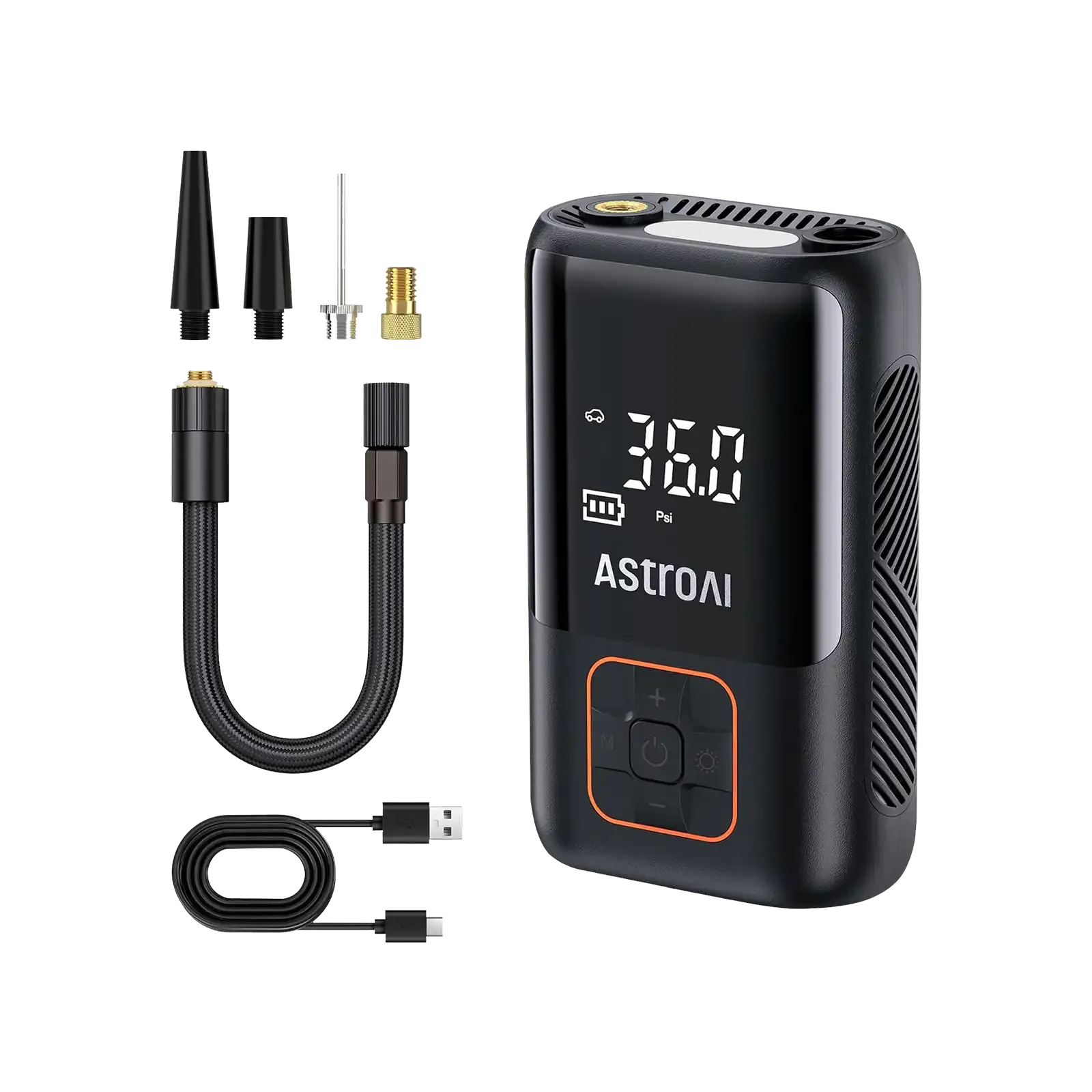
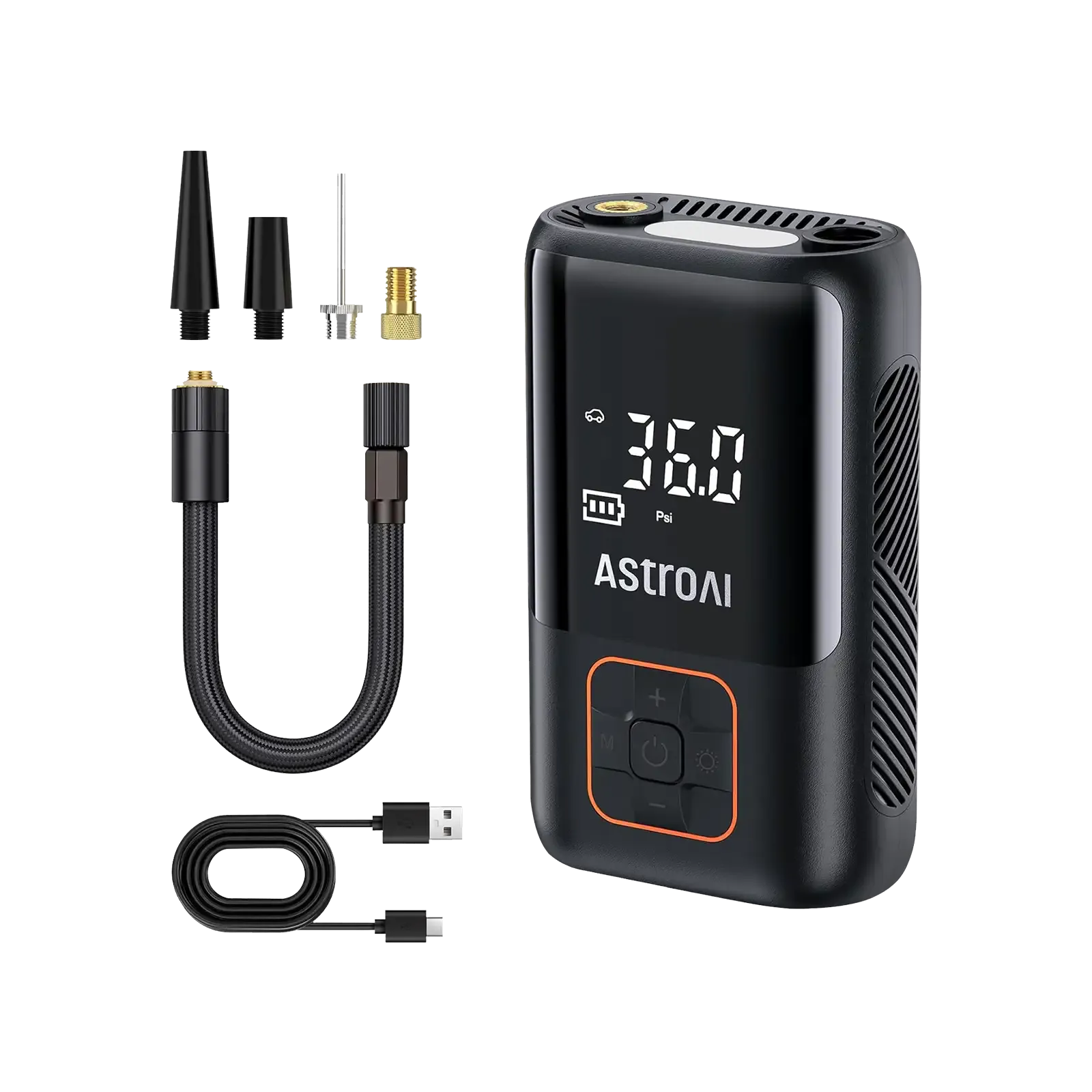
The page and manual list a Presta adapter and a needle-valve adapter, as well as separate swim-ring and air-mattress nozzles. The manual's tire-hose instruction says to tighten the connection onto the tire valve, which supports a twist-on classification for this reviewed arrangement. It does not explicitly identify the default tire connection as Schrader compatible, so do not infer that subtype from the car-tire use label alone if it is essential. The Presta adapter is the documented conversion fitting for a Presta bicycle valve, and the needle is the included attachment for a ball. Those attachments do not establish every valve fit, every ball type or low-pressure precision. Verify that the fitting seats correctly, especially on a bicycle or ball whose required pressure is below ordinary vehicle pressures.
Maximum pressure is not a workload rating
The exact product title and ATJ-8566 manual both state a 150 PSI maximum working pressure. That is an equipment ceiling, not a recommended tire setting and not evidence that the L3 is appropriate for a high-pressure task. The manual names the four intended preset item types, but it does not set a maximum tire size, give a pressure-specific flow rate, or publish a controlled fill-time test. AstroAI's browser-rendered official style page advertises 35-second inflation for the L3, but it gives no defined item, starting pressure, ending pressure or test method; a direct local retrieval of that style page returned HTTP 403, so the headline is retained only as an unconditioned manufacturer claim. It cannot answer how long this pump will take to raise your tire. Battery runtime and tires per charge are also unstated. I would not use the maximum PSI or the brief marketing headline as a substitute for those missing boundaries.
For continuous operation, the manual sets a maximum of 15 minutes followed by at least 12 minutes of cooling. It calls for active monitoring, warns that the hose becomes hot after inflation, and estimates operating noise around 80 dB. This is not a unit to leave running unattended. The 15/12 instruction is a concrete operating limit, but it does not imply a particular number of tires per interval or a guaranteed full-flat recovery. If repeated inflation, a known tire-size envelope or a backup vehicle-power route is essential, compare models whose own manuals document those conditions rather than projecting them onto the L3.
Storage and use boundaries
The manual lists body dimensions of 5.39 × 3.50 × 1.87 inches. It warns that cold reduces battery capacity, recommends 50–80% charge before long storage, and calls for a recharge at least every three months. It specifies a 5V/2A charging adapter but no charge-time estimate, battery replacement procedure or runtime. The sources do not establish suitability for long-term storage in vehicle heat.
Who should consider it?
The L3 is plausible for someone who wants a self-contained rechargeable pump with a display and preset stop for the listed car, motorcycle, bicycle and basketball tasks, can keep it charged, and will follow the cooling instructions. It is a poor fit when a socket or clamp backup, a verified wall adapter, tire-size-specific fill evidence, or a low-pressure accuracy range is essential.
Before choosing an offer, match ACAC19BK-US / ATJ-8566, verify the exact cable and wall-adapter contents, and use the tire maker's pressure target. The 150 PSI maximum is not a target; follow the 15-minute / 12-minute work-rest direction and remain present. The L3 needs guide maps individual finder choices to these limits.
Key specifications
Key details at a glance
| Product-page maximum-pressure claim | 150 PSI |
|---|---|
| Automatic stop at target | Yes |
| USB power-bank output | Yes |
| Documented accessories | Air pump / Air hose / Presta adapter / Needle valve adapter / Swim-ring nozzle / Air-mattress nozzle / Type-C charging cable |
| Operating power arrangement | Internal rechargeable battery |
| Maximum working pressure | 150 PSI |
| Tire-chuck connection style | Twist-on tire chuck |
| Published duty-cycle condition | The ATJ-8566 manual limits continuous operation to 15 minutes and requires at least 12 minutes of cooling afterward. It also requires active monitoring and warns the hose becomes hot; this is a manufacturer instruction, not a tested duty-cycle or fill-time result. |
Use the exact model’s instructions for operating limits, supplied equipment and version differences.
Sources for this review
Sources for this assessment
- AstroAI official Air Compressors collection snapshot
- AstroAI exact U.S. L3 storefront page and item record
- AstroAI ATJ-8566 Smart Portable Air Pump manual (ACAC19BK-named file)
- AstroAI L3 model/style information page (browser-rendered; direct fetch returned HTTP 403)
- Exact page-linked AstroAI ACAC19BK-US product image
Match the inflator to your power and tire
Use the finder to check whether a reviewed model's documented power source, mode and accessories fit your requirements. It cannot prove an unlisted fit or predict actual fill time.