
Your needs, this model
Does it fit your priorities?
What powers the AIRUN L7 while it inflates?
The manual documents a charged internal rechargeable battery. Type-C is for charging the pump and USB output powers another device; there is no documented vehicle-socket or clamp inflation route. The wall adapter is not included.
Explore this need in the finder →Does the L7 stop at a set pressure, and what does 150 PSI tell me?
The manual describes selected-pressure automatic stopping, but publishes no preset range or gauge tolerance. 150 PSI is the maximum working pressure, not a recommended tire target.
Explore this need in the finder →Which tasks and fittings does the L7 manual actually name?
It lists car, motorcycle, bicycle and basketball modes, plus a Presta-to-Schrader adapter and a needle. The default tire head's exact valve subtype, tire-size capacity and pressure-conditioned fill time are not stated. Follow the 15-minute run / 10-minute cooling instruction.
Explore this need in the finder →This is a document-based assessment of AstroAI's AIRUN L7 and the U.S.-facing L7 listing, not a hands-on test. AstroAI's manual identifies the pump as AIRUN L7 and its download path names ACACL7BK; the retail category and product page call it L7. The manufacturer also lists L7S separately. That distinction matters: the two small pumps share many headline specifications but their manuals list different package pieces.
A compact pump with one documented power route
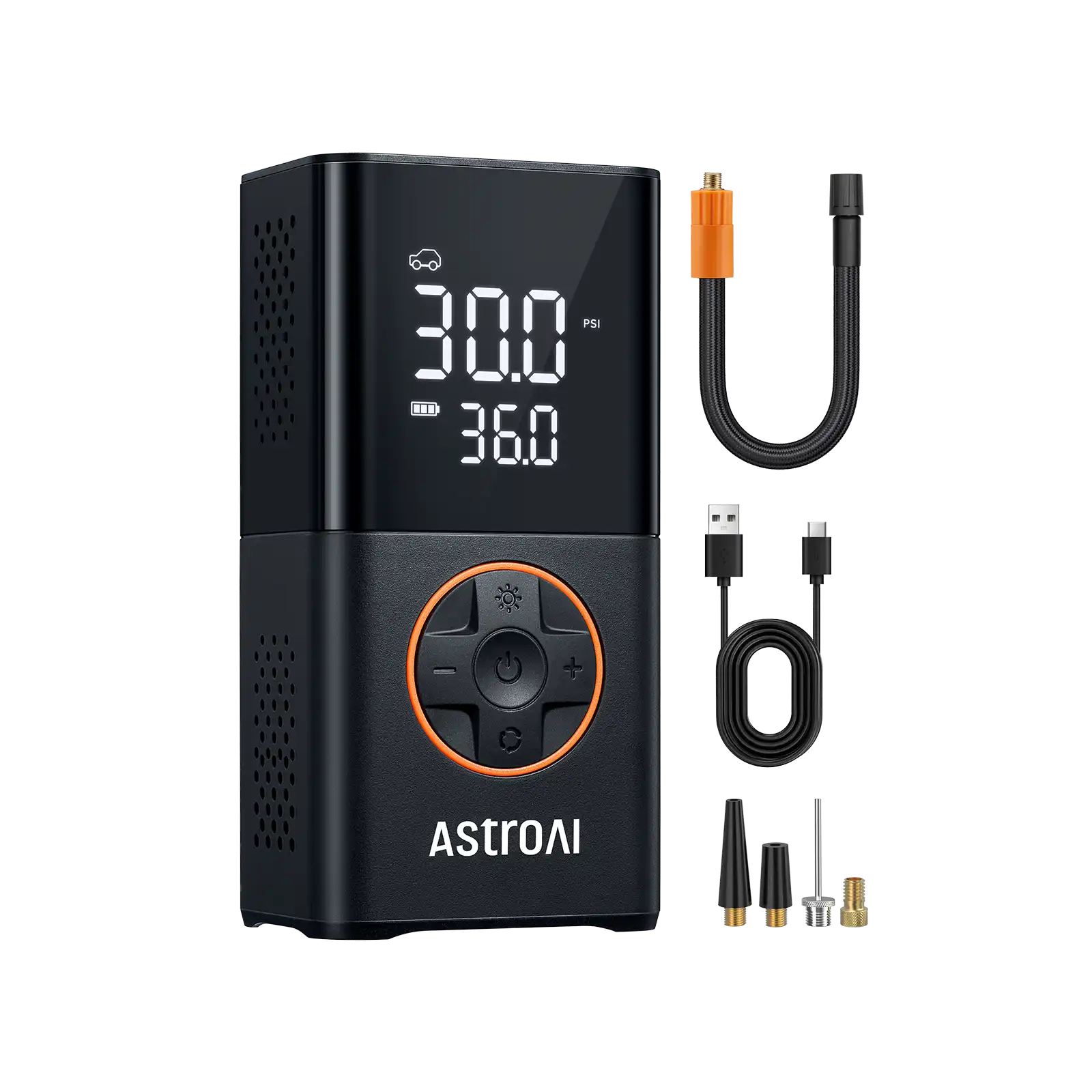
The AIRUN L7 is built around a rechargeable internal battery. Its manual describes two 2,000mAh cells, which the product page summarizes as a 4,000mAh battery. That makes the pump independent of a running car while inflating, but the Type-C cable is a charging lead, not evidence that the unit can inflate from USB or a 12V outlet. The manual gives a 5V, 1A Type-C input and a separate 5V, 1A USB output for charging another device. No vehicle-socket, direct-clamp, trailer-circuit or pump-while-charging arrangement is documented.
AstroAI says the Type-C cord is included and the outlet adapter is not. Plan to supply a compatible USB power adapter, charge the pump before an outing and periodically top it up in storage: the manual recommends a 50–80% charge before long-term storage and a recharge every three months. It gives no charge-time estimate, replaceable-battery procedure, measured run time or tire count per charge. Cold-weather capacity loss is also called out in the troubleshooting instructions. A battery icon is useful, but it cannot tell a buyer how many tires a particular starting-to-target-pressure job will finish.
Named uses and the fittings that are actually listed
The manual's operating modes name cars, motorcycles, bicycles and basketballs. It includes a quick connector, two air nozzles, a Presta-to-Schrader adapter and a needle-valve adapter. Those documented items make the L7 more flexible than a tire-only pump, but they do not establish a tire-size envelope, low-pressure accuracy, a pressure range for balls or a particular fill time. The manual does not use a specific valve term for the default hose head. The Presta-to-Schrader adapter suggests a Schrader interface, but the sources do not explicitly name the base connection as Schrader; if that exact standard is essential, confirm the offered fitting rather than relying on implication.
For a Presta bicycle valve, the included adapter is the relevant item to check in the box. For a basketball, the included needle is documented, but the manual does not supply a ball-pressure range or certify every ball type. AstroAI's preset modes are starting points rather than a replacement for the pressure printed on the tire or specified by its maker. The live reading and preset pressure help the user follow that target; they are not a published accuracy guarantee.
Automatic stop, maximum pressure and heat limits
The manual's inflation procedure says the pump stops automatically at the selected pressure and can also be stopped with the power button. The maximum working pressure is 150 PSI. That number is an equipment ceiling, not a suggested setting for a vehicle tire. AstroAI publishes 17 L/min and 50 W, but supplies no pressure point, nozzle setup or repeatable tire test for the flow claim, so it should not be translated into an expected fill time. The documents also leave the preset range, adjustment increment and gauge tolerance unspecified.
For longer work, the manual sets a concrete boundary: after 15 minutes of continuous use, allow at least 10 minutes for cooling. It warns that the hose can become hot during inflation and says battery capacity and life diminish in low temperatures. The short hose is listed as 0.82 feet (25 cm); the Type-C charging lead is 0.98 feet (0.3 m). The manual's body dimensions are 5.27 × 2.59 × 1.96 inches. These are published specifications, not measurements taken for this review. Keep the pump attended, avoid touching the hot hose and do not infer that a 15-minute run/rest cycle is a promise to complete a certain number of tires.
How it differs from the L7S
The L7S is a separate AstroAI model, not just a different color. Its matching AIRUN L7S manual lists one air-nozzle cone and an extension-hose coupling; the L7 manual lists two air nozzles and no coupling. Both manuals describe a 4,000mAh internal battery, 17 L/min, a 150 PSI maximum, the same named inflation modes and the same 15-minute/10-minute cooling rule. The L7S manual lists slightly different body dimensions. The term “extension hose coupling” does not reveal a longer hose or its usable reach, and neither model's product photograph proves what a seller will pack. See the separate AIRUN L7S assessment rather than transferring its kit contents to the L7.
Who should consider it?
The L7 is a plausible fit for someone who wants a small, self-contained rechargeable pump for the manual's listed car, motorcycle, bicycle or basketball tasks, is willing to keep it charged, can supply a wall adapter and will follow the run/rest instructions. It is a poor match when a 12V backup, direct clamps, a verified Schrader-head specification, tire-size-specific performance, known battery runtime, or a calibrated low-pressure gauge is essential. The manual does not answer those questions, so none should be inferred from the 150 PSI headline or compact form.
Before choosing an offer, confirm that it is the AIRUN L7 and that its package contains the manual-listed Presta and needle attachments. The official product page groups several L-series styles and pack choices on a shared storefront, so double-check the selected L7 option rather than assuming a neighboring L7S package applies. Set the vehicle maker's cold-tire target, remain present, and verify critical pressure with an appropriate gauge. The L7/L7S needs guide explains where this model's documented battery, use and accessory limits affect the finder.
Key specifications
Key details at a glance
| Product-page maximum-pressure claim | 150 PSI |
|---|---|
| Automatic stop at target | Yes |
| Operating power arrangement | Internal rechargeable battery |
| Maximum working pressure | 150 PSI |
| Air hose length | 0.82 ft |
Use the exact model’s instructions for operating limits, supplied equipment and version differences.
Sources for this review
Sources for this assessment
- AstroAI U.S. Portable Air Compressor & Tire Inflator category snapshot
- AstroAI official L7 Portable Tire Inflator page
- AstroAI-hosted AIRUN L7 portable car air pump manual (ACACL7BK code)
- AstroAI-hosted AIRUN L7S manual used only for the documented L7/L7S package comparison
- L7 image linked from the exact AstroAI product page

Match the inflator to your power and tire
Use the finder to check whether a reviewed model's documented power source, mode and accessories fit your requirements. It cannot prove an unlisted fit or predict actual fill time.