
Your needs, this model
Does it fit your priorities?
What powers the AIRUN L7S while it inflates?
The manual documents a charged internal rechargeable battery. Type-C is for charging the pump and USB output powers another device; there is no documented vehicle-socket or clamp inflation route. The wall adapter is not included.
Explore this need in the finder →What is different about the L7S package versus the L7?
The L7S manual lists an extension-hose coupling and one nozzle cone; the L7 manual lists two nozzles and no coupling. The L7S manual does not give another hose length, so the coupling does not establish added reach.
Explore this need in the finder →Can the L7S automatically stop at a target, and how long can it run?
The manual says it automatically stops at a selected pressure but publishes no preset range or tolerance. After 15 minutes of continuous use, it directs 10 minutes cooling; the 150 PSI maximum is not a target.
Explore this need in the finder →This is a source-based assessment of AstroAI's AIRUN L7S, not a product-use report. The U.S. product listing calls it L7S; the AstroAI-hosted manual cover identifies AIRUN L7S and its file path names ACACL7SYE. The U.S. category places L7 and L7S on separate cards, and the official manuals list different accessory kits. Treating them as one interchangeable bundle would hide a practical difference.
Battery power without a car lead
The L7S manual specifies two 2,000mAh lithium cells, or 4,000mAh in the storefront's terminology. Its documented inflation arrangement uses the charged internal battery. The Type-C input is for recharging the pump at 5V/1A, and the USB output is for powering another device; neither is described as a live compressor supply. The manual does not document a 12V vehicle-socket lead, battery clamps, a 7-way trailer connection, or operation while charging. Do not interpret the USB charging cable as an alternate pump-power plan.
The manual says the Type-C charging cord is supplied but a power adapter is not. Charge before relying on the pump, use an appropriate external USB adapter, and follow the storage advice to leave it at 50–80% before long storage and recharge every three months. There is no stated charging time, runtime, replaceable pack procedure or tire count per charge. Cold conditions can reduce lithium-battery capacity. The display's battery icon is a practical status cue, not a runtime guarantee.
Why the L7S package is its own configuration
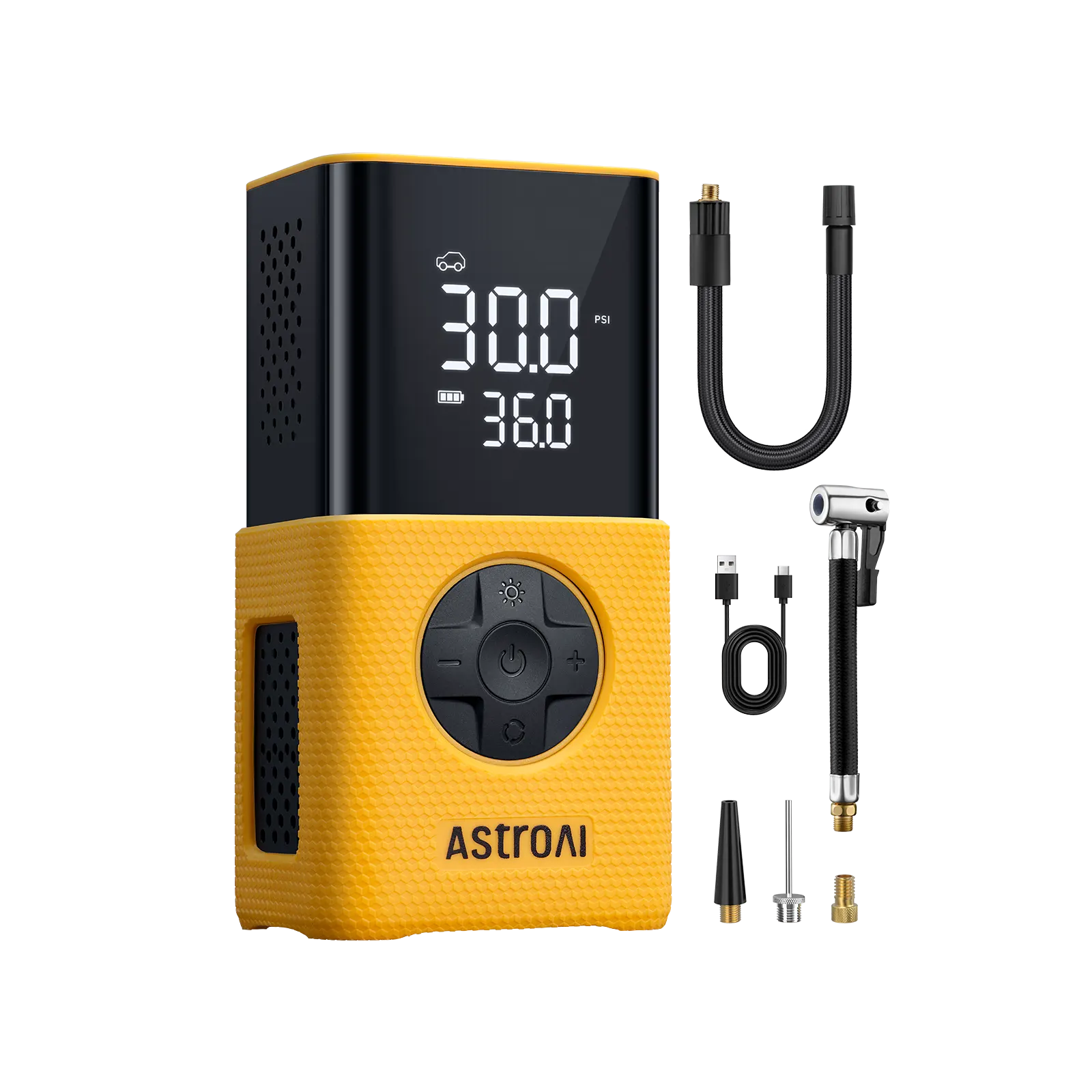
The L7S manual's package table lists a quick connector, USB charging cable, one air-nozzle cone, a needle-valve adapter, a Presta-to-Schrader adapter and an extension-hose coupling. That coupling is a real included part that is not in the L7 manual's package table; however, AstroAI gives no second hose length or assembled reach for it. The coupling should not be described as a longer hose unless the exact selected offer or manual says so. The L7 instead lists two air nozzles and omits the coupling. Confirm the exact L7S choice and contents in the offered package; a shared product-family page can show L7, L7S, L3 and L7 Mini selections side by side.
The manual names car, motorcycle, bicycle and basketball modes, and its introduction limits the car wording to small car tires. The listed Presta adapter is the relevant fitting for a Presta bicycle valve, while the needle is the supplied ball accessory. The manual describes a tire quick connector but does not name the default hose head's valve standard in text. Although the adapter is described as Presta-to-Schrader, I would verify the exact base connector when Schrader compatibility is a hard requirement instead of using a product title or photo as proof. Neither the adapter list nor a ball mode establishes a pressure-accuracy range for low-pressure bicycle or ball use.
Pressure control is useful, but not a performance promise
The L7S instructions describe selecting a target and say the pump automatically stops at that set value; the user can also stop it manually. The published maximum working pressure is 150 PSI, which is the pump's ceiling, not a recommended tire setting. AstroAI lists 17 L/min and 50 W, but no test pressure, tire size, starting-to-ending pressure or fill protocol accompanies the flow figure. The manual does not publish gauge tolerance, preset range or adjustment increment. Those omissions matter more than the top-line maximum when a shopper needs known performance on a particular tire.
Continuous use is bounded: the manual warns that prolonged operation can heat the pump and calls for 10 minutes of cooling after 15 minutes of continuous use. It warns not to touch the hose during inflation because it can become hot, and says battery performance worsens at low temperatures. It lists an inflation hose of 0.82 feet (25 cm), a 0.98-foot (0.3 m) charging cord and body dimensions of 5.31 × 2.71 × 2.04 inches. These figures are transcribed from the manual, not measured for this assessment. Stay with the pump and allow the full rest period; the schedule does not promise a particular number of tires per cycle.
Where it fits—and where another source is needed
The L7S makes sense for a buyer who values a compact rechargeable inflator, selected-pressure stopping and the specific Presta and needle attachments in a single package. It is not the option to choose if the compressor must run from the vehicle outlet, clamps or a trailer circuit, or if verified tire-size capacity, controlled fill times, gauge accuracy or a longer hose reach are non-negotiable. The official sources do not establish those capabilities. Its “150 PSI” heading cannot fill those evidence gaps.
Before purchase, match the AIRUN L7S manual and confirm the correct color/style and written in-box list. Do not substitute L7 directions or assume that the shared L-series page's nearby L7 or L7 Mini bundle pieces are included. Use the vehicle manufacturer's cold-tire target, remain present, and confirm important readings with a suitable gauge. Compare the distinct AIRUN L7 assessment if two nozzles matter more than the L7S extension coupling. The L7/L7S needs guide maps documented use, rechargeable power, auto-stop and adapter choices to the finder without treating unknowns as compatibility proof.
Key specifications
Key details at a glance
| Product-page maximum-pressure claim | 150 PSI |
|---|---|
| Automatic stop at target | Yes |
| Operating power arrangement | Internal rechargeable battery |
| Maximum working pressure | 150 PSI |
| Air hose length | 0.82 ft |
Use the exact model’s instructions for operating limits, supplied equipment and version differences.
Sources for this review
Sources for this assessment
- AstroAI U.S. Portable Air Compressor & Tire Inflator category snapshot
- AstroAI official L7S Portable Air Compressor product page
- AstroAI-hosted AIRUN L7S portable car air pump manual (ACACL7SYE code)
- AstroAI-hosted AIRUN L7 manual used only for the documented L7/L7S package comparison
- L7S image linked from the exact AstroAI product page

Match the inflator to your power and tire
Use the finder to check whether a reviewed model's documented power source, mode and accessories fit your requirements. It cannot prove an unlisted fit or predict actual fill time.