
Your needs, this model
Does it fit your priorities?
Does the PCL031B include the battery and charger?
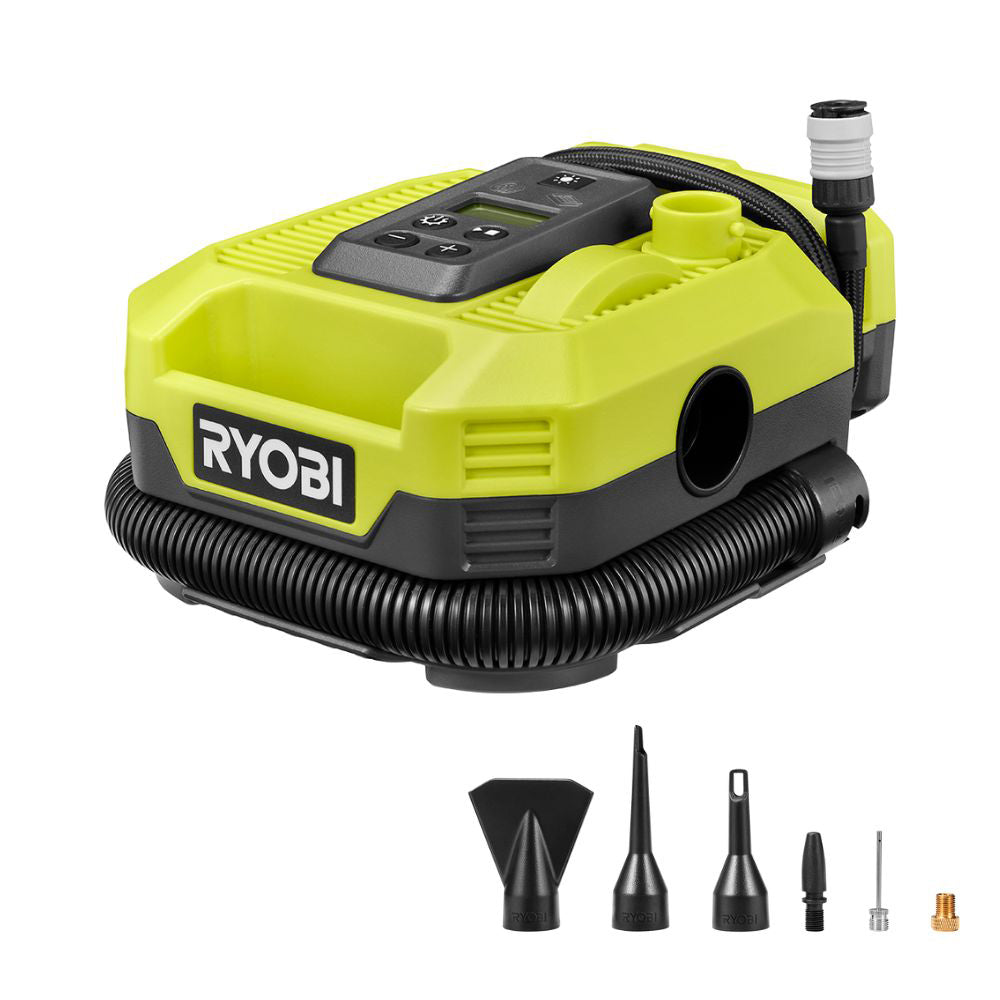
No. The exact RYOBI PCL031B product description says the battery and charger are sold separately. It is a tool-only PCL031 that uses a compatible removable 18V ONE+ pack; the page lists the Presta adapter, sports-ball needle, pinch-valve adapter and manual. Check the package and budget for the separate power system.
Explore this need in the finder →Can the PCL031B inflate a bicycle tire using Presta?
The exact PCL031B page lists a Presta adapter, and the PCL031 manual gives a separate procedure: thread the adapter into the air chuck, loosen the Presta stem nut, thread on the adapter without cross-threading, then tighten the locknut after inflation. The manual provides no bicycle pressure range or gauge tolerance, so set the bicycle maker's target and check it with a suitable independent gauge.
Explore this need in the finder →Does PCL031B reliably stop the pump at a selected tire pressure?
RYOBI's exact page advertises automatic shutoff, but the PCL031 manual's automatic-shutoff heading refers to the digital gauge turning off after up to five minutes. The manual describes manual start/stop control and says never to leave the inflator unattended with a nozzle attached; it does not confirm a pressure-triggered pump stop. Treat the feature as unverified.
Explore this need in the finder →What pressure and cooling limits matter on PCL031B?
The manufacturer page and manual specifications state 160 PSI, while a specific safety rule in the same manual says not to use above 150 PSI; honor the lower written safety ceiling unless RYOBI clarifies. Neither is a tire target. The manual says settings change in 5 PSI increments, use 5 minutes of continuous operation followed by 5 minutes of cooling, monitor the item and use short bursts plus a calibrated check at 10 PSI or below. Its gauge tolerance and tire-size/fill-time envelope are not published.
Explore this need in the finder →The RYOBI PCL031B is the tool-only configuration of the 18V ONE+ Dual Function Digital Inflator/Deflator. Its central distinction is functional: it carries a high-pressure hose for tires and sports balls and a separate high-volume hose for larger inflatables. Its package distinction is just as important: RYOBI says the B listing does not include a battery or charger. This is a source-based assessment of the exact US-facing PCL031B page and the PCL031 operator manual, not a hands-on test.
Two different air paths, not one universal hose
The PCL031 manual describes the high-pressure hose for car, motorcycle and bicycle tires, along with sports balls. The supplied Presta adapter and ball needle are relevant to those tasks: the manual explains threading the Presta adapter into the chuck and onto a loosened Presta stem, and separately identifies the needle for ball inflation. The standard tire connection is called a quick-connect air chuck on the product page, but the manual does not classify it as a press-on or twist-on chuck or name a valve family. I therefore would not choose this model for a required chuck subtype or Schrader-specific result without checking the exact head on the delivered unit.
The other hose serves a different job. RYOBI and the manual describe a high-volume mode for inflating or deflating items such as air mattresses, rafts, floats and pool toys. The manual lists a 14-inch high-volume hose and a 24-inch high-pressure hose. It also names a spreader nozzle, standard pinch-valve nozzle and narrower pinch-valve nozzle. Those are not substitutes for the tire hose, and the manual says the gauge and preset features apply only to high-pressure-hose use. RYOBI's page says up to 16 SCFM in high-volume mode, but does not give a test method; treat that as a manufacturer claim, not a measured fill-rate comparison.
What the tire-pressure figures do—and do not—say
The manufacturer page advertises as much as 160 PSI, and the manual's specification table also lists 160 PSI. A specific safety rule in that same manual, however, says not to use above 150 PSI. The documents do not explain the discrepancy. The safer reading is to honor the lower written safety ceiling unless RYOBI clarifies it; neither number is an appropriate tire target. Use the vehicle or tire maker's recommended pressure rather than the pump's headline maximum.
Pressure changes are made in 5 PSI increments, which may be coarse for a low-pressure task. The manual treats the built-in gauge as a guide rather than an exact instrument, provides no numeric accuracy tolerance, and says to check vehicle pressure with a reliable measuring device before driving. For items at 10 PSI or less it calls for short bursts and a calibrated check after each burst; it also says most sports-ball pressures are too low for accurate readings on this gauge. A ball needle establishes a connection, not a precise low-pressure measurement.
Do not assume the advertised pressure stop is settled
The PCL031B product page promotes automatic shutoff at the desired PSI. The manual's section titled “Automatic Shutoff” instead discusses the digital gauge staying on for up to five minutes before it turns off. Elsewhere it describes manual start/stop operation and tells the user to hold the start/stop button until the desired pressure is reached. It does not clearly explain a pressure-triggered pump stop. Because the page and instructions do not establish the same behavior, preset pump stopping is unresolved here—not a feature I would rely on when an automatic stop is essential. The manual also says never to leave the inflator unattended with a nozzle attached and to monitor the item during inflation.
Power, package and operating limits
PCL031B uses a removable RYOBI 18V ONE+ battery, not an internal rechargeable battery. The exact B page says the battery and charger are sold separately. That makes the tool-only package potentially sensible for an existing ONE+ owner, but a new buyer should account for both the compatible pack and charging system. It is not a 12V socket or direct-clamp inflator.
The manual says to allow five minutes of cooling after each five minutes of continuous use. A separate notice calls for ten minutes of cooling for every ten minutes of use; following the shorter five-on/five-off interval is the more conservative interpretation. The manual also says the unit is not designed for commercial application. It gives no supported tire-size range, named tire fill time, battery runtime, fills-per-charge estimate or independent flow test. The page's accessory list and the manual's more extensive “includes” list are not identical, so verify small nozzles and the accessory bag in the exact offer.
Who should consider the B package?
This configuration is worth comparing when the user already has a compatible ONE+ battery and wants one device with separate tire/ball and large-inflatable pathways. The Presta adapter and sports-ball needle add useful connection options; the high-volume hose adds an unrelated but legitimate task beyond tires. Before choosing, identify which hose applies, confirm the actual tire-valve connection, use the correct manufacturer pressure target and gauge, and plan the required cooling breaks. If you need a battery in the same package, compare the distinct PCL031K1 kit assessment; if a verified target-pressure stop is non-negotiable, do not infer it from product-page marketing alone.
Bottom line: PCL031B's case is its two-mode design, not a proven speed or all-in-one pressure guarantee. It is a tool-only 18V platform purchase with useful high-pressure attachments and a separate high-volume hose, but the package leaves the battery/charger to the buyer. Manual warnings, the 150/160 PSI discrepancy, uncertain target stopping, short cooling cycle and undocumented chuck family deserve more weight than a maximum-pressure headline.
Key specifications
Key details at a glance
| Product-page maximum-pressure claim | 160 PSI |
|---|---|
| Documented accessories | PCL031 18V ONE+ dual-function inflator/deflator / high-pressure hose (24 in.) / high-volume hose (14 in.) / Presta valve adapter / sports-ball needle / pinch-valve adapter / spreader nozzle / standard pinch-valve nozzle / narrow pinch-valve nozzle / accessory bag / operator's manual |
| Operating power arrangement | Removable 18v one plus battery |
| Published duty-cycle condition | The manual says to allow five minutes of cooling after each five minutes of continuous operation; a separate notice says ten minutes of cooling for every ten minutes of use. The five-on/five-off schedule is retained as the conservative operating interpretation. |
| Pressure gauge scale | 160 PSI |
Use the exact model’s instructions for operating limits, supplied equipment and version differences.
Sources for this review
Sources for this assessment

Match the inflator to your power and tire
Use the finder to check whether a reviewed model's documented power source, mode and accessories fit your requirements. It cannot prove an unlisted fit or predict actual fill time.