
Your needs, this model
Does it fit your priorities?
Can the L4 run from a vehicle socket while I inflate?
No such pump-power arrangement is documented. The manual describes a built-in rechargeable battery, Type-C charging input and separate USB output. The outlet adapter is sold separately; the 12V product-page voltage line is not treated as proof of socket operation.
Explore this need in the finder →Does the L4 stop at a target, and is 150 PSI a tire setting?
The manual documents automatic stopping at the selected preset pressure, but does not provide the preset range or gauge tolerance. 150 PSI is the maximum working-pressure ceiling, not a recommended tire target.
Explore this need in the finder →Does the L4 package list the adapters for bicycle and ball use?
The AIRUN L4 manual lists bicycle and basketball modes plus a Presta-to-Schrader adapter and a needle valve adapter. It gives no low-pressure accuracy or ball-pressure range, and the default quick connector's valve standard is not named. Follow the 15-minute/10-minute use-and-cool boundary.
Explore this need in the finder →This is a document-based assessment of AstroAI's L4 Portable Tire Inflator, not a hands-on test. The exact U.S.-facing listing identifies SKU ACACL4BK-US, while the matching English manual names AIRUN L4 and uses the same ACACL4BK base code. The suffix is not printed in the manual, so I treat the retail page as the exact U.S. identity and the manual as model-specific operating evidence rather than inventing another number.
Convenience comes from one rechargeable plan
The L4 is a cordless pump built around an internal rechargeable battery. AstroAI's exact item record summarizes the battery as 6,600 mAh; the manual expresses it as three 2,200 mAh cells. Its Type-C input is for charging, and its 5V USB output is for a separate device. Neither is an alternate way to power the compressor. The manual does not document operation from a 12V vehicle outlet, battery clamps or a trailer circuit, so buyers who require continuous vehicle power should look at a different, specifically wired arrangement.
The included charging cord is not a wall adapter. AstroAI's manual says the outlet adapter is sold separately and recommends storing the pump at roughly half to four-fifths charge and topping it up every three months for long storage. It also warns that cold conditions can reduce lithium-battery capacity. Neither a charge indicator nor a large mAh figure tells you how many tires a particular starting pressure, tire volume and target will consume. There is no documented battery runtime method or replacement procedure in the evidence reviewed here.
Named tire and ball uses, with a useful accessory list
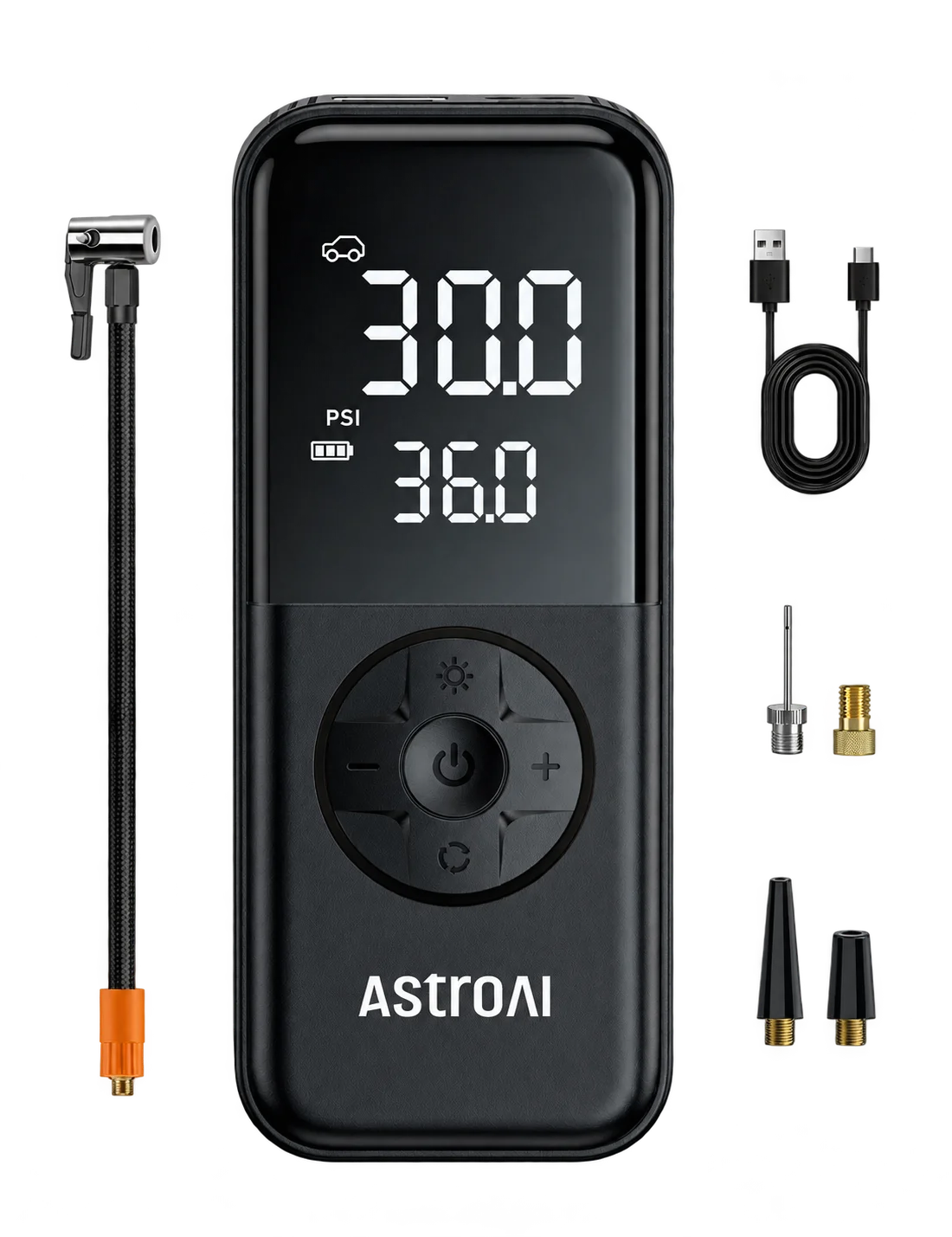
The AIRUN L4 manual gives five modes: car, motorcycle, bicycle, basketball and custom. Its written package list names a quick connector, two air nozzles, a Presta-to-Schrader adapter, a needle valve adapter, a USB charging cord and a storage bag. That is practical breadth for someone who wants one charged pump and those attachments at hand. It does not establish a tire-size envelope, an approved pressure range for every ball or bicycle, low-pressure measurement accuracy, or a particular task's fill time.
The manual calls the tire end a quick connector but does not spell out the base head's valve standard. A separate Presta adapter is explicitly listed, which is useful for a Presta bicycle valve; it is not a basis for silently labeling the unadapted connector Schrader. A needle appears in the package table, but the manual does not give a sports-ball pressure range. Set the target from the tire or ball maker, not the inflator's maximum rating, and confirm that the selected offer still includes the exact accessories you need.
Automatic stopping is a control, not a calibration claim
The manual says the pump will stop when it reaches the selected preset pressure and can also be stopped manually. The stated 150 PSI is a maximum working pressure, not a recommended vehicle-tire pressure. AstroAI's product material includes an example of a 225/75 R17 tire and a 90-second inflation claim, as well as an up-to-40-minute runtime statement. Those are manufacturer claims, not independent results: the page does not supply enough starting-pressure, temperature, battery-state and duty-cycle detail to make either a promise for another tire or a reason to ignore the manual's heat warning.
The manual's safety boundary is specific: allow ten minutes of cooling after fifteen minutes of continuous operation. It also says the hose can get hot during inflation and that repeated continuous heat can damage the pump. Treat that interval as a limit on the pump's use, not a prediction that a chosen tire will be finished before it. Stay with the unit, avoid touching a hot hose and check the result with a suitable gauge if the pressure is safety-critical. AstroAI does not publish a preset range or gauge tolerance for this configuration.
Conflicting specifications should not decide fit
Two parts of AstroAI's own evidence do not agree on basic reference figures. The exact product page's technical panel lists 35 L/min and dimensions of 7.24 × 4.56 × 1.06 inches; the AIRUN L4 manual lists 19 L/min and 6.49 × 2.75 × 1.96 inches. These could reflect a content, revision or measurement-definition difference, but the sources do not explain it. I do not select one number, use flow to predict a fill time, or present either dimension set as an independently measured fit check. If trunk space or a required flow rate is a hard constraint, confirm the exact unit with AstroAI before relying on those figures.
Where it fits in the compact L-series
The L4 is distinct from the smaller-battery L7 Mini, the L7 and the L7S; their family product pages show selectable styles, but a shared page is not proof of shared kits. The L4 manual has a named storage bag and a 15-minute/10-minute use-and-cool rule. The L7 Mini's exact U.S. orange listing identifies a separate 1,800 mAh style, while its available English manual is attached to a yellow/Australian download code; its precise U.S. package and timed duty limit remain less settled. The L7 and L7S have their own manuals and package records. Compare the separate L7 Mini assessment, L7 assessment and L7S assessment rather than assuming the accessories or run limits transfer.
Who should consider the L4?
It is a plausible fit for someone who wants a rechargeable, self-contained pump for the manual's car, motorcycle, bicycle or basketball modes, values a documented Presta adapter and needle, and can charge it before use. The storage bag and USB output are secondary conveniences; neither changes the single battery-powered inflation plan. It is a poor choice when an operating 12V backup, clamps, exact tire-size performance, known gauge accuracy, a verified flow number or a specified continuous-work schedule is essential.
Before selecting an offer, verify that it is the L4 / ACACL4BK-US and that its box contains the manual-listed attachments. Use the vehicle maker's cold-pressure target, not the sidewall maximum or the pump's 150 PSI ceiling. Plan around the fifteen-minute continuous-use limit and ten-minute cool-down, and resolve the page/manual size discrepancy if storage fit matters. The AstroAI L-series needs guide shows how battery, use, adapter and stop requirements affect the finder without treating unknowns as compatibility evidence.
Key specifications
Key details at a glance
| Product-page maximum-pressure claim | 150 PSI |
|---|---|
| Automatic stop at target | Yes |
| Operating power arrangement | Internal rechargeable battery |
| Maximum working pressure | 150 PSI |
| Air hose length | 0.98 ft |
Use the exact model’s instructions for operating limits, supplied equipment and version differences.
Sources for this review
Sources for this assessment

Match the inflator to your power and tire
Use the finder to check whether a reviewed model's documented power source, mode and accessories fit your requirements. It cannot prove an unlisted fit or predict actual fill time.